If a person gets ataxia with an accident, the damaged part of the brain is
1
Pons Varolii
2
Cerebellum
3
Cerebrum
4
Medulla oblongata
Official Solution
Correct Option:
(2)
Ataxia is a neurological condition characterized by a lack of muscle coordination during voluntary movements, such as walking or picking up objects. This condition arises due to damage to the cerebellum, the part of the brain responsible for: \begin{itemize}
\item Maintaining balance and posture,
\item Coordinating voluntary movements,
\item Fine motor control.
\end{itemize} Other brain parts like the \textit{pons}, \textit{cerebrum}, and \textit{medulla oblongata} have different roles unrelated directly to coordination of movement in the context of ataxia.
02
PYQ 2023
medium
zoologyID: ap-eapce
The substances eliminated through sweat are
1
Sterols, Waxes
2
Cholesterol, Steroid hormones
3
Hydrocarbons, drugs
4
Small amount Urea, lactic acid
Official Solution
Correct Option:
(4)
Sweat is secreted by sweat glands and primarily contains:
\begin{itemize}
\item Water,
\item Sodium chloride (NaCl),
\item Small amounts of metabolic wastes such as urea, uric acid, and lactic acid.
\end{itemize} Substances like sterols, cholesterol, steroid hormones, and hydrocarbons are not typically eliminated in sweat. Therefore, the correct answer is option 4.
03
PYQ 2023
medium
zoologyID: ap-eapce
The enzyme present in sweat, saliva and tears is
1
Lysozyme
2
Granzyme
3
Trypsin
4
Integrase
Official Solution
Correct Option:
(1)
Lysozyme is an antimicrobial enzyme found in many secretions of the body such as sweat, saliva, and tears. It plays a key role in the first line of defense by breaking down the peptidoglycan layer of bacterial cell walls, thereby acting as a natural antibiotic. Other options like granzyme (involved in apoptosis), trypsin (digestive enzyme), and integrase (viral enzyme) are not found in these secretions. Thus, the correct answer is Lysozyme.
04
PYQ 2023
medium
zoologyID: ap-eapce
Assertion (A): Cardiac muscle is highly resistant to fatigue. Reason (R): Cardiac muscles are innervated by the somatic nervous system.
1
Both A and R are correct and R is the correct explanation of A
2
Both A and R are correct but R is not the correct explanation of A
3
A is correct but R is incorrect
4
A is incorrect but R is correct
Official Solution
Correct Option:
(3)
- Assertion (A) is correct: Cardiac muscles have abundant mitochondria and a rich blood supply. These features make them highly resistant to fatigue, allowing them to contract continuously throughout life. - Reason (R) is incorrect: Cardiac muscles are not innervated by the somatic nervous system, which controls voluntary muscles. Instead, they are regulated by the autonomic nervous system (sympathetic and parasympathetic), which manages involuntary functions.
05
PYQ 2023
medium
zoologyID: ap-eapce
Find the correct match
Label
Respiratory Volume
Typical Value
A
Tidal Volume
iii. 500 ml
B
Inspiratory Reserve Volume
i. 3000–3500 ml
C
Expiratory Reserve Volume
ii. 1000–1100 ml
D
Inspiratory Capacity
iv. 2500–3500 ml
1
A -- iii, B -- i, C -- iv, D -- i
2
A -- ii, B -- iii, C -- i, D -- iv
3
A -- iii, B -- iv, C -- i, D -- ii
4
A -- iii, B -- iv, C -- i, D -- ii
Official Solution
Correct Option:
(4)
- Tidal Volume (TV): Normal volume of air inhaled or exhaled during normal breathing = ~500 ml → (iii).
- Inspiratory Reserve Volume (IRV): Extra volume of air that can be inhaled with a deep breath = ~2500–3500 ml → (iv).
- Expiratory Reserve Volume (ERV): Additional air that can be exhaled forcibly = ~1000–1100 ml → (ii).
- Inspiratory Capacity (IC): TV + IRV = ~3000–3500 ml → (i).
06
PYQ 2023
medium
zoologyID: ap-eapce
Identify the correct statement:
1
The ascending limb of Henle’s loop is impermeable to water.
2
The ascending limb of Henle’s loop is permeable to water.
3
The descending limb of Henle’s loop is permeable to electrolytes.
4
The descending limb of Henle’s loop is impermeable to water.
Official Solution
Correct Option:
(1)
The loop of Henle plays a crucial role in the concentration of urine and maintaining osmotic balance: - The descending limb of Henle’s loop is permeable to water but impermeable to solutes (electrolytes).
- The ascending limb is impermeable to water but actively transports Na\textsuperscript{+}, K\textsuperscript{+}, and Cl\textsuperscript{–} into the medullary interstitium. Therefore, the correct statement is:
- "The ascending limb of Henle’s loop is impermeable to water."
07
PYQ 2023
medium
zoologyID: ap-eapce
Identify the correct sequence of the air passage in man:
The correct sequence of the air passage in humans is: - External nares are the nostrils through which air enters.
- The nasal chamber warms and filters the air.
- Air then moves to the pharynx and passes through the larynx (voice box).
- From the larynx, it flows into the trachea (windpipe).
- The trachea divides into bronchi, which further divide into bronchioles.
- Finally, air reaches the alveoli where gaseous exchange occurs.
08
PYQ 2025
medium
zoologyID: ap-eapce
Following are different stages in blood clotting. Arrange them in correct sequence: [I)] Activation of prothrombin
[II)] Formation of prothrombin activator
[III)] Conversion of fibrinogen into soluble fibrin
[IV)] Clot retraction
[V)] Conversion of soluble fibrin into insoluble fibrin threads
1
II, I, V, III, IV
2
II, I, III, V, IV
3
I, II, III, IV, V
4
IV, V, III, I, II
Official Solution
Correct Option:
(2)
The correct order of events in blood clotting is: % Option
(A) Formation of prothrombin activator (II)
% Option
(B) Activation of prothrombin (I)
% Option
(C) Conversion of fibrinogen into soluble fibrin (III)
% Option
(D) Conversion of soluble fibrin into insoluble fibrin threads (V)
% Option
(E) Clot retraction (IV)
09
PYQ 2025
medium
zoologyID: ap-eapce
Cushing's syndrome is due to hypersecretion of
1
Aldosterone
2
Adrenalin
3
Epinephrine
4
Cortisol
Official Solution
Correct Option:
(4)
Step 1: Understand Cushing’s syndrome
Cushing’s syndrome is a hormonal disorder caused by prolonged exposure to high levels of cortisol. This can be due to the body producing too much cortisol or from external sources like taking high doses of corticosteroid medications.
Step 2: Evaluate each hormone’s role and association with Cushing’s syndrome
Aldosterone: Aldosterone is a mineralocorticoid hormone secreted by the adrenal cortex. Its primary role is to regulate blood pressure by controlling sodium and potassium balance. Hypersecretion of aldosterone leads to Conn’s syndrome (primary aldosteronism), which is characterized by high blood pressure and low potassium, but not Cushing’s syndrome. This option is incorrect.
Adrenalin (Epinephrine): Adrenalin, also known as epinephrine, is a catecholamine secreted by the adrenal medulla. It is involved in the "fight or flight" response, increasing heart rate, blood pressure, and glucose levels. Hypersecretion of adrenalin can occur in conditions like pheochromocytoma, but it does not cause Cushing’s syndrome. This option is incorrect.
Epinephrine: Epinephrine is the same hormone as adrenalin. As explained above, its hypersecretion is not the cause of Cushing’s syndrome. This option is incorrect.
Cortisol: Cortisol is a glucocorticoid hormone secreted by the adrenal cortex. It plays a crucial role in the body’s response to stress, metabolism, inflammation, and immune function. Chronic hypersecretion of cortisol is the direct cause of Cushing’s syndrome, leading to symptoms like weight gain (especially around the midsection and upper back), a rounded face (moon face), thinning skin, high blood pressure, and muscle weakness. This option is correct.
Step 3: Conclude the correct option
Cushing’s syndrome is directly caused by the hypersecretion of cortisol.
The final answer is: Cortisol.
10
PYQ 2025
medium
zoologyID: ap-eapce
Study the following and identify the correct option.
Statement I: The juxtaglomerular cells release renin in response to decreased blood pressure.
Statement II: Renin directly acts on distal convoluted tubule, leading to increased blood pressure.
1
Both statements I and II are correct.
2
Statement I is correct, but statement II is incorrect.
3
Statement I is incorrect, but statement II is correct.
4
Both statements I and II are incorrect.
Official Solution
Correct Option:
(2)
Let’s evaluate the statements using a checklist approach to determine their accuracy. For Statement I, we check if juxtaglomerular cells release renin when blood pressure decreases. These cells, located in the kidney near the glomerulus, indeed release renin in response to low blood pressure as part of the renin-angiotensin-aldosterone system (RAAS), which helps regulate blood pressure—Statement I is correct. For Statement II, we assess if renin directly acts on the distal convoluted tubule to increase blood pressure. Renin actually acts on angiotensinogen in the blood to produce angiotensin I, which is then converted to angiotensin II; angiotensin II affects blood vessels and the adrenal glands, not directly the distal convoluted tubule, and the tubule is more directly influenced by aldosterone later in the process—Statement II is incorrect. Conclusion: Statement I is correct, but Statement II is incorrect, matching option (2).
11
PYQ 2025
medium
zoologyID: ap-eapce
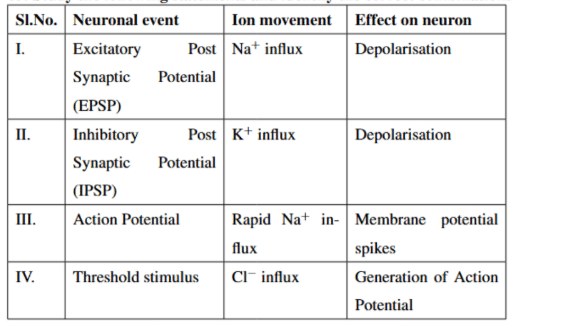
Study the following statements and identify the correct combinations :
1
I and II
2
II and III
3
III and IV
4
I and III
Official Solution
Correct Option:
(4)
Step 1: Analyze each statement/combination in the table. \begin{itemize} \item I. Excitatory Post Synaptic Potential (EPSP): \begin{itemize} \item Neuronal event: Excitatory Post Synaptic Potential (EPSP) \item Ion movement: EPSPs are caused by the influx of positive ions, primarily Na (sodium ions), into the postsynaptic neuron. \item Effect on neuron: The influx of positive ions makes the inside of the cell less negative, leading to depolarization (a shift towards a more positive membrane potential), which brings the neuron closer to its firing threshold. \end{itemize} This statement is Correct. \item II. Inhibitory Post Synaptic Potential (IPSP): \begin{itemize} \item Neuronal event: Inhibitory Post Synaptic Potential (IPSP) \item Ion movement: IPSPs are typically caused by the influx of Cl (chloride ions) or the efflux of K (potassium ions) from the postsynaptic neuron. Both make the inside of the cell more negative. \item Effect on neuron: The effect of IPSP is hyperpolarization (making the membrane potential more negative) or stabilization of the membrane potential, making it harder for the neuron to reach its firing threshold. The table states "Depolarisation," which is incorrect for IPSP. \end{itemize} This statement is Incorrect. \item III. Action Potential: \begin{itemize} \item Neuronal event: Action Potential \item Ion movement: The rising phase (depolarization) of an action potential is characterized by a rapid influx of Na (sodium ions) through voltage-gated sodium channels. \item Effect on neuron: This rapid influx causes a sharp, transient change in membrane potential, creating a "spike" or nerve impulse. \end{itemize} This statement is Correct. \item IV. Threshold stimulus: \begin{itemize} \item Neuronal event: Threshold stimulus \item Ion movement: A threshold stimulus is the minimum level of stimulation required to initiate an action potential. It causes a sufficient depolarization to open voltage-gated sodium channels. The ion movement associated with \textit{generating} an action potential at threshold is typically Na influx, not Cl influx. Cl influx is usually associated with inhibition (IPSPs). \item Effect on neuron: A threshold stimulus indeed leads to the generation of an action potential. However, the associated ion movement (Cl influx) is incorrect. \end{itemize} This statement is Incorrect.
\end{itemize} Step 2: Identify the correct combinations from the analysis.
Based on the analysis:
\begin{itemize} \item Statement I is Correct. \item Statement II is Incorrect. \item Statement III is Correct. \item Statement IV is Incorrect.
\end{itemize}
Therefore, the correct combinations are I and III. Step 3: Conclude the correct option.
The option that lists I and III as correct is the answer. The final answer is .
12
PYQ 2025
medium
zoologyID: ap-eapce
Correct sequence of electrical impulse transmission in the human heart is A) Purkinje fibres B) Atrio ventricular node C) Sino Atrial node D) Bundle branches E) Bundle of His
1
C B E D A
2
C E B D A
3
C D B E A
4
B C E A D
Official Solution
Correct Option:
(1)
Step 1: Understand the Cardiac Conduction System
The human heart has a specialized conduction system composed of cardiac muscle cells that generate and transmit electrical impulses, ensuring synchronized contraction of the atria and ventricles. Step 2: Trace the path of electrical impulse generation and transmission
The normal sequence of electrical impulse transmission in the heart is as follows:
1. Sinoatrial (SA) node (C): Often called the "pacemaker" of the heart, it spontaneously generates electrical impulses. The impulse originates here.
2. Atrioventricular (AV) node (B): The impulse from the SA node spreads through the atrial muscle and reaches the AV node. The AV node briefly delays the impulse, allowing the atria to fully contract and pump blood into the ventricles before ventricular contraction begins.
3. Bundle of His (E): From the AV node, the impulse travels down to the Bundle of His (also known as the atrioventricular bundle), which is located in the interventricular septum.
4. Bundle branches (D): The Bundle of His divides into left and right bundle branches, which extend down the interventricular septum towards the apex of the heart.
5. Purkinje fibers (A): The bundle branches then branch out into a network of Purkinje fibers, which rapidly distribute the impulse throughout the ventricular muscle, causing the ventricles to contract efficiently from the apex upwards. Step 3: Arrange the given components in the correct sequence
Based on the physiological pathway:
C (Sinoatrial node) B (Atrioventricular node) E (Bundle of His) D (Bundle branches) A (Purkinje fibres) Step 4: Compare with the given options
The correct sequence is C B E D A, which matches option (1).
13
PYQ 2025
medium
zoologyID: ap-eapce
It is a secondary lymphoid organ.
1
Thymus gland
2
Bone marrow
3
Spleen
4
Bursa of fabricius
Official Solution
Correct Option:
(3)
Step 1: Understand primary and secondary lymphoid organs
Primary (central) lymphoid organs: These are the sites where lymphocytes (B cells and T cells) are produced and mature into immunocompetent cells (cells capable of recognizing specific antigens). Examples include the bone marrow (where B cells mature and T cells originate) and the thymus (where T cells mature). Secondary (peripheral) lymphoid organs: These are the sites where mature lymphocytes encounter antigens and are activated, proliferate, and differentiate into effector cells and memory cells. These are the sites where immune responses are initiated and carried out.
Step 2: Evaluate each option based on the definitions
Thymus gland: The thymus gland is a primary lymphoid organ. It is the site where T lymphocytes (T cells) mature and undergo selection processes. This option is incorrect.
Bone marrow: Bone marrow is a primary lymphoid organ. It is the site of hematopoiesis (formation of all blood cells, including lymphocytes) and the maturation of B lymphocytes (B cells). T lymphocytes also originate in the bone marrow before migrating to the thymus for maturation. This option is incorrect.
Spleen: The spleen is a large, secondary lymphoid organ located in the upper left abdomen. It serves as a filter for blood, playing a crucial role in immune responses against blood-borne antigens. It contains B cells, T cells, and macrophages and is a major site for initiating adaptive immune responses. This option is correct.
Bursa of Fabricius: The Bursa of Fabricius is a primary lymphoid organ found only in birds. It is the site of B cell maturation in birds, analogous to the bone marrow in mammals for B cell development. This option is incorrect as it’s not a secondary lymphoid organ and not found in mammals.
Step 3: Conclude the correct option
Among the given options, the spleen is a secondary lymphoid organ.
The final answer is: Spleen.
14
PYQ 2025
medium
zoologyID: ap-eapce
Hormone that is having receptor on the surface of target cell membrane
1
Estrogen
2
Thyroxine
3
Epinephrine
4
Testosterone
Official Solution
Correct Option:
(3)
Step 1: Understand how hormone receptors work. Hormones can either bind to receptors located on the surface of the target cell or inside the cell. Water-soluble hormones like peptides and catecholamines (e.g., epinephrine) cannot pass through the lipid membrane, so their receptors are located on the cell surface. Step 2: Analyze the options. Estrogen, Thyroxine, and Testosterone are lipid-soluble hormones that typically pass through the cell membrane and bind to intracellular receptors. Epinephrine, on the other hand, is a water-soluble hormone (a catecholamine) and acts through receptors on the surface of target cells. Conclusion: The hormone with receptors on the cell surface is Epinephrine (Option 3).
15
PYQ 2025
medium
zoologyID: ap-eapce
This hormone involves in ovulation.
1
Estrogen
2
Progesterone
3
Luteinizing hormone
4
Follicle-stimulating hormone
Official Solution
Correct Option:
(3)
Luteinizing hormone (LH) plays a crucial role in ovulation by triggering the release of the mature egg from the ovarian follicle.
Estrogen and progesterone regulate the menstrual cycle but do not directly cause ovulation.
Follicle-stimulating hormone (FSH) promotes follicle growth.
Thus, the hormone responsible for ovulation is Luteinizing hormone.
Study the following statements and identify the correct option :
Statement I : Satellite cells surround the cell bodies in ganglia of central nervous sytem.
Statement II : All types of neuroglial cells originate from the embryonic ectoderm.
1
Both statement I and II are correct.
2
Statement I is correct, but statement II is incorrect.
3
Statement I is incorrect, but statement II is correct.
4
Both statements I and II are incorrect.
Official Solution
Correct Option:
(4)
Step 1: Analyze Statement I.
Statement I: "Satellite cells surround the cell bodies in ganglia of central nervous sytem."
Satellite cells are indeed neuroglial cells that surround the cell bodies of neurons. However, they are primarily found in the ganglia of the peripheral nervous system (PNS), not the central nervous system (CNS). In the CNS, neuronal cell bodies are typically surrounded by astrocytes or other glial cells, but not specifically satellite cells. Therefore, Statement I is Incorrect. Step 2: Analyze Statement II.
Statement II: "All types of neuroglial cells originate from the embryonic ectoderm."
Neuroglial cells (or glial cells) are non-neuronal cells that support and protect neurons. While most neuroglial cells (like astrocytes, oligodendrocytes, and ependymal cells in the CNS, and Schwann cells in the PNS) do originate from the embryonic ectoderm (specifically, the neural tube or neural crest), there is a significant exception: microglia. Microglia are immune cells of the CNS and originate from the mesoderm (specifically, from hematopoietic stem cells in the yolk sac) rather than the ectoderm. Since the statement says "All types," and microglia are a type of neuroglial cell with a mesodermal origin, this statement is Incorrect. Step 3: Evaluate the options based on the truthfulness of Statement I and Statement II.
\begin{itemize} \item Option (1): Both statement I and II are correct. (Incorrect, as both are incorrect) \item Option (2): Statement I is correct, but statement II is incorrect. (Incorrect, as Statement I is also incorrect) \item Option (3): Statement I is incorrect, but statement II is correct. (Incorrect, as Statement II is also incorrect) \item Option (4): Both statements I and II are incorrect. (This matches our analysis)
\end{itemize} Step 4: Conclude the correct option.
Based on the analysis, both Statement I and Statement II are incorrect. The final answer is .
18
PYQ 2025
medium
zoologyID: ap-eapce
MHC class II molecules are primarily found on
1
All nucleated cells
2
Red blood cells
3
Antigen presenting cells
4
Blood platelets
Official Solution
Correct Option:
(3)
Step 1: Understand MHC molecules. Major Histocompatibility Complex (MHC) molecules are essential for the immune system to recognize foreign molecules. There are two classes—MHC I and MHC II. Step 2: Identify where MHC II is found. MHC class II molecules are present only on the surface of specific immune cells known as Antigen Presenting Cells (APCs), such as dendritic cells, macrophages, and B cells. These molecules present processed antigens to helper T cells (CD4+). Step 3: Evaluate the options. - All nucleated cells express MHC class I, not class II. - Red blood cells lack nuclei and do not express MHC molecules. - Antigen presenting cells is the correct answer. - Blood platelets do not express MHC class II. Conclusion: MHC class II molecules are found primarily on Antigen presenting cells (Option 3).
19
PYQ 2025
easy
zoologyID: ap-eapce
Which one of the following is not involved in the regulation of respiration?
Official Solution
Correct Option:
(1)
20
PYQ 2025
medium
zoologyID: ap-eapce
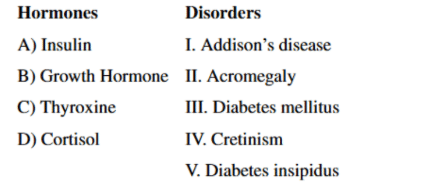
Match the following:
1
A-III, B-IV, C-V, D-II
2
A-III, B-II, C-IV, D-I
3
A-V, B-II, C-IV, D-I
4
A-IV, B-I, C-III, D-II
Official Solution
Correct Option:
(2)
Understand the function of each hormone and its related disorder.A) Insulin — III. Diabetes mellitus Insulin regulates blood sugar levels. Its deficiency leads to high blood glucose, causing Diabetes mellitus. B) Growth Hormone — II. Acromegaly Overproduction of growth hormone in adults causes Acromegaly, characterized by abnormal growth of bones and tissues. C) Thyroxine — IV. Cretinism Thyroxine (produced by the thyroid gland) is essential for growth and development. Its deficiency in childhood causes Cretinism, leading to stunted physical and mental growth. D) Cortisol — I. Addison's disease Cortisol is a steroid hormone from the adrenal cortex. Its deficiency causes Addison’s disease, characterized by fatigue, weight loss, and low blood pressure.
21
PYQ 2025
easy
zoologyID: ap-eapce
Statement I : Ammonia is highly toxic and needs more water for elimination and therefore excretion of ammonia is more common in aquatic animals. Statement II : Urea is synthesised in kidneys. Identify the correct option from the following
Official Solution
Correct Option:
(1)
22
PYQ 2025
easy
zoologyID: ap-eapce
Assertion (A): Gastric juice plays an important role in absorption of vitamin B12.
Reason (R): Gastric juice contains Castle’s intrinsic factor.
Identify the correct option from the following:
Official Solution
Correct Option:
(1)
23
PYQ 2025
medium
zoologyID: ap-eapce
Low pH, high CO\textsubscript{2, high temperature shifts the oxygen-haemoglobin dissociation curve towards}
1
Left side
2
Right side
3
Remains same
4
Upper side
Official Solution
Correct Option:
(2)
Step 1: Understand the Oxygen-Hemoglobin Dissociation Curve
The oxygen-hemoglobin dissociation curve illustrates the relationship between the partial pressure of oxygen (PO\textsubscript{2}) and the percentage of hemoglobin saturated with oxygen. It is typically S-shaped. Step 2: Analyze the given conditions and their effect on the curve (Bohr Effect)
The conditions mentioned – low pH, high CO\textsubscript{2}, and high temperature – are all factors that decrease the affinity of hemoglobin for oxygen. This phenomenon is known as the Bohr effect for pH and CO\textsubscript{2}, and also applies to temperature. Low pH (high H\textsuperscript{+} concentration): An increase in H\textsuperscript{+} ions (more acidic environment) binds to hemoglobin, reducing its affinity for oxygen. High CO\textsubscript{2:} High partial pressure of carbon dioxide (PCO\textsubscript{2}) also reduces hemoglobin's affinity for oxygen. CO\textsubscript{2} can directly bind to hemoglobin (forming carbaminohemoglobin) or lead to increased H\textsuperscript{+} concentration through the formation of carbonic acid. High temperature: An increase in temperature weakens the bond between oxygen and hemoglobin.
These conditions are characteristic of metabolically active tissues (e.g., muscles during exercise), where more oxygen needs to be released from hemoglobin. Step 3: Determine the shift in the curve
When hemoglobin's affinity for oxygen decreases, it means that at a given partial pressure of oxygen, less oxygen will be bound to hemoglobin, or conversely, more oxygen will be released. Graphically, this is represented by a shift of the oxygen-haemoglobin dissociation curve to the right. A rightward shift signifies that hemoglobin is releasing oxygen more readily. Step 4: Conclude the correct option
Therefore, low pH, high CO\textsubscript{2}, and high temperature all cause the oxygen-haemoglobin dissociation curve to shift to the right.
24
PYQ 2025
medium
zoologyID: ap-eapce
Infertility due to low sperm count can be rectified by the following Assisted Reproductive Technique.
1
Zygote Intra Fallopian Transfer (ZIFT)
2
In Vitro Fertilization (IVF)
3
Gamete Intra Fallopian Transfer (GIFT)
4
Intra Cytoplasmic Sperm Injection (ICSI)
Official Solution
Correct Option:
(4)
ICSI is an assisted reproductive technology where a single sperm is injected directly into an egg, effectively treating male infertility caused by low sperm count or motility.
ZIFT, IVF, and GIFT require a higher number of viable sperms.
Hence, the best method for low sperm count is ICSI.
25
PYQ 2025
medium
zoologyID: ap-eapce
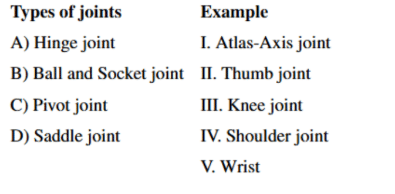
Match the following The correct option is:
1
A-III, B-IV, C-I, D-II
2
A-V, B-II, C-III, D-IV
3
A-III, B-II, C-IV, D-V
4
A-IV, B-I, C-II, D-III
Official Solution
Correct Option:
(1)
Step 1: Understand the characteristics of each joint type.
\begin{itemize} \item Hinge joint: Allows movement primarily in one plane, like the hinge of a door (flexion and extension). \item Ball and Socket joint: Allows movement in many directions (flexion, extension, abduction, adduction, rotation, circumduction), providing the greatest range of motion. \item Pivot joint: Allows rotational movement around a single axis. \item Saddle joint: Allows movement in two planes (flexion/extension and abduction/adduction), but not rotation. It provides more movement than a hinge or condyloid joint but less than a ball-and-socket joint.
\end{itemize} Step 2: Match each joint type from List A with its correct example from List B. \begin{itemize} \item A) Hinge joint: \item III. Knee joint: The knee joint primarily allows flexion and extension, acting like a hinge. \item Therefore, A matches with III. \item B) Ball and Socket joint: \item IV. Shoulder joint: The shoulder joint (glenohumeral joint) allows for extensive movement in all planes, characteristic of a ball and socket joint. \item Therefore, B matches with IV. \item C) Pivot joint: \item I. Atlas-Axis joint: The joint between the atlas (C1) and axis (C2) vertebrae in the neck allows for rotation of the head (e.g., shaking head "no"). This is a classic pivot joint. \item Therefore, C matches with I. \item D) Saddle joint: \item II. Thumb joint: The carpometacarpal joint of the thumb is a saddle joint, allowing for the unique opposable movement of the thumb (flexion/extension, abduction/adduction). \item Therefore, D matches with II.
\end{itemize} Step 3: Combine the matches and check against the given options.
A - III
B - IV
C - I
D - II Comparing this with the options:
\begin{itemize} \item (1) A-III, B-IV, C-I, D-II - This perfectly matches our derived combinations. \item (2) A-V, B-II, C-III, D-IV - Incorrect. \item (3) A-III, B-II, C-IV, D-V - Incorrect. \item (4) A-IV, B-I, C-II, D-III - Incorrect.
\end{itemize} The final answer is .
26
PYQ 2025
medium
zoologyID: ap-eapce
Assertion (A) : The parietal cells of gastric glands secrete Castle's intrinsic factor in man.
Reason (R) : Castle's intrinsic factor is essential for the absorption of cyanocobalamin.
Identify the correct option from the following
1
(A) and (R) are true. (R) is correct explanation for (A).
2
(A) and (R) are true. But R is not correct explanation for (A).
3
(A) is true, but (R) is false.
4
(A) is false, but (R) is true.
Official Solution
Correct Option:
(1)
Step 1: Analyze Assertion (A).
Assertion (A) states: "The parietal cells of gastric glands secrete Castle's intrinsic factor in man."
Parietal cells (also known as oxyntic cells) are indeed found in the gastric glands of the stomach. Their two main secretions are hydrochloric acid (HCl) and intrinsic factor (also known as Castle's intrinsic factor). This statement is True. Step 2: Analyze Reason (R).
Reason (R) states: "Castle's intrinsic factor is essential for the absorption of cyanocobalamin."
Cyanocobalamin is the synthetic form of Vitamin B12. Intrinsic factor is a glycoprotein that binds to Vitamin B12 (including cyanocobalamin) in the stomach and facilitates its absorption in the ileum (the final section of the small intestine). Without intrinsic factor, Vitamin B12 cannot be properly absorbed, leading to conditions like pernicious anemia. This statement is True. Step 3: Evaluate if Reason (R) is the correct explanation for Assertion (A).
Assertion (A) states \textit{what} parietal cells secrete (intrinsic factor). Reason (R) states \textit{why} intrinsic factor is important (for Vitamin B12 absorption). The secretion of intrinsic factor by parietal cells is precisely for its function in Vitamin B12 absorption. The cell secretes it because it has this essential role. Therefore, Reason (R) directly explains the physiological importance and thus the reason for the existence and secretion of intrinsic factor by parietal cells. This establishes a cause-and-effect relationship where the function (R) explains the existence/secretion (A). Thus, (R) is the correct explanation for (A). Step 4: Conclude the correct option.
Both (A) and (R) are true, and (R) is the correct explanation for (A). The final answer is .
27
PYQ 2025
medium
zoologyID: ap-eapce
Tall T-wave of ECG indicates
1
Hyperkalemia
2
Hypokalemia
3
Bradycardia
4
Tachycardia
Official Solution
Correct Option:
(1)
Tall T waves on an ECG are a hallmark of elevated potassium levels in blood (hyperkalemia).
Hypokalemia causes flattened T waves. Bradycardia and tachycardia refer to heart rate abnormalities, not T-wave morphology.
Hence, tall T waves indicate hyperkalemia.
About Human Physiology - AP-EAPCET
Human Physiology is a vital chapter for AP-EAPCET aspirants. Mastering the concepts covered in this chapter is essential for securing a top rank.
By rigorously practicing the previous year questions associated with this chapter, you can identify high-yield topics, understand the examiner's perspective, and boost your confidence during the actual exam.
Frequently Asked Questions
Why focus on Human Physiology PYQs?
Analyzing PYQs for this specific chapter reveals the most frequently tested concepts and the typical complexity of questions, allowing you to tailor your study plan efficiently.
How to best use this analysis?
Review the topic breakdown to see which sub-topics within Human Physiology carry the most weight. Then, tackle the questions iteratively to solidify your understanding.