Choose the correct statement about India's nuclear policy from the statements given below:
1
India's nuclear programme was started in 1952 under the guidance of Homi J. Bhabha.
2
India was in support of the NPT.
3
Now India has made it clear that the policy of 'no first use' can be reviewed.
4
Nehru was not against nuclear weapons.
Official Solution
Correct Option: (3)
- Statement (A): India's nuclear program began in the 1940s, but it became more prominent in 1974 after the first nuclear test (Smiling Buddha). Homi J. Bhabha played a major role in its development, but it was not started in 1952. - Statement (B): India has historically been against the Non-Proliferation Treaty (NPT), as it discriminates between nuclear-armed states and non-nuclear states. - Statement (C): India has recently made it clear that the policy of 'no first use' of nuclear weapons could be reviewed, depending on the changing security environment. - Statement (D): Nehru, the first Prime Minister of India, was not against nuclear weapons but strongly advocated for disarmament. Thus, the correct answer is (C) Now India has made it clear that the policy of 'no first use' can be reviewed.
02
PYQ 2025
medium
political-scienceID: cbse-cla
Given below are two statements: Statement-I: The collapse of the 'Second World' of the Soviet Union and the socialist system in Eastern Europe had no profound consequences for world politics. Statement-II: The end of the Soviet bloc meant the emergence of many new countries. All these countries had their own independent aspirations and choices.
1
Both Statement-I and Statement-II are true.
2
Both Statement-I and Statement-II are false.
3
Statement-I is true, but Statement-II is false.
4
Statement-I is false, but Statement-II is true.
Official Solution
Correct Option: (4)
- Statement-I: This statement is false because the collapse of the Soviet Union and the socialist bloc in Eastern Europe did have profound consequences for world politics. It marked the end of the Cold War and led to significant geopolitical changes. The United States became the undisputed global superpower, and the world saw a shift toward liberal democracies and market economies. - Statement-II: This statement is true. The end of the Soviet Union and the socialist bloc in Eastern Europe resulted in the emergence of many new independent countries with their own political systems and aspirations. Countries like Ukraine, Latvia, and others gained independence and sought to redefine their national identity and political direction. Thus, the correct answer is (D) Statement-I is false, but Statement-II is true.
03
PYQ 2025
medium
political-scienceID: cbse-cla
Choose the correct statement about India's nuclear policy from the statements given below:
1
India's nuclear programme was started in 1952 under the guidance of Homi J. Bhabha.
2
India was in support of the NPT.
3
Now India has made it clear that the policy of ‘no first use' can be reviewed.
4
Nehru was not against nuclear weapons.
Official Solution
Correct Option: (3)
India's nuclear policy has been largely based on maintaining a posture of "No First Use" (NFU), which means that India will not use nuclear weapons unless first attacked by an adversary using nuclear weapons. However, in recent years, there has been a shift in India's stance, with discussions suggesting that this policy might be reviewed depending on future security dynamics. Thus, the correct answer is (C) Now India has made it clear that the policy of 'no first use' can be reviewed.
04
PYQ 2025
easy
political-scienceID: cbse-cla
Which leader played an important role in the disintegration and coup against Soviet Union?
1
Boris Yeltsin
2
Nikita Khrushchev
3
John F. Kennedy
4
Joseph Stalin
Official Solution
Correct Option: (1)
Boris Yeltsin played a crucial role in the disintegration of the Soviet Union, particularly during the August 1991 coup attempt against Gorbachev. Yeltsin was the President of the Russian Soviet Federative Socialist Republic (RSFSR) and emerged as a key figure opposing the hardline communist coup. His defiance and leadership during the crisis marked him as an important figure in the eventual collapse of the Soviet Union. Thus, the correct answer is (A) Boris Yeltsin.
05
PYQ 2026
easy
political-scienceID: cbse-cla
Which one of the following statements is True about the concept of ‘Co-operative Security’?
1
Initiating action by the developed countries against non-traditional threats.
2
Earning ‘collective security’ by the NATO countries in case of threats.
3
Strengthening internal security by various measures within a state.
4
Involving several countries to decide on a collective solution against non-traditional threats.
Official Solution
Correct Option: (4)
Step 1: Understand concept
Co-operative security refers to collaboration among multiple countries to address shared security challenges, especially non-traditional threats such as climate change, terrorism, and pandemics. Step 2: Evaluate options
(A) Limited to developed countries → incorrect ✘
(B) Refers to NATO military alliance → not the general meaning of cooperative security ✘
(C) Focuses on internal security within a single state → not cooperative ✘
(D) Joint participation of multiple countries for common solutions → correct ✔ Final Answer:(D)
06
PYQ 2026
medium
political-scienceID: cbse-cla
Explain any two reasons responsible for the strong relation between Russia and India.
Official Solution
Correct Option: (1)
Concept:
India and Russia (earlier the Soviet Union) have maintained a long-standing and friendly relationship since the early years of India's independence. Their relationship has been based on mutual trust, cooperation and strategic interests in areas such as defence, technology and international politics. Two major reasons for strong relations between India and Russia are:
Defence and Military Cooperation: Russia has been one of the largest suppliers of defence equipment to India. The two countries cooperate in the production of military technology, such as fighter aircraft, submarines and missiles. This strong defence partnership has strengthened strategic relations between the two nations.
Support in International Politics: Russia has often supported India on important international issues, particularly in forums like the United Nations. For example, the Soviet Union used its veto power in the UN Security Council several times in favour of India during conflicts such as the Kashmir issue.
Conclusion:
Thus, defence cooperation and mutual support in international politics have played a major role in maintaining strong relations between India and Russia.
07
PYQ 2026
medium
political-scienceID: cbse-cla
Describe any two areas of co-operation and any two reasons for conflicts between India and Pakistan.
Official Solution
Correct Option: (1)
Concept:
India and Pakistan became independent in 1947 after the partition of British India. Since then, both countries have experienced periods of cooperation as well as conflicts due to political, territorial and security issues. Two areas of co-operation:
Trade and Economic Relations: India and Pakistan have engaged in limited trade and economic exchanges which help in improving mutual relations and economic cooperation.
People-to-People Contacts and Cultural Exchanges: Both countries share historical, cultural and linguistic similarities. Cultural programmes, sports events and diplomatic dialogues help in promoting understanding between the people of the two countries.
Two reasons for conflicts:
Kashmir Issue: The dispute over Jammu and Kashmir has been the major cause of tension and wars between India and Pakistan.
Cross-Border Terrorism: India has accused Pakistan of supporting militant groups operating across the border, which has increased tensions between the two countries.
Conclusion:
Thus, although there are areas of cooperation, territorial disputes and security concerns have often led to conflicts between India and Pakistan.
08
PYQ 2026
medium
political-scienceID: cbse-cla
Describe any two areas of co-operation and any two reasons for conflicts between India and Nepal.
Official Solution
Correct Option: (1)
Concept:
India and Nepal share close historical, cultural and geographical ties. The two countries maintain friendly relations and cooperate in several areas, though some political and territorial issues have also caused tensions. Two areas of co-operation:
Economic and Trade Relations: India is one of Nepal’s largest trading partners and provides economic assistance and development support for infrastructure, energy and education.
Open Border and Cultural Ties: India and Nepal share an open border which allows citizens of both countries to travel and work freely. The two nations also share strong cultural and religious connections.
Two reasons for conflicts:
Border Disputes: Differences over territories such as Kalapani and Lipulekh have created tensions between the two countries.
Political and Economic Differences: At times Nepal has expressed concerns about India's influence in its internal affairs, which has led to diplomatic tensions.
Conclusion:
Thus, India and Nepal share strong cooperation in economic and cultural areas, but border issues and political misunderstandings occasionally lead to conflicts.
09
PYQ 2026
medium
political-scienceID: cbse-cla
Explain the concept of ‘Human Security’.
Official Solution
Correct Option: (1)
Introduction:
Human Security is a concept that shifts the focus of security from protecting the state to protecting individuals and their well-being. It emphasizes safeguarding people from various threats that affect their daily lives. Key Dimensions: 1. Economic Security:
Ensuring protection from poverty, unemployment, and lack of income opportunities. 2. Food Security:
Ensuring access to sufficient, safe, and nutritious food for all individuals. 3. Health Security:
Protection from diseases and ensuring access to proper healthcare services. 4. Environmental Security:
Protection from environmental degradation, pollution, and natural disasters. 5. Personal Security:
Ensuring safety from violence, crime, and human rights violations. Conclusion:
Human security focuses on ensuring freedom from fear and freedom from want, promoting overall human welfare and development.
10
PYQ 2026
medium
political-scienceID: cbse-cla
Explain the challenges faced by India in its neighbourhood.
Official Solution
Correct Option: (1)
Introduction:
India faces several political, security, and economic challenges in its neighbouring region due to complex geopolitical dynamics. Major Challenges: 1. Border Disputes:
Territorial disputes with countries like China and Pakistan affect peace and stability in the region. 2. Political Instability:
Frequent political instability in neighbouring countries influences regional relations and security. 3. Terrorism and Security Threats:
Cross-border terrorism remains a major challenge for India’s national security. 4. External Influence:
Increasing influence of external powers, especially China, in South Asia creates strategic challenges for India. 5. Migration Issues:
Illegal migration from neighbouring countries creates social, economic, and political challenges. Conclusion:
India must adopt a balanced strategy involving diplomacy, regional cooperation, and security measures to effectively manage these challenges.
11
PYQ 2026
medium
political-scienceID: cbse-cla
Discuss the role of India in the Non-Aligned Movement (NAM).
Official Solution
Correct Option: (1)
Introduction:
The Non-Aligned Movement (NAM) emerged during the Cold War as a group of countries that chose not to align with either the United States or the Soviet Union. India was one of the founding members. Role of India: 1. Leadership Role:
India, under the leadership of Jawaharlal Nehru, played a key role in establishing and promoting the Non-Aligned Movement. 2. Promotion of Peaceful Coexistence:
India advocated peaceful relations among nations and supported diplomatic solutions to international conflicts. 3. Voice of Developing Nations:
India represented the interests and concerns of newly independent and developing countries in global forums. 4. Strategic Autonomy:
Through NAM, India maintained independence in its foreign policy decisions without aligning with major power blocs. Conclusion:
India played a significant role in shaping NAM as a platform for promoting peace, independence, and cooperation among developing countries.
12
PYQ 2026
medium
political-scienceID: cbse-cla
Explain any two differences between the refugees and the migrants.
Official Solution
Correct Option: (1)
Concept:
People move from one country or region to another for various reasons such as economic opportunities, safety, or better living conditions. Based on the reasons for movement, they are generally classified as refugees or migrants. Although both involve movement of people, their causes and legal status are different. Two major differences between refugees and migrants are:
Reason for Movement:
Refugees: They are forced to leave their country due to war, persecution, violence, or natural disasters.
Migrants: They move voluntarily to another country mainly for better employment, education, or improved living conditions.
Legal Protection:
Refugees: They receive international protection under international laws and conventions such as the UN Refugee Convention.
Migrants: They do not have the same international legal protection and must follow the immigration laws of the country they move to.
Conclusion:
Thus, refugees are people forced to flee their country due to threats to their safety, whereas migrants move voluntarily in search of better opportunities.
13
PYQ 2026
medium
political-scienceID: cbse-cla
Discuss the main features of India’s foreign policy.
Official Solution
Correct Option: (1)
Introduction:
India’s foreign policy is based on principles that promote peace, sovereignty, cooperation, and national development. It aims to safeguard India’s national interests while contributing to global peace. Key Features: 1. Non-Alignment:
India adopted the policy of non-alignment during the Cold War, avoiding alignment with any major power blocs. 2. Peaceful Coexistence:
India emphasizes peaceful relations with other countries based on respect for sovereignty and territorial integrity. 3. Panchsheel Principles:
India follows the Panchsheel principles which include mutual respect, non-aggression, non-interference, equality, and peaceful coexistence. 4. Support for Developing Countries:
India actively supports the interests and rights of developing countries in international forums. 5. Strategic Autonomy:
India maintains independent decision-making in international affairs without external pressure. Conclusion:
Thus, India’s foreign policy aims to balance national interest with international cooperation and peaceful global relations.
14
PYQ 2026
medium
political-scienceID: cbse-cla
Analyse the role of SAARC in promoting regional cooperation.
Official Solution
Correct Option: (1)
Introduction:
SAARC (South Asian Association for Regional Cooperation) was established in 1985 to promote regional cooperation and development among South Asian countries. Role of SAARC: 1. Economic Cooperation:
SAARC promotes regional trade and economic integration through agreements such as the South Asian Free Trade Area (SAFTA). 2. Social Development:
It focuses on improving living standards through cooperation in areas such as poverty alleviation, education, and healthcare. 3. Cultural Exchange:
SAARC promotes cultural understanding and people-to-people contact among member countries. 4. Platform for Dialogue:
It provides a forum for member states to discuss common regional issues and promote peaceful relations. Limitations:
Political tensions, especially between India and Pakistan, have limited the effectiveness of SAARC. Conclusion:
Although SAARC has faced challenges, it remains an important platform for promoting cooperation and development in South Asia.
15
PYQ 2026
medium
political-scienceID: cbse-cla
Explain the concept of ‘Global Commons’.
Official Solution
Correct Option: (1)
Introduction:
Global Commons refer to natural resources or areas that belong to all humanity and are not owned by any single country. Examples:
Examples include the high seas, the atmosphere, Antarctica, and outer space. Key Features: 1. Shared Ownership:
No single country has exclusive rights over these resources. 2. Collective Responsibility:
All countries share the responsibility to protect and manage these resources. 3. Environmental Sustainability:
Overexploitation of global commons can lead to environmental crises such as climate change. 4. Need for Global Cooperation:
International agreements and cooperation are necessary for their protection and sustainable use. Conclusion:
Therefore, Global Commons require responsible and cooperative management to ensure sustainable benefits for all nations.
16
PYQ 2026
medium
political-scienceID: cbse-cla
Explain the concept of ‘Globalisation’ and its impact on Indian economy.
Official Solution
Correct Option: (1)
Introduction:
Globalisation refers to the increasing integration and interconnection of economies across the world through trade, investment, technology, and communication. Impact on Indian Economy: 1. Economic Growth:
Globalisation increased international trade and foreign investment, contributing to higher economic growth in India. 2. Employment Opportunities:
Expansion of sectors such as Information Technology (IT), services, and manufacturing created new job opportunities. 3. Technological Advancement:
India gained access to modern technology, innovation, and global markets. 4. Challenges and Inequality:
Globalisation also increased income inequality and made the economy more dependent on global markets. Conclusion:
Thus, globalisation has significantly influenced the Indian economy by creating opportunities for growth while also presenting certain economic and social challenges.
17
PYQ 2026
medium
political-scienceID: cbse-cla
What is meant by ‘New International Economic Order (NIEO)’? Explain its main objectives.
Official Solution
Correct Option: (1)
Introduction:
The New International Economic Order (NIEO) refers to a set of proposals put forward by developing countries during the 1970s to create a more just and equitable international economic system. It aimed to reduce inequalities between developed and developing countries. Main Objectives: 1. Economic Equality:
To reduce the economic gap between developed and developing nations and ensure fair participation in the global economy. 2. Fair Trade System:
To provide better trade opportunities and fair prices for the exports of developing countries. 3. Control over Natural Resources:
To allow developing countries full control and sovereignty over their natural resources for national development. 4. Transfer of Technology and Aid:
To encourage developed countries to share technology and provide financial assistance to developing nations. Conclusion:
Thus, the NIEO aimed at restructuring the global economic system to ensure fairness, equality, and sustainable development for developing countries.
18
PYQ 2026
medium
political-scienceID: cbse-cla
Which of the following statements is NOT correct about ASEAN?
1
It was established in 1967.
2
It aims to promote economic growth and regional stability.
3
All Asian countries are members of ASEAN.
4
It encourages cooperation among member states.
Official Solution
Correct Option: (3)
Concept:
ASEAN (Association of Southeast Asian Nations) is a regional organization formed to promote economic growth, peace, and cooperation among Southeast Asian countries. Analysis:
(A) Correct → ASEAN was established in 1967. ✔
(B) Correct → It promotes economic growth and regional stability. ✔
(C) Incorrect → ASEAN includes only 10 Southeast Asian countries, not all Asian countries. ✘
(D) Correct → Encouraging cooperation among member states is one of its main objectives. ✔ Conclusion:
ASEAN is a regional organization limited to Southeast Asian nations. Final Answer:(C)
19
PYQ 2026
medium
political-scienceID: cbse-cla
Explain the role of the United Nations in maintaining international peace and security.
Official Solution
Correct Option: (1)
Introduction:
The United Nations (UN), established in 1945, aims to maintain international peace and security and promote cooperation among nations. Key Roles: 1. Peacekeeping Operations:
The UN deploys peacekeeping forces in conflict areas to maintain ceasefires and help restore stability. 2. Conflict Resolution and Mediation:
The UN acts as a mediator between conflicting nations and encourages peaceful negotiation and diplomacy. 3. Sanctions and Enforcement Measures:
Through the Security Council, the UN can impose economic sanctions or authorize collective action against aggressive states. 4. Promotion of Collective Security:
The UN encourages member states to act together to prevent threats to international peace. Conclusion:
Therefore, the United Nations plays a vital role in maintaining global peace, promoting cooperation, and preventing international conflicts.
20
PYQ 2026
medium
political-scienceID: cbse-cla
Explain any two differences between refugees and migrants.
Official Solution
Correct Option: (1)
Introduction:
Refugees and migrants both move from one place to another, but their reasons for movement and legal status are different. Differences: 1. Reason for Movement:
Refugees are forced to leave their country due to war, persecution, or violence. Migrants move voluntarily, usually for better economic opportunities, education, or living conditions. 2. Legal Protection:
Refugees receive protection under international law, such as the UN Refugee Convention. Migrants are governed by the immigration laws of the country they move to and do not have the same international protection. Conclusion:
Thus, refugees are people who are forced to migrate and are protected by international law, whereas migrants generally move by choice for economic or social reasons.
21
PYQ 2026
medium
political-scienceID: cbse-cla
Why could the reforms initiated by Mikhail Gorbachev not save the disintegration of the Soviet Union? Explain any two reasons.
Official Solution
Correct Option: (1)
Introduction:
Mikhail Gorbachev introduced reforms such as Glasnost (openness) and Perestroika (restructuring) to revive the Soviet political and economic system. Reasons for Failure: 1. Economic Weakness:
The Soviet economy was already facing severe problems. Instead of improving the situation, the reforms created economic instability and shortages. 2. Rise of Nationalism:
Various republics within the Soviet Union began demanding independence, which weakened the unity of the federation. 3. Political Liberalization:
Glasnost allowed freedom of expression, which led to widespread criticism of the government and the Communist Party. 4. Decline of Communist Party Control:
The authority of the Communist Party weakened, leading to political fragmentation and loss of central control. Conclusion:
Thus, instead of strengthening the Soviet system, these reforms accelerated political instability and contributed to the disintegration of the Soviet Union in 1991.
22
PYQ 2026
medium
political-scienceID: cbse-cla
Assess the impact of outside powers on the South Asian Countries.
Official Solution
Correct Option: (1)
Explanation: Outside powers such as the United States, China, and Russia have played an important role in shaping the political, economic, and strategic developments of South Asian countries. Key Impacts: 1. Political Influence – Major powers often influence domestic politics by supporting certain governments or political groups in South Asian countries. 2. Economic Assistance and Investment – External powers provide financial aid, loans, and investments. For example, China's Belt and Road Initiative (BRI) has funded several infrastructure projects in the region. 3. Military Support and Strategic Alliances – Outside powers supply arms, provide military training, and form strategic partnerships, which affect the regional balance of power. 4. Impact on Regional Conflicts – External involvement sometimes intensifies or prolongs conflicts in the region, such as in Afghanistan. Conclusion:
The involvement of outside powers brings economic opportunities and development, but it can also increase dependency and create geopolitical tensions in South Asia.
23
PYQ 2026
medium
political-scienceID: cbse-cla
Which one of the following is NOT a consequence of ‘Shock Therapy’?
1
The value of the Rouble declined.
2
The economy of the entire region was ruined.
3
The system of social welfare got strengthened.
4
The collective farm system disintegrated.
Official Solution
Correct Option: (3)
Step 1: Understand Shock Therapy
Shock Therapy refers to the rapid transition from a socialist economy to a capitalist market economy in the former Soviet Union and Eastern European countries during the 1990s. Step 2: Effects
- The value of the rouble declined sharply ✔
- The regional economy experienced severe crisis and instability ✔
- The collective farming system collapsed ✔
- Social welfare systems weakened rather than strengthened ✔ Step 3: Identify incorrect statement
Option (C) states that the system of social welfare got strengthened, which is incorrect because social welfare provisions actually declined. Final Answer:(C)
24
PYQ 2026
medium
political-scienceID: cbse-cla
Given below are two statements:Statement I: The International Monetary Fund (IMF) is an international organization that oversees financial institutions and regulates those that act at the international level. Statement II: All the 189 members of IMF organization have equal say.
1
Both Statement I and II are true
2
Both Statement I and II are false
3
Statement I is true, but Statement II is false
4
Statement I is false, but Statement II is true
Official Solution
Correct Option: (3)
Step 1: Analyze Statement I
The International Monetary Fund (IMF) supervises the global financial system, provides financial assistance to countries facing economic crises, and monitors international financial stability. Therefore, Statement I is true. Step 2: Analyze Statement II
In the IMF, voting power is determined by the quota assigned to each member country, which is based on its economic strength. Hence, all members do not have equal voting power. Therefore, Statement II is false. Step 3: Conclusion
Statement I is true, but Statement II is false. Final Answer:(C)
25
PYQ 2026
medium
political-scienceID: cbse-cla
Which statement is the best description of ‘Veto Power’?
1
It is a power of positive voting.
2
After the end of the Second World War, Veto Power is given only to permanent members of the United Nations Security Council (UNSC).
3
All the temporary members of the UNSC have the right to use Veto Power only for two years.
4
All the members of the UNSC possess Veto Power.
Official Solution
Correct Option: (2)
Step 1: Concept
Veto power refers to the authority that allows a country to block or reject a resolution, even if all other members support it. Step 2: Key fact
In the United Nations Security Council (UNSC), only the five permanent members — USA, UK, Russia, China, and France — possess veto power. Step 3: Evaluate options
(A) Incorrect → Veto is not a positive voting power; it is the power to block decisions. ✘
(B) Correct ✔
(C) Temporary members of the UNSC do not have veto power. ✘
(D) Not all UNSC members possess veto power. ✘ Final Answer:(B)
26
PYQ 2026
medium
political-scienceID: cbse-cla
Which one of the following is related to the traditional notion of security?
1
Russia–Ukraine War
2
Continuous rise in global temperature
3
9/11 attack on USA
4
Spread of COVID-19 epidemic in the world
Official Solution
Correct Option: (1)
Step 1: Understand traditional security
Traditional security refers to military threats, wars, and conflicts between nation-states. Step 2: Evaluate options
(A) Russia–Ukraine War → military conflict → traditional security ✔
(B) Climate change → environmental issue → non-traditional ✘
(C) 9/11 attack → terrorism → non-traditional ✘
(D) COVID-19 → health crisis → non-traditional ✘ Final Answer:(A)
27
PYQ 2026
medium
political-scienceID: cbse-cla
Identify the correct trio of Baltic Republics:
1
Estonia, Latvia, Lithuania
2
Slovenia, Estonia, Lithuania
3
Slovenia, Romania, Estonia
4
Estonia, Romania, Latvia
Official Solution
Correct Option: (1)
Step 1: Recall Baltic states
The Baltic republics were part of the former Soviet Union and are located along the Baltic Sea in Northern Europe. Step 2: List them
The three Baltic republics are:
- Estonia
- Latvia
- Lithuania Step 3: Evaluate options
Only option (A) correctly includes all three Baltic republics. Final Answer:(A)
28
PYQ 2026
medium
political-scienceID: cbse-cla
Why could the reforms initiated by Mikhail Gorbachev not save the disintegration of Soviet Union? Explain any two reasons.
Official Solution
Correct Option: (1)
Step 1: Understanding the Question: The question asks for the reasons why Mikhail Gorbachev's well-intentioned reform policies (Perestroika and Glasnost) failed to prevent, and perhaps accelerated, the collapse of the USSR. Step 3: Detailed Explanation: 1. Unleashing of Nationalist Sentiments (Glasnost): Gorbachev's policy of 'Glasnost' (openness) granted citizens the freedom of speech and the press, which had been suppressed for decades. Instead of just critiquing the economy, people used this freedom to express long-suppressed nationalist sentiments, leading to strong demands for independence in various Soviet republics like the Baltic states (Estonia, Latvia, Lithuania), which the central government could no longer control. 2. Economic Disruption without Immediate Replacement (Perestroika): The policy of 'Perestroika' (restructuring) aimed to introduce market-like reforms into the rigid command economy. However, dismantling the old state-controlled system before a functional market system could be established caused severe economic chaos, widespread shortages of essential goods, and immense frustration among the common people who expected quick results. Step 4: Final Answer: Gorbachev's reforms failed because 'Glasnost' unleashed uncontrollable nationalist movements demanding independence, while 'Perestroika' disrupted the existing economic structure without providing immediate relief, leading to severe economic crisis and public dissatisfaction.
29
PYQ 2026
medium
political-scienceID: cbse-cla
Highlight any two internal threats which any state may face.
Official Solution
Correct Option: (1)
Step 1: Understanding the Question:
The question requires identifying and explaining security challenges that arise within the territorial borders of a country, as opposed to external military invasions. Step 3: Detailed Explanation:
A state may face various internal threats that challenge its stability and sovereignty. Two such major threats are:
1. Separatist or Secessionist Movements: These are movements where a group within a state demands a separate sovereign nation based on ethnic, linguistic, or regional identity. Such movements often lead to violent conflicts, civil unrest, and challenge the territorial integrity of the country. For example, various insurgencies in North-East India or the movement in Punjab in the 1980s.
2. Internal Armed Insurgency or Civil War: This involves armed struggle by groups within the country against the established government to overthrow it or to change its policies. Such conflicts result in massive loss of life, displacement of people, and economic breakdown. Naxalism or Left-Wing Extremism in India is a significant example of an internal armed threat that challenges the state's authority in several districts. Step 4: Final Answer:
The two primary internal threats are secessionist movements that challenge territorial integrity and armed insurgencies that threaten the domestic peace and the constitutional order.
30
PYQ 2026
medium
political-scienceID: cbse-cla
In what ways are the environmental concerns of Global North different from the Global South? Explain with the help of three examples.
Official Solution
Correct Option: (1)
Concept:
The terms Global North and Global South refer to the division between developed and developing countries. Their environmental concerns differ due to differences in economic development and priorities. Examples of differences:
Industrial Pollution vs Development Needs: Developed countries focus on reducing industrial pollution, while developing countries prioritize economic development.
Climate Change Responsibility: Countries of the Global South argue that developed countries should take greater responsibility for climate change since they contributed more to pollution in the past.
Resource Use: Developed countries emphasize environmental protection, while developing countries emphasize sustainable use of resources for development.
Conclusion:
Thus, environmental priorities differ between the Global North and Global South due to differences in economic development and historical responsibility.
31
PYQ 2026
medium
political-scienceID: cbse-cla
Explain the meaning of “Indigenous People” and assess the threats which they face for their survival.
Official Solution
Correct Option: (1)
Concept: Indigenous people are the original inhabitants of a region who have their own distinct culture, traditions, languages and ways of living closely connected to nature. Threats faced by indigenous people:
Loss of Land and Resources: Development projects such as mining, dams and industries often displace indigenous communities.
Cultural Assimilation: Globalization and modernization sometimes threaten their traditional culture and identity.
Economic Exploitation: Indigenous communities are often marginalized and face poverty and exploitation.
Environmental Degradation: Deforestation and environmental damage affect their traditional lifestyle and survival.
Conclusion:
Thus, indigenous people face threats to their land, culture, livelihood and environment.
32
PYQ 2026
medium
political-scienceID: cbse-cla
Explain any four problems faced during the process of partition of India.
Official Solution
Correct Option: (1)
Concept:
The Partition of India in 1947 led to the creation of two independent nations—India and Pakistan. Although it marked the end of British rule, it also created several social, political and humanitarian problems. Major problems faced during partition:
Communal Violence: Large-scale violence broke out between Hindus, Muslims and Sikhs, resulting in the loss of thousands of lives.
Mass Migration: Millions of people migrated across the borders of India and Pakistan to settle in areas where their religious community was in majority.
Refugee Crisis: A huge number of refugees had to be rehabilitated, creating economic and social challenges for both countries.
Loss of Property and Livelihood: Many people lost their homes, property and sources of livelihood during the migration.
Conclusion:
Thus, communal violence, migration, refugee problems and economic losses were some of the major challenges during the partition of India.
33
PYQ 2026
medium
political-scienceID: cbse-cla
Assess the role of Jawaharlal Nehru, the first Prime Minister of India in the formation of India's Foreign Policy.
Official Solution
Correct Option: (1)
Concept:
Jawaharlal Nehru played a significant role in shaping India's foreign policy after independence. His ideas emphasized peace, cooperation and independence in international relations. Role of Nehru in shaping foreign policy:
Policy of Non-Alignment: Nehru promoted the policy of non-alignment, which meant that India would not join any military alliance during the Cold War.
Promotion of Peaceful Coexistence: He supported peaceful relations among countries and opposed war and aggression.
Support for Anti-Colonial Movements: India under Nehru supported freedom movements in Asia and Africa.
Panchsheel Principles: Nehru introduced the Panchsheel principles to promote peaceful relations between nations.
Conclusion:
Thus, Nehru laid the foundation of India's foreign policy based on peace, cooperation and independent decision-making.
34
PYQ 2026
medium
political-scienceID: cbse-cla
Analyse any three main causes of conflict between India and China.
Official Solution
Correct Option: (1)
Concept:
India and China initially had friendly relations after independence, but several issues later led to conflicts between the two countries. Main causes of conflict:
Border Dispute: Differences over the boundary lines in regions such as Aksai Chin and Arunachal Pradesh led to tensions.
Tibet Issue: India's decision to grant asylum to the Dalai Lama after the Chinese occupation of Tibet increased tensions between the two countries.
Chinese Construction in Aksai Chin: China built a road linking Tibet with Xinjiang through Aksai Chin, which India considers its territory.
Conclusion:
Thus, border disputes, the Tibet issue and territorial disagreements were the main causes of conflict between India and China.
35
PYQ 2026
easy
political-scienceID: cbse-cla
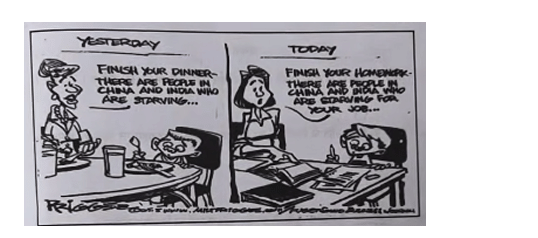
Study the given cartoon carefully and answer the questions that follow: