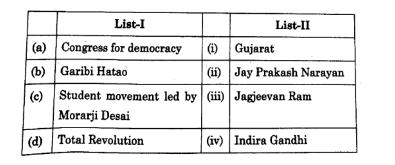
Match List-I with List-II correctly and choose the correct answer from the codes given below:
List-I
List-II
(a) Congress for democracy
(i) Gujarat
(b) Garibi Hatao
(ii) Jay Prakash Narayan
(c) Student movement led by Morarji Desai
(iii) Jagjeevan Ram
(d) Total Revolution
(iv) Indira Gandhi
Codes:
1
(a)-(i), (b)-(ii), (c)-(iv), (d)-(iii)
2
(a)-(iv), (b)-(iii), (c)-(i), (d)-(ii)
3
(a)-(iii), (b)-(iv), (c)-(i), (d)-(ii)
4
(a)-(ii), (b)-(i), (c)-(iii), (d)-(iv)
Official Solution
Correct Option:
(3)
Concept:
During the political developments of the 1970s in India, several movements, slogans, and political groups emerged that were associated with specific leaders and regions.
Congress for Democracy: This party was formed by Jagjivan Ram in 1977 after he left the Congress Party.
Garibi Hatao: This famous political slogan was given by Indira Gandhi during the 1971 election campaign.
Student movement led by Morarji Desai: This movement took place in Gujarat, known as the Navnirman Movement.
Total Revolution: This movement was led by Jayaprakash Narayan against corruption and for democratic reforms.
Step 1: {\color{red}Match (a).
Congress for Democracy was associated with Jagjivan Ram. Hence, (a) → (iii). Step 2: {\color{red}Match (b).
The slogan Garibi Hatao was given by Indira Gandhi. Hence, (b) → (iv). Step 3: {\color{red}Match (c).
The student movement led by Morarji Desai took place in Gujarat. Hence, (c) → (i). Step 4: {\color{red}Match (d).
The Total Revolution movement was led by Jayaprakash Narayan. Hence, (d) → (ii). Step 5: {\color{red}Final matching:}
02
PYQ 2026
medium
political-scienceID: cbse-cla
State any two reasons for the Students' Movement in Gujarat in 1974.
Official Solution
Correct Option:
(1)
Concept:
The Students' Movement in Gujarat (1974) was a major political protest known as the Navnirman Movement. It began as a protest by students against rising prices and corruption in the state government and later turned into a mass movement involving many sections of society. Two main reasons for the Students' Movement in Gujarat were:
Rise in Prices and Economic Hardships: There was a sharp increase in the prices of essential commodities and hostel food charges. This created dissatisfaction among students and common people, leading to protests.
Corruption in the State Government: The government led by Chief Minister Chimanbhai Patel was accused of corruption and misuse of power. This angered the public and strengthened the student-led agitation.
Conclusion:
Thus, rising prices and widespread corruption in the state government were the major reasons for the Students' Movement in Gujarat in 1974.
03
PYQ 2026
medium
political-scienceID: cbse-cla
Explain any four advantages of coalition governments with reference to Indian politics.
Official Solution
Correct Option:
(1)
Concept:
A coalition government is formed when two or more political parties come together to form a government. In India, coalition governments have become common since 1989 and have contributed to inclusive and representative governance. Four advantages of coalition governments are:
Better Representation: Coalition governments include multiple parties, ensuring representation of diverse regions, communities and interests.
Promotion of Federalism: Regional parties get a voice at the national level, strengthening the federal structure of India.
Consensus-Based Decision Making: Decisions are taken after discussions among different parties, reducing the chances of arbitrary decisions.
Check on Autocracy: No single party dominates, which prevents concentration of power and promotes democratic functioning.
Conclusion:
Thus, coalition governments promote inclusiveness, cooperation, and democratic decision-making in Indian politics.
04
PYQ 2026
medium
political-scienceID: cbse-cla
Analyse the main reason responsible for the formation of Coalition Governments after 1989.
Official Solution
Correct Option:
(1)
Introduction:
After 1989, Indian politics witnessed the emergence of coalition governments due to major political changes in the country. Main Reasons: 1. Decline of Congress Dominance:
The Congress Party gradually lost its position as the dominant political party, resulting in no single party gaining a clear majority in elections. 2. Rise of Regional Parties:
Regional political parties gained strength and began representing local interests, making coalition politics necessary. 3. Social and Political Diversity:
India’s diverse society with different caste, regional, and linguistic groups demanded greater representation in governance. 4. Acceptance of Coalition Politics:
Political parties increasingly cooperated and formed alliances to achieve a majority and form stable governments. Conclusion:
Therefore, the decline of single-party dominance and the rise of regional parties were the main reasons behind the formation of coalition governments after 1989.
05
PYQ 2026
medium
political-scienceID: cbse-cla
Name any four political parties that had merged to form Janata Party in 1977.
Official Solution
Correct Option:
(1)
Introduction:
The Janata Party was formed in 1977 by merging several opposition parties to challenge the Congress Party after the Emergency period. Constituent Parties: 1. Bharatiya Lok Dal
2. Congress (O)
3. Bharatiya Jana Sangh
4. Socialist Party Conclusion:
These parties united to form the Janata Party and successfully formed the government after the 1977 general elections.
06
PYQ 2026
medium
political-scienceID: cbse-cla
Explain any four differences between the governments formed in the first three General Elections held in India after independence and the coalition governments formed after the year 1989.
Official Solution
Correct Option:
(1)
Introduction:
Indian politics has evolved from a phase of single-party dominance in the early years after independence to coalition-based governance after 1989. Differences: 1. Nature of Government:
During the first three general elections, the government was formed by a single dominant party (Indian National Congress).
After 1989, governments were mostly formed through coalitions of multiple parties. 2. Stability of Government:
Earlier governments were relatively stable because a single party had a clear majority.
Coalition governments are often less stable due to dependence on several parties. 3. Decision-Making Process:
In the early period, decisions were taken quickly by the ruling party.
In coalition governments, decisions require consultation and agreement among coalition partners. 4. Representation of Interests:
Earlier governments had limited representation of regional interests.
Coalition governments provide greater representation to regional and smaller parties. Conclusion:
Coalition governments reflect the political diversity of India, though they require cooperation and compromise among multiple political parties.
07
PYQ 2026
medium
political-scienceID: cbse-cla
How does the geographical location of the North-East region affect the expression of its regional demands? Explain.
Official Solution
Correct Option:
(1)
Explanation: The North-East region of India has a unique geographical location. It is connected to the rest of the country by a narrow strip of land known as the Siliguri Corridor, often called the “Chicken’s Neck”. This geographical condition has influenced the expression of regional demands in the region. Impacts of Geography: 1. Geographical Isolation – The region’s distance from mainland India and limited connectivity create a feeling of neglect and alienation among the people. 2. Ethnic and Cultural Diversity – The region is home to numerous tribes and ethnic groups with distinct languages and traditions, leading to strong regional identities and demands for autonomy. 3. International Borders – The North-East shares borders with China, Myanmar, Bangladesh, and Bhutan, which raises security concerns and influences political dynamics. 4. Economic and Developmental Challenges – Hilly terrain and poor connectivity hinder infrastructure development and economic growth, leading to demands for greater development and government support. Conclusion:
Due to these geographical and socio-cultural factors, the North-East region has witnessed demands for autonomy, greater political representation, economic development, and protection of cultural identity.
08
PYQ 2026
medium
political-scienceID: cbse-cla
Arrange the following events in chronological order:
(i) Declaration of National Emergency on the basis of internal disturbances
(ii) Railway strike by government employees under the leadership of George Fernandes
(iii) Sixth General Election held in India
(iv) Declaration of the doctrine of ‘basic structure’ of the Constitution in the ‘Keshavananda Bharati’ case
1
(iv), (ii), (i), (iii)
2
(i), (iii), (iv), (ii)
3
(iii), (ii), (i), (iv)
4
(iv), (iii), (ii), (i)
Official Solution
Correct Option:
(1)
Step 1: Identify years
(iv) Keshavananda Bharati case → 1973
(ii) Railway strike led by George Fernandes → 1974
(i) National Emergency declared in India → 1975
(iii) Sixth General Election held in India → 1977 Step 2: Arrange chronologically
1973 → 1974 → 1975 → 1977 Step 3: Match with option
(iv), (ii), (i), (iii) Final Answer:(A)
09
PYQ 2026
medium
political-scienceID: cbse-cla
The alliance that has formed the government at the centre maximum number of times is:
1
United Progressive Alliance (UPA)
2
National Front
3
United Front
4
National Democratic Alliance (NDA)
Official Solution
Correct Option:
(4)
Step 1: Recall alliances
United Progressive Alliance (UPA) governed India from 2004 to 2014, completing two consecutive terms.
National Democratic Alliance (NDA) formed governments in 1998–2004 and again from 2014 onwards. Step 2: Compare frequency
Among the given alliances, the NDA has formed the central government the maximum number of times. Final Answer:(D)
10
PYQ 2026
medium
political-scienceID: cbse-cla
Which was the last state toured by Rajiv Gandhi for his election campaign in May 1991?
1
Tamil Nadu
2
Karnataka
3
Kerala
4
Andhra Pradesh
Official Solution
Correct Option:
(1)
Step 1: Historical context
Rajiv Gandhi was campaigning for the 1991 general elections when he was assassinated. Step 2: Location
The assassination occurred at Sriperumbudur in Tamil Nadu on 21 May 1991 during an election rally. Step 3: Conclusion
Therefore, Tamil Nadu was the last state toured by Rajiv Gandhi for his election campaign. Final Answer:(A)
11
PYQ 2026
medium
political-scienceID: cbse-cla
Which one of the following statements is NOT correct about the first two Five Year Plans?
1
The first Five Year Plan was drafted by K.N. Raj and the second Five Year Plan was drafted by P.C. Mahalanobis.
2
The first Five Year Plan focused on agriculture and the second Five Year Plan focused on industries.
3
The first Five Year Plan emphasized the active role of the public sector and the second Five Year Plan made industrialization for large scale projects.
4
The aim of first Five Year Plan was to raise industrial production and in the second Five Year Plan, the government imposed tariffs on imports to protect industries.
Official Solution
Correct Option:
(4)
Step 1: Recall facts
The First Five Year Plan (1951–56) mainly focused on agriculture, irrigation, and rural development.
The Second Five Year Plan (1956–61) emphasized rapid industrialization based on the Mahalanobis model. Step 2: Evaluate options
(A) Correct ✔ — The first plan was drafted by K.N. Raj and the second by P.C. Mahalanobis.
(B) Correct ✔ — The first plan emphasized agriculture, while the second focused on industries.
(C) Correct ✔ — Public sector expansion and large-scale industrialization were key elements of the second plan.
(D) Incorrect ✘ — It wrongly states that the first plan focused on raising industrial production. Final Answer:(D)
12
PYQ 2026
medium
political-scienceID: cbse-cla
Given below are two statements marked as Assertion (A) and Reason (R). Read the statements and choose the correct answer from the given options:Assertion (A): The idea of Five Year Plans (FYP) in India was inspired by the USSR. Reason (R): Due to acute economic crisis, the Indian Government started 'Plan Holiday' in 1966.
1
Both Assertion (A) and Reason (R) are true, and Reason (R) is the correct explanation of Assertion (A).
2
Both Assertion (A) and Reason (R) are true, but Reason (R) is not the correct explanation of Assertion (A).
3
Assertion (A) is false, but Reason (R) is true.
4
Assertion (A) is true, but Reason (R) is false.
Official Solution
Correct Option:
(2)
Step 1: Analyze Assertion
India adopted the planning model after independence, and it was indeed inspired by the centralized planning system of the Soviet Union. Hence, Assertion (A) is true. Step 2: Analyze Reason
The 'Plan Holiday' (1966–1969) was introduced due to economic crisis, wars, and drought conditions. Hence, Reason (R) is also true. Step 3: Check relationship
However, the reason given (economic crisis leading to plan holiday) has no connection with why India adopted Five Year Plans initially. Therefore, it does not explain the assertion. Final Answer:(B)
13
PYQ 2026
medium
political-scienceID: cbse-cla
Highlight any four points of the political ideology of Communist Party of India.
Official Solution
Correct Option:
(1)
Step 1: Understanding the Question: The question requires outlining the core ideological principles that define the Communist Party of India (CPI). Step 3: Detailed Explanation: 1. Marxism-Leninism: The CPI bases its core political ideology on the principles of Marxism and Leninism. It advocates for the establishment of a socialist society and ultimately a communist state where the working class (proletariat) holds power. 2. Advocacy for the Working Class and Peasantry: The party strongly champions the rights of industrial workers, landless laborers, and poor peasants. It campaigns for fair wages, land reforms, and the redistribution of wealth to eliminate extreme economic inequalities. 3. Anti-Imperialism and Anti-Capitalism: The CPI staunchly opposes Western imperialism, neo-colonialism, and global capitalist forces. It argues against policies that favor large multinational corporations at the expense of local workers and self-reliance. 4. Secularism and Anti-Communalism: The party is committed to strict secularism and vehemently opposes communal, caste-based, and religious politics. It believes that religious divisions are often used to distract the working class from their shared economic struggles. Step 4: Final Answer: The four core points of CPI's ideology are its foundation in Marxism-Leninism, its focus on working-class and peasant rights, its opposition to capitalism and imperialism, and its strong commitment to secularism.
14
PYQ 2026
medium
political-scienceID: cbse-cla
Which one of the following statements is NOT correct about the first two Five Year Plan?
1
The first Five Year Plan was drafted by K.N. Raj and the second Five Year Plan was drafted by P.C. Mahalnobis.
2
The first Five Year Plan focussed on agriculture and the second Five Year Plan focussed on industries.
3
The first Five Year Plan emphasized on the active role of the public sector and the second Five Year Plan made huge allocations for large scale projects.
4
The aim of first Five Year Plan was to raise the industrial production and in the second Five Year Plan, the government imposed substantial tariffs on imports in order to protect both public and private sector industries.
Official Solution
Correct Option:
(4)
Step 1: Understanding the Question:
The goal is to identify the incorrect statement among the options regarding India's first two Five Year Plans. Step 2: Detailed Explanation:
The First Five Year Plan (1951-56) focused primarily on agriculture, irrigation, and dam construction, not on industrial production as its primary goal.
The Second Five Year Plan (1956-61) focused on rapid industrialization, specifically heavy industries, and the Mahalanobis model was used.
Option (D) incorrectly claims the first plan's aim was to raise industrial production, which is historically inaccurate compared to the agricultural priority of the first plan. Step 3: Final Answer:
The incorrect statement is (D).
15
PYQ 2026
medium
political-scienceID: cbse-cla
Describe any four factors responsible to make Indira Gandhi's government popular in the beginning of 1970s decade.
Official Solution
Correct Option:
(1)
Step 1: Understanding the Question: The question seeks to identify the key policies, slogans, and events that led to the massive resurgence and popularity of Indira Gandhi during the early 1970s (especially around the 1971 elections). Step 3: Detailed Explanation: 1. The 'Garibi Hatao' Slogan: During the 1971 election campaign, Indira Gandhi coined the incredibly popular slogan "Garibi Hatao" (Eradicate Poverty). This sharply contrasted with the opposition's "Indira Hatao" (Remove Indira) slogan and directly connected her with the poor, landless laborers, Dalits, and marginalized communities. 2. Abolition of Privy Purses: Indira Gandhi took the bold step of abolishing the 'Privy Purses', which were special privileges and pensions granted to the former rulers of princely states. This move was highly popular as it was seen as a strong commitment to egalitarianism and social justice. 3. Nationalization of Banks: She nationalized 14 leading private banks in India. This policy was perceived as a pro-poor measure aimed at redirecting credit and financial resources away from a few wealthy industrialists toward agriculture and small-scale industries. 4. Victory in the 1971 Indo-Pak War: Under her decisive leadership, India achieved a historic military victory over Pakistan in 1971, which led to the creation of the independent nation of Bangladesh. This elevated her status to a strong nationalist leader and generated immense national pride, cementing her political dominance. Step 4: Final Answer: Indira Gandhi's popularity surged due to her pro-poor "Garibi Hatao" campaign, bold socialist policies like the abolition of privy purses and bank nationalization, and her strong leadership during the 1971 Indo-Pak war.
16
PYQ 2026
medium
political-scienceID: cbse-cla
Match List-I with List-II correctly and choose the correct answer from the codes given below :
1
(a)-(i), (b)-(ii), (c)-(iv), (d)-(iii)
2
(a)-(iv), (b)-(iii), (c)-(i), (d)-(ii)
3
(a)-(iii), (b)-(iv), (c)-(i), (d)-(ii)
4
(a)-(ii), (b)-(i), (c)-(iii), (d)-(iv)
Official Solution
Correct Option:
(3)
Step 1: Understanding the Question:
This question requires matching historical Indian political movements and slogans with their associated leaders or events. Step 2: Detailed Explanation:
(a) Congress for Democracy was formed by Jagjeevan Ram.
(b) 'Garibi Hatao' was a famous slogan used by Indira Gandhi in the 1971 elections.
(c) The Student movement in Gujarat was led by Morarji Desai (Nav Nirman Andolan).
(d) The 'Total Revolution' movement was led by Jay Prakash Narayan.
Matching (a)-(iii), (b)-(iv), (c)-(i), (d)-(ii) gives us option (C). Step 3: Final Answer:
The correct sequence matches option (C).
17
PYQ 2026
medium
political-scienceID: cbse-cla
Explain any four policies adopted by China to accelerate its economic growth.
Official Solution
Correct Option:
(1)
Concept:
China introduced several economic reforms after 1978 under the leadership of Deng Xiaoping to transform its economy from a strictly socialist system to a more market-oriented economy. Four policies adopted by China for economic growth are:
Economic Reforms and Open Door Policy: China opened its economy to foreign trade and investment to boost industrial and economic growth.
Establishment of Special Economic Zones (SEZs): China created SEZs where foreign companies could invest with fewer restrictions and better facilities.
Encouragement of Private Enterprise: The government allowed private businesses and enterprises to operate, increasing economic activity and employment.
Modernization of Agriculture and Industry: China modernized agriculture and industries by introducing new technologies and improving productivity.
Conclusion:
Thus, economic reforms, SEZs, foreign investment and modernization helped China achieve rapid economic growth.
18
PYQ 2026
medium
political-scienceID: cbse-cla
How did Princely States pose a threat to the National Security of India? Explain.
Official Solution
Correct Option:
(1)
Concept:
At the time of India's independence in 1947, there were about 565 princely states. These states were ruled by kings or princes and were not directly under British India. After independence, these princely states had the option to join India, join Pakistan or remain independent. Their uncertain position posed serious challenges to India's national security. Threats posed by princely states:
Possibility of Fragmentation: If princely states had chosen to remain independent, India could have been divided into many small states, threatening national unity.
External Influence: Some princely states could have developed relations with foreign countries, which might have threatened India's sovereignty and security.
Strategic Location: Certain princely states were located in strategically important regions, and their independence could have created security risks.
Internal Instability: Differences between rulers and the people in these states could have created internal conflicts affecting national stability.
Conclusion:
Thus, the uncertain political status of princely states after independence posed a threat to India's national security until their integration into the Indian Union.
19
PYQ 2026
medium
political-scienceID: cbse-cla
Explain any four factors that led Japan to emerge as a new centre of power even after the destruction caused by Atom Bombs.
Official Solution
Correct Option:
(1)
Concept:
After the Second World War, Japan suffered massive destruction due to the atomic bombings of Hiroshima and Nagasaki. Despite this devastation, Japan rebuilt its economy rapidly and emerged as a major economic power in the world. Four factors responsible for Japan’s emergence as a new centre of power are:
Economic Reconstruction and Industrial Growth: Japan focused on rebuilding its economy by developing modern industries, technology and manufacturing.
Support from the United States: The United States provided financial assistance, security support and access to markets which helped Japan’s economic recovery.
Skilled Workforce and Technology: Japan invested heavily in education, technology and innovation which increased productivity and industrial efficiency.
Peace Constitution and Focus on Development: Japan adopted a peaceful constitution and avoided large military spending, allowing it to concentrate resources on economic growth.
Conclusion:
Thus, strong economic planning, US support, technological development and peaceful policies helped Japan become a major centre of power.
20
PYQ 2026
medium
political-scienceID: cbse-cla
The ideology of 'Bharatiya Jana Sangh' party was to make India a progressive and strong nation. Do you agree with the statement? Support your answer with any four suitable arguments.
Official Solution
Correct Option:
(1)
Concept:
The Bharatiya Jana Sangh (BJS) was founded in 1951 by Dr. Syama Prasad Mookerjee. The party aimed to build a strong and progressive India based on the principles of nationalism, cultural unity and economic development. Many of its policies and ideological positions reflected the goal of strengthening the nation politically, culturally and economically. Yes, the statement is correct. The following arguments support it:
Promotion of Cultural Nationalism: The Bharatiya Jana Sangh emphasized the idea of cultural nationalism and aimed to promote Indian traditions and values in order to strengthen national unity.
Strong National Security: The party advocated a strong defence policy and national security to protect India's sovereignty and territorial integrity.
Economic Self-Reliance: The Bharatiya Jana Sangh supported economic development based on self-reliance and indigenous production to make the country economically strong.
National Integration: The party supported policies that aimed at strengthening national integration, including the complete integration of Jammu and Kashmir with India.
Conclusion:
Thus, through its emphasis on nationalism, economic development, strong defence and national integration, the Bharatiya Jana Sangh aimed to make India a progressive and strong nation.
21
PYQ 2026
medium
political-scienceID: cbse-cla
Explain the concept of non-Congressism with the help of any one example.
Official Solution
Correct Option:
(1)
Concept: Non-Congressism was a political strategy proposed by Dr. Ram Manohar Lohia. It aimed to oppose the dominance of the Indian National Congress by encouraging all non-Congress parties to unite and form alliances against it. The idea was that if opposition parties worked together, they could challenge the Congress Party, which had been dominating Indian politics since independence. Example:
1967 General Elections: In the 1967 elections, several opposition parties joined together to form coalition governments in many states such as Uttar Pradesh, Bihar and Punjab. These governments were known as Samyukta Vidhayak Dal (SVD) governments. The alliance of different parties successfully defeated the Congress in several states, demonstrating the idea of non-Congressism in practice.
Conclusion:
Thus, non-Congressism was a strategy of political unity among opposition parties to challenge Congress dominance, and it became visible during the 1967 elections when coalition governments replaced Congress in several states.
22
PYQ 2026
medium
political-scienceID: cbse-cla
In the given political outline map of India, four states have been marked as A, B, C and D. Identify these on the basis of the information given below and write their correct names in your answer-book along with their respective serial number of the information used and the concerned alphabet as per the format that follows:
[(i)] The state related to the leader of Dravidian Movement E.V. Ramasami Naicker.
[(ii)] The state whose formation was supported by Master Tara Singh.
[(iii)] The state where the movement against outsiders was started by students.
[(iv)] The state for which Rajiv Gandhi and Laldenga signed an agreement for peace.
Official Solution
Correct Option:
(1)
Concept:
Different political movements and agreements in India are associated with particular states and leaders.
Tamil Nadu: E.V. Ramasami Naicker (Periyar) was a prominent leader of the Dravidian Movement, which originated in Tamil Nadu.
Punjab:Master Tara Singh strongly supported the demand for a separate Punjabi-speaking state, which later resulted in the formation of Punjab in 1966.
Assam: The Assam Movement against illegal immigrants and outsiders was started by student organizations such as the All Assam Students' Union (AASU).
Mizoram: The Mizo Peace Accord was signed in 1986 between Prime Minister Rajiv Gandhi and Mizo National Front leader Laldenga, leading to peace and the creation of Mizoram as a state.
About Indian Politics - CBSE-CLASS-XII
Indian Politics is a vital chapter for CBSE-CLASS-XII aspirants. Mastering the concepts covered in this chapter is essential for securing a top rank.
By rigorously practicing the previous year questions associated with this chapter, you can identify high-yield topics, understand the examiner's perspective, and boost your confidence during the actual exam.
Frequently Asked Questions
Why focus on Indian Politics PYQs?
Analyzing PYQs for this specific chapter reveals the most frequently tested concepts and the typical complexity of questions, allowing you to tailor your study plan efficiently.
How to best use this analysis?
Review the topic breakdown to see which sub-topics within Indian Politics carry the most weight. Then, tackle the questions iteratively to solidify your understanding.