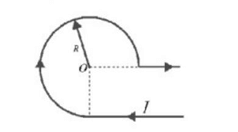
What is the magnetic induction of the field at the point O in a current I carrying wire that has the shape as shown in the figure? The radius of the curved part of the wire is R, the linear parts are assumed to be very long.
1
2
3
4
Official Solution
Correct Option:
(4)
Step 1: Concept
The total field at O is the sum of the fields from the straight wires and the circular arc. Step 2: Analysis
- Field from the horizontal semi-infinite wire: .
- Field from the 3/4 circular arc: .
- The other linear wire passes through O, so its field is zero. Step 3: Calculation
. Step 4: Conclusion
Hence, the magnetic induction is . Final Answer:(D)
02
PYQ 2025
easy
physicsID: cuet-ug-
A long wire with a small current element of length 1 cm is placed at the origin and carries a current of 10 A along the x-axis. The magnitude of the magnetic field, due to the element, on the y-axis at a distance 0.5 m from it, would be
1
4 x 10 T
2
5 x 10 T
3
6 x 10 T
4
2 x 10 T
Official Solution
Correct Option:
(1)
Step 1: Understanding the Concept:
This problem requires the application of the Biot-Savart Law to find the magnetic field produced by a small current-carrying element. The Biot-Savart Law gives the magnetic field at a point in space due to a current element.
Step 2: Key Formula or Approach:
The magnitude of the magnetic field due to a current element at a distance is given by the Biot-Savart Law:
where is the permeability of free space ( ), is the current, is the length of the element, is the distance from the element to the point, and is the angle between the direction of the current element and the position vector to the point.
Step 3: Detailed Explanation: Given data:
Current, .
Length of the element, .
Distance to the point on the y-axis, .
The current element is along the x-axis, and the point is on the y-axis. Therefore, the angle between the current element and the position vector is . Thus, .
The constant . Calculation:
Substitute the values into the Biot-Savart Law formula:
Step 4: Final Answer:
The magnitude of the magnetic field due to the element at the given point is T.
About Biot Savart Law - CUET-UG
Biot Savart Law is a vital chapter for CUET-UG aspirants. Mastering the concepts covered in this chapter is essential for securing a top rank.
By rigorously practicing the previous year questions associated with this chapter, you can identify high-yield topics, understand the examiner's perspective, and boost your confidence during the actual exam.
Frequently Asked Questions
Why focus on Biot Savart Law PYQs?
Analyzing PYQs for this specific chapter reveals the most frequently tested concepts and the typical complexity of questions, allowing you to tailor your study plan efficiently.
How to best use this analysis?
Review the topic breakdown to see which sub-topics within Biot Savart Law carry the most weight. Then, tackle the questions iteratively to solidify your understanding.