A family uses 8 kW of power. Direct solar energy is incident on the horizontal surface at an average rate of 200 W per square meter. If 20% of this energy can be converted to useful electrical energy, how large an area is needed to supply 8 kW? }
1
2
3
4
800 m²
Official Solution
Correct Option: (1)
Step 1: Concept
Useful Power = Total Incident Power Efficiency. Step 2: Analysis Target Power = 8 kW = 8000 W. Incident Intensity = 200 W/ . Efficiency = 20% = 0.20. Step 3: Calculation Useful power per = W/ . Total Area needed = Total Power / Useful Power per = . Step 4: Conclusion
Hence, an area of 200 is required. Final Answer:(A)
02
PYQ 2021
medium
physicsID: cuet-ug-
A 40 kg boy whose legs are 4 in area and 50 cm long falls through a height of 2 m without breaking his leg bones. If the bones can withstand a stress of 0.9 The Young's modulus for the material of the bone is ________.
1
2
3
4
Official Solution
Correct Option: (3)
Step 1: Concept
Energy conservation: Potential energy lost = Elastic energy gained. . Step 2: Analysis kg, m, m, (two legs). Stress ( ) = . Volume ( ) = . Step 3: Calculation J. Elastic energy = . . Step 4: Conclusion
Hence, the Young's modulus is . Final Answer:(C)
03
PYQ 2021
medium
physicsID: cuet-ug-
The length of a metal wire is when the tension is and when the tension is . The unstretched length of the wire is ________.
1
2
3
4
Official Solution
Correct Option: (1)
Step 1: Concept
Hooke's Law: , where is the unstretched length. Step 2: Analysis ...(1) ...(2) Step 3: Calculation Divide (1) by (2): . . . . Step 4: Conclusion
Hence, the unstretched length is . Final Answer:(A)
04
PYQ 2021
medium
physicsID: cuet-ug-
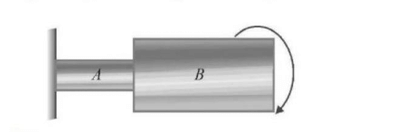
Two cylinders A and B of the same material have same length, their radii being in the ratio 1: 2 respectively. The two are joined end to end as shown in the figure. One end of cylinder A is rigidly clamped while free end of cylinder B is twisted through an angle . The angle of twist of cylinder A is ________.
1
2
3
4
Official Solution
Correct Option: (4)
Step 1: Concept
For cylinders in series, the torque ( ) is the same for both. The torque is given by , where is the torsional rigidity ( ) and is the angle of twist. Step 2: Analysis
Let the twist in A be and in B be . The total twist is .
Since material and length are same, . Given , so . Step 3: Calculation
Equating torque: .
Substituting in total twist: .
Thus, . Step 4: Conclusion
Hence, the angle of twist of cylinder A is . Final Answer:(D)
05
PYQ 2021
medium
physicsID: cuet-ug-
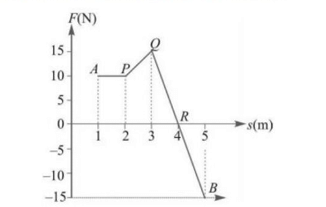
A body moves from point A to B under the action of a force, varying in magnitude as shown in the figure. Force is expressed in newton and displacement in meter. What is the total work done? }
1
37.5 J
2
100 J
3
12.5 J
4
22.5 J
Official Solution
Correct Option: (4)
Step 1: Concept
Work done is the area under the Force-Displacement ( ) graph. Step 2: Analysis Area from to (Rectangle AP): J. Area from to (Trapezium PQ): J. Area from to (Triangle QR): J. Area from to (Triangle RB - below axis): J. Step 3: Calculation Total Work = J. Step 4: Conclusion
Hence, the total work done is 22.5 J. Final Answer:(D)
06
PYQ 2025
easy
physicsID: cuet-ug-
The work done by the force of gravity on a satellite moving in a circular orbit around the Earth is:
1
Positive
2
Negative
3
Zero
4
Infinite
Official Solution
Correct Option: (3)
To solve the problem, we need to understand the nature of the work done by the force of gravity on a satellite moving in a circular orbit around Earth.
1. Understanding the Concepts:
- Work Done by a Force: Work is defined as the force applied times the displacement in the direction of the force.
- Mathematically,
where is the angle between force and displacement.
- Force of Gravity: Always acts towards the center of the Earth (radially inward).
- Satellite Movement: Satellite moves tangentially to its circular orbit, meaning its displacement at any instant is perpendicular to the gravitational force.
2. Analyze the Work Done by Gravity:
- Since the gravitational force acts towards the center and the satellite's instantaneous displacement is perpendicular (at 90°) to this force,
- The angle , and .
- Therefore, the work done by gravity over any segment of the circular path is:
3. Interpretation:
- Gravity changes the direction of the satellite's velocity but not its speed.
- Hence, it does no work on the satellite because the satellite's kinetic energy remains constant in uniform circular motion.
Final Answer:
The work done by the force of gravity on a satellite moving in a circular orbit around the Earth is zero.
07
PYQ 2025
medium
physicsID: cuet-ug-
A body of mass 2 kg is raised to a height of 5 m. What is the potential energy gained? (Take )
1
10 J
2
50 J
3
100 J
4
150 J
Official Solution
Correct Option: (3)
The potential energy gained by a body raised to a certain height is given by the formula: Where: = mass of the body = 2 kg = acceleration due to gravity = 10 = height = 5 m Step 1: Substitute the values into the formula Step 2: Interpretation The body has gained 100 joules of gravitational potential energy as a result of being raised. This energy is stored due to its position above the ground and can be converted into kinetic energy if it falls. Why not the other options? - 10 J and 50 J are too low, based on the formula. - 150 J would require a greater height or mass.
08
PYQ 2025
medium
physicsID: cuet-ug-
How much work is done to slide a crate for a distance of 25 m along a loading dock by pulling on it with a 180 N force where the dock is at an angle of 45∘ from the horizontal?
1
1.188 × 1025 MeV
2
1.288 × 1025 MeV
3
1.588 × 1025 MeV
4
1.988 × 1025 MeV
Official Solution
Correct Option: (4)
To solve the problem, we first calculate the work done in joules and then convert it into millielectronvolts (meV).