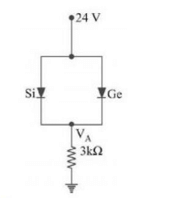
In the circuit shown in figure, the potential barrier for Ge diode is 0.3 V and for Si diode it is 0.7 V. What is the voltage ?
1
23.7 V
2
23 V
3
24.3 V
4
24.7 V
Official Solution
Correct Option:
(1)
Step 1: Concept
In a parallel diode configuration, the diode with the lower barrier voltage will conduct first, clamping the voltage across the other diode. Step 2: Analysis
Ge barrier (0.3 V) < Si barrier (0.7 V). Therefore, the Ge diode will conduct and the Si diode will remain off. Step 3: Calculation
.
. Step 4: Conclusion
Hence, the voltage is 23.7 V. Final Answer:(A)
02
PYQ 2023
medium
physicsID: cuet-ug-
Which of the following statements is NOT correct:
1
Pure silicon doped with a trivalent impurity gives a p-type semiconductor.
2
Majority carriers in an n-type semiconductor are holes.
3
Minority carriers in a p-type semiconductor are electrons.
4
The resistivity of an intrinsic semiconductor decreases with increase of temperature.
Official Solution
Correct Option:
(4)
- Statement 1: Pure silicon doped with a trivalent impurity (such as boron) results in a p-type semiconductor, which has more holes as majority carriers. This statement is correct. - Statement 2: In an n-type semiconductor, the majority carriers are electrons, not holes. This statement is also correct. - Statement 3: In a p-type semiconductor, the majority carriers are holes, and the minority carriers are electrons. Therefore, this statement is correct. - Statement 4: The resistivity of an intrinsic semiconductor decreases with an increase in temperature, which is incorrect. In intrinsic semiconductors, resistivity decreases as temperature increases due to an increase in charge carriers, making this statement the incorrect one.
03
PYQ 2023
medium
physicsID: cuet-ug-
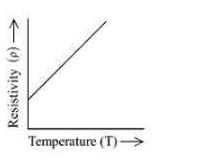
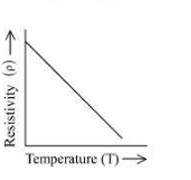
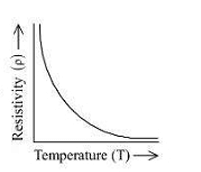
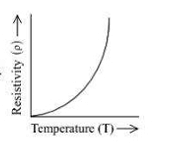
Identify the graph from the following showing the temperature dependence of resistivity for a typical semiconductor?
1
2
3
4
Official Solution
Correct Option:
(3)
The resistivity of a semiconductor decreases with an increase in temperature. As the temperature increases, more charge carriers are excited, leading to a decrease in resistivity. Therefore, the graph showing a downward curve as temperature increases best represents the behavior of resistivity in a typical semiconductor.
About Semiconductors - CUET-UG
Semiconductors is a vital chapter for CUET-UG aspirants. Mastering the concepts covered in this chapter is essential for securing a top rank.
By rigorously practicing the previous year questions associated with this chapter, you can identify high-yield topics, understand the examiner's perspective, and boost your confidence during the actual exam.
Frequently Asked Questions
Why focus on Semiconductors PYQs?
Analyzing PYQs for this specific chapter reveals the most frequently tested concepts and the typical complexity of questions, allowing you to tailor your study plan efficiently.
How to best use this analysis?
Review the topic breakdown to see which sub-topics within Semiconductors carry the most weight. Then, tackle the questions iteratively to solidify your understanding.