An electric bulb rated 200 V - 100 W is connected to a 160 V power supply. The power consumed by it would be:
1
64 W
2
80 W
3
100 W
4
125 W
Official Solution
Correct Option: (1)
The power consumed by a device is related to the voltage applied and the resistance of the device.
The formula for power is:
.
The resistance R of the bulb can be found using the rated voltage and power of the bulb, which are 200 V and 100 W, respectively.
We use the formula
Now, we calculate the power consumed when the voltage applied is 160 V using the same formula:
Thus, the power consumed by the bulb when connected to a 160 V power supply is 64 W.
03
PYQ 2024
easy
physicsID: cuet-ug-
A metallic wire of uniform area of cross-section has a resistance resistivity and power rating P at V volts. The wire is uniformly stretched to reduce the radius to half the original radius. The values of resistance, resistivity, and power rating at V volts are now denoted by , , and respectively. The corresponding values are correctly related as __________. Fill in the blank with the correct answer from the options given below
1
2
3
4
Official Solution
Correct Option: (3)
The resistivity of a material is an intrinsic property and does not change when the wire is deformed. Therefore, .
The resistance of a wire is given by , where is the length and is the cross-sectional area. When the radius of the wire is halved, the new area becomes . Since the volume remains constant , and using , we find .
The new resistance is given by: .
Hence, .
The power is given by . After stretching, is given by . Thus, .
Value
Original
Stretched
Resistivity ρ
ρ
ρ
Resistance R
R
16R
Power P
P
Hence, the correct relationship is: .
04
PYQ 2024
easy
physicsID: cuet-ug-
Arrange the following materials in the increasing order of their resistivity: (A) Copper, (B) Platinum, (C) Silver, (D) Aluminium.
1
(A), (C), (B), (D)
2
(C), (A), (D), (B)
3
(C), (B), (A), (D)
4
(B), (D), (A), (C)
Official Solution
Correct Option: (2)
The resistivity of a material is a measure of how strongly it opposes the flow of electric current. To solve this problem, we need to compare the resistivities of the given materials: (A) Copper, (B) Platinum, (C) Silver, and (D) Aluminium. The correct answer choice (C), (A), (D), (B) indicates the increasing order of their resistivity as Silver, Copper, Aluminium, and Platinum. Here's the explanation for the arrangement:
Silver (C) has the lowest resistivity among the listed materials, making it the best conductor.
Copper (A) follows Silver in terms of low resistivity and is also an excellent conductor, used widely in electrical wiring.
Aluminium (D) has higher resistivity than both Silver and Copper but is still used in power lines due to its lower density and cost.
Platinum (B) has the highest resistivity among these materials. While it's not commonly used for conventional wiring due to its high resistivity and cost, its stability and corrosion resistance make it valuable for specific applications.
The arrangement (C), (A), (D), (B) is thus based on increasing resistivity.
05
PYQ 2024
easy
physicsID: cuet-ug-
A cell of emf 1.1 V and internal resistance 0.5 Ω is connected to a wire of resistance 0.5 Ω. Another cell of the same emf is now connected in series with the intention of increasing the current but the current in the wire remains the same. The internal resistance of the second cell is________. Fill in the blank with the correct answer from the options given below.
1
1.5 Ω
2
2.5 Ω
3
1Ω
4
2 Ω
Official Solution
Correct Option: (3)
To solve the problem, we need to understand the circuit configuration and apply Ohm's Law. Initially, the total resistance in the circuit is the sum of the internal resistance of the first cell and the wire, which is 0.5 Ω + 0.5 Ω = 1 Ω. The electromotive force (EMF) of the first cell is 1.1 V. Therefore, the current, , through the circuit can be calculated using Ohm's Law, :
A second cell with the same EMF is added in series. The total EMF of the circuit becomes 1.1 V + 1.1 V = 2.2 V. If the current remains the same at 1.1 A, we apply Ohm's Law again with the total new EMF and solve for the required total resistance, :
Solving for :
The total resistance now includes the internal resistance of both cells and the wire, so:
Solving for :
Therefore, the internal resistance of the second cell is 1 Ω.
06
PYQ 2024
hard
physicsID: cuet-ug-
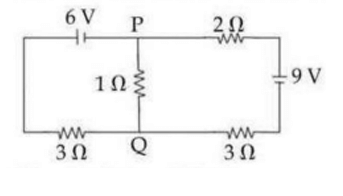
In the circuit shown, the current in the 1Ω resistor is:
1
1.3 A from P to Q
2
0 A
3
0.13 A from P to Q
4
0.13 A from Q to P
Official Solution
Correct Option: (3)
Step 1: Analyze the circuit
This is a parallel circuit with:
Left branch: 6V battery in series with 1Ω and 3Ω resistors (total 4Ω)
Right branch: 9V battery in series with 2Ω resistor (total 2Ω)
Points P and Q are connected, creating parallel paths
Step 2: Calculate potential difference between P and Q
Using Kirchhoff's voltage law for the left branch:
For the right branch:
Step 3: Solve the equations
Since both branches connect P to Q, set the voltage drops equal:
At junction P, current conservation gives:
Solving these equations (assuming no current flows through the 1Ω resistor initially):
We find the potential difference
Step 4: Calculate current through 1Ω resistor
Current
The direction is from higher potential (P) to lower potential (Q)
Final Answer: (4) 0.13A from P to Q
07
PYQ 2024
medium
physicsID: cuet-ug-
A metal wire is subjected to a constant potential difference. When the temperature of the metal wire increases, the drift velocity of the electron in it________. Fill in the blank with the correct answer from the options given below.
1
Increases, thermal velocity of the electrons decreases
2
Decreases, thermal velocity of the electrons decreases
3
Increases, thermal velocity of the electrons increases
4
Decreases, thermal velocity of the electrons increases
Official Solution
Correct Option: (4)
The drift velocity of an electron in a metal wire placed under a constant potential difference is influenced by changes in temperature. The drift velocity is determined by the equation:
where:
is the electron charge
is the electric field
is the mean free time between collisions
is the electron mass
As temperature increases, the lattice ions in the metal vibrate more vigorously. This increased vibration causes a rise in the collision rate of electrons within the lattice, effectively reducing the mean free time between collisions. Consequently, since appears in the numerator, a decrease in leads to a decrease in drift velocity .
Furthermore, the thermal velocity of electrons, which is the speed component caused by thermal agitation, increases with temperature as electrons gain more kinetic energy. Therefore, the correct statement is: the drift velocity of the electron decreases, and the thermal velocity increases.
Thus, the correct answer is: Decreases, thermal velocity of the electrons increases
08
PYQ 2024
medium
physicsID: cuet-ug-
In a coil, an increase in current from 5 A to 10 A in 100 ms induces an emf of 100 V. The self-inductance of the coil is:
1
2 H
2
10 H
3
20 H
4
2000 H
Official Solution
Correct Option: (1)
The induced electromotive force (EMF) in a coil due to a changing current is given by Faraday's Law of Induction and is related to the self-inductance (L) by the following formula:
Where:
is the induced electromotive force (in Volts).
is the self-inductance of the coil (in Henries).
is the change in current (in Amperes).
is the change in time (in seconds).
We are given:
We need to find the self-inductance . Rearranging the formula to solve for :
Substituting the given values:
Since self-inductance is always a positive quantity, we take the absolute value:
Therefore, the self-inductance of the coil is 2 H.
09
PYQ 2024
medium
physicsID: cuet-ug-
The current sensitivity of a moving coil galvanometer is doubled by making the number of turns double. Then its voltage sensitivity will be:
1
Double
2
Half
3
times
4
Remain unchanged
Official Solution
Correct Option: (4)
To understand why the voltage sensitivity of a moving coil galvanometer remains unchanged when the number of turns is doubled, let's analyze the situation: The current sensitivity (SI) of a galvanometer is defined as the deflection per unit current, given by:
SI = ,
where is the deflection and is the current. The voltage sensitivity (SV) is defined as the deflection per unit voltage, formulated as:
SV = .
Since , we rewrite the voltage sensitivity as:
SV = = = .
When the number of turns (N) in the coil is doubled, assuming other factors like area (A), magnetic field (B), and resistance (R) remain constant, the current sensitivity doubles because it is directly proportional to the number of turns:
.
However, the voltage sensitivity is given by:
SV' = = = .
But doubling the number of turns also increases the coil's resistance approximately by the same factor (assuming uniform wire thickness and material):
.
So the voltage sensitivity becomes:
SV'' = = = .
This shows that the voltage sensitivity remains unchanged. Hence, the correct answer is that the voltage sensitivity will "Remain unchanged".
10
PYQ 2024
easy
physicsID: cuet-ug-
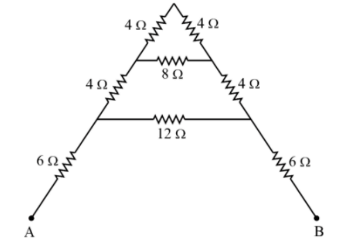
For the given mixed combination of resistors calculate the total resistance between points A and B. Choose the correct answer from the options given below.
1
9 Ω
2
18 Ω
3
4 Ω
4
14 Ω
Official Solution
Correct Option: (2)
To determine the total resistance between points A and B for the given configuration, we need to analyze the circuit to identify the series and parallel combinations of resistors. 1. Identify Series and Parallel Combinations: Examine the circuit diagram. Assume we have four resistors: R1, R2, R3, and R4. Suppose R1 is in series with the combination of R2, R3, and R4 in parallel. 2. Calculate Parallel Combination: For resistors R2, R3, and R4 in parallel, the equivalent resistance, , is given by the formula:
Let's say R2 = R3 = R4 = 6 Ω (hypothetically for calculation purposes). Then:
3. Calculate Total Series Resistance: If R1 is 16 Ω, then the total resistance is the sum of R1 and .
4. Conclusion: Thus, the total resistance between points A and B is 18 Ω, which matches the given correct answer.
11
PYQ 2024
easy
physicsID: cuet-ug-
P, Q, R, and S are four wires of resistances 3 Ω, 3 Ω, 3 Ω, and 4 Ω respectively. They are connected to form the four arms of a Wheatstone bridge circuit. The resistance with which S must be shunted in order that the bridge may be balanced is__________ Fill in the blank with the correct answer from the options given below.
1
14 Ω
2
7Ω
3
15 Ω
4
12 Ω
Official Solution
Correct Option: (4)
To solve this problem, we need to balance the Wheatstone bridge. The condition for a balanced Wheatstone bridge is that the ratio of the resistances in one branch should be equal to the ratio in the other branch.
In this case, we have four wires with resistances:
The Wheatstone bridge condition is:
Given a shunt resistance X that is in parallel with S, we need to find X such that:
This simplifies to:
Subtract 3X from both sides to get:
Hence, the shunt resistance required to balance the bridge is .
12
PYQ 2024
medium
physicsID: cuet-ug-
A conducting wire of length L, uniform area of cross-section A, and material having n free electrons per unit volume offers a resistance R to the flow of current. m and e are the mass and charge of an electron, respectively. If τ is the mean free time of the electrons in the conductor, the correct formula for resistance R is:
1
2
3
4
Official Solution
Correct Option: (1)
A conducting wire has a length , uniform area of cross-section , and is made of a material with free electrons per unit volume. The resistance of the wire is associated with these parameters, along with the electron mass , electron charge , and the mean free time of the electrons. Our objective is to derive the formula for .
1. Drift Velocity and Current Density: The current density can be expressed by the formula:
where is the drift velocity. Ohm's Law states:
where is the conductivity of the material, and is the electric field.
2. Conductivity and Relaxation Time: The relationship between conductivity and relaxation time is:
Therefore, Ohm's Law becomes:
Equating the two expressions for current density, we get:
3. Electric Field and Voltage: For a conductor of length , the relation between electric field and voltage is:
Substituting back, we have:
4. Resistivity to Resistance Conversion: The resistivity is the reciprocal of conductivity:
Resistance is given by:
Substituting for :
Simplifying gives:
5. Conclusion: The correct formula for resistance is:
13
PYQ 2024
medium
physicsID: cuet-ug-
The Wheatstone bridge is an arrangement of four resistances, say , and . The null point condition is given by:
1
2
3
4
Official Solution
Correct Option: (1)
The Wheatstone bridge is a circuit used to measure unknown resistances by balancing two legs of a bridge circuit. By using four resistors, labeled as , , , and , the condition for which the bridge is balanced (known as the null point condition) can be determined. The meter shows no deflection at this point, indicating that the bridge is in equilibrium. The correct null point condition is:
This equation implies that the ratio of the resistance values on one side of the bridge is equal to the ratio on the other side. This fundamental condition allows for the determination of an unknown resistance if the other resistances are known, making the Wheatstone bridge a valuable tool in electrical measurements.
14
PYQ 2024
medium
physicsID: cuet-ug-
A long solenoid is formed by winding insulated copper wire at the rate of 20 turns per cm. The current required to produce a magnetic field of 20 mT inside the solenoid at its center would be:
1
7.0 A
2
9.0 A
3
8.0 A
4
10.0 A
Official Solution
Correct Option: (3)
To determine the current required to produce a magnetic field of 20 mT inside a long solenoid, we can use the formula for the magnetic field inside a solenoid:
B = μ₀ n I
where:
B is the magnetic field (20 mT or 0.02 T)
μ₀ is the permeability of free space (4π x 10⁻⁷ T·m/A)
n is the number of turns per meter
I is the current in amperes
Since the solenoid is wound at 20 turns per cm, we convert this to turns per meter:
n = 20 turns/cm x 100 cm/m = 2000 turns/m
Substituting these values into the formula, we get:
0.02 = 4π x 10⁻⁷ x 2000 x I
Solving for I gives:
I = 0.02 / (4π x 10⁻⁷ x 2000)
I = 8 A
Thus, the required current is 8.0 A.
15
PYQ 2024
hard
physicsID: cuet-ug-
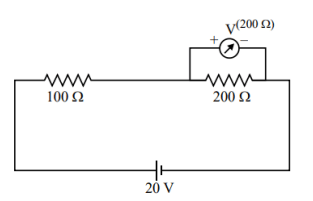
Two resistances of 100 and 200 are connected in series across a 20 V battery as shown in the figure below. The reading in a 200 voltmeter connected across the 200 esistance is _______. Fill in the blank with the correct answer from the options given below
1
4V
2
3
10V
4
16V
Official Solution
Correct Option: (2)
To find the reading on the voltmeter connected across the 200 resistor, we must first calculate the total resistance in the series circuit. The total resistance is given by the sum of the individual resistances:
Using Ohm's Law, the total current flowing through the circuit is calculated as follows:
Now, calculate the voltage drop across the 200 resistor using Ohm's Law:
The voltmeter reading is therefore .
Thus, the correct answer is .
16
PYQ 2024
easy
physicsID: cuet-ug-
The current through a external resistance connected to a parallel combinationof two cells of 2 V and 1 V emf and internal resistances of 1 and 2 respectively is ______. Fill in the blank with the correct answer from the options given below
1
1A
2
3
4
Official Solution
Correct Option: (4)
When two cells are connected in parallel, the effective emf and internal resistance of the combination need to be calculated. Let and , and and . The effective emf of cells in parallel is given by: .
Substituting the given values, .
The effective internal resistance is given by: .
Now we calculate the total resistance : .
The current through the circuit is given by Ohm's Law: .
Thus, the current through the external resistance is .
17
PYQ 2024
medium
physicsID: cuet-ug-
A galvanometer with resistance 100 Ω gives full-scale deflection with a current of 2 mA. The resistance required to convert the galvanometer into an ammeter of range 0 to 20 A is nearly:
1
10 Ω in series
2
10 Ω in parallel
3
10 Ω in parallel
4
10 Ω in series
Official Solution
Correct Option: (2)
To convert a galvanometer into an ammeter, we need to connect a shunt resistor in parallel with the galvanometer. The purpose of this shunt resistor is to allow most of the current (20 A in this case) to bypass the galvanometer, allowing it to measure higher currents without being damaged.
First, we calculate the full-scale voltage across the galvanometer, , using Ohm's Law:
Given and , we find:
Next, to find the shunt resistance, , we use the formula:
Where is the total current through the ammeter:
Thus, the correct resistance required to connect in parallel is approximately to achieve the desired range. Hence, the correct answer is:
10 Ω in parallel
18
PYQ 2024
medium
physicsID: cuet-ug-
A capacitor and a coil with resistance R are in series and connected to a 6 V AC source. By varying the frequency of the source, a maximum current of 600 mA is observed. If the same coil is now connected to a cell of emf 6 V and internal resistance of 2 ohms, the current through it will be:
1
0.6 A
2
0.5 A
3
1.0 A
4
2.0 A
Official Solution
Correct Option: (2)
To solve the problem, we need to first analyze the given conditions and then apply the relevant formulas to find the current through the coil when connected with a cell.
Initially, when the capacitor and coil are in resonance with the AC source, the maximum current occurs at the resonant frequency where the reactance of the coil and capacitor cancel each other out. Thus at resonance, the impedance Z is purely resistive and equal to R.
At this condition:
Given:
Using the formula:
Now, when the same coil is connected to a cell of 6 V with internal resistance 2 ohms, the total resistance in the circuit is given by:
Applying Ohm's Law to find the current , we have:
Thus, the current through the coil when connected with the cell is 0.5 A.
19
PYQ 2024
medium
physicsID: cuet-ug-
In an LCR series circuit, the source of emf is E=30sin(100t), R=120Ω, L=100mH, C=100μF. (A) The numerical value of impedance (B) The numerical value of resistance R (C) The numerical value of capacitive reactance (D) The numerical value of inductive reactance. Arrange the values of quantities mentioned in (A, B, C, D) in increasing order.
1
(A), (B), (C), (D)
2
(A), (C), (B), (D)
3
(D), (C), (B), (A)
4
(B), (A), (D), (C)
Official Solution
Correct Option: (3)
To solve the problem of finding the impedance, resistance, capacitive reactance, and inductive reactance in an LCR series circuit, we follow these steps:
Arranging the values in increasing order: (D), (C), (B), (A).
20
PYQ 2024
medium
physicsID: cuet-ug-
For a series LCR circuit, at the condition of resonance, the value of the power factor will be:
1
Zero
2
1
3
0.2
4
0.5
Official Solution
Correct Option: (2)
In a series LCR circuit, resonance occurs when the inductive reactance equals the capacitive reactance, effectively canceling each other out. At this point, the circuit's impedance is purely resistive. The power factor, which is defined as the cosine of the phase angle between the voltage and current, is given by:
Power Factor
At resonance, the phase difference ϕ is zero because the current and voltage are in phase. This leads to:
Therefore, at the condition of resonance in a series LCR circuit, the value of the power factor is 1.
21
PYQ 2025
easy
physicsID: cuet-ug-
In a circuit, if the resistance is doubled and the voltage is halved, what happens to the current flowing through the circuit?
1
Becomes half
2
Becomes quarter
3
Becomes double
4
Remains same
Official Solution
Correct Option: (2)
Step 1: Recall Ohm’s Law. Let original voltage be , and resistance be , then the original current is: Step 2: Modify the values. New voltage , and new resistance Step 3: Substitute into the current formula.Step 4: Compare with original current. So the new current becomes one-fourth of the original.