Two thin lenses of power +3D and -1D are held in contact with each other. Focal length of the combination would be:
1
5m
2
50cm
3
10m
4
100cm
Official Solution
Correct Option:
(2)
The correct option is (B): 50cm
02
PYQ 2023
medium
physicsID: cuet-ug-
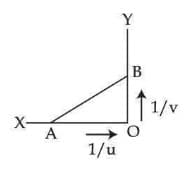
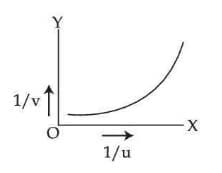
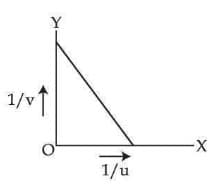
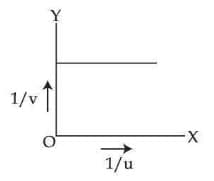
The shape of graph between 1/u and 1/v in case of a convex lens is:
1
2
3
4
Official Solution
Correct Option:
(1)
The correct option is (A):
03
PYQ 2023
medium
physicsID: cuet-ug-
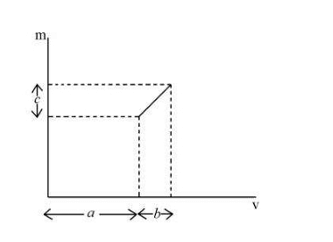
The graph shows the variation of the magnification (m) produced by a thin lens with image distance (v). The focal length of the lens is:
1
2
3
4
Official Solution
Correct Option:
(1)
The given graph shows the relationship between magnification and image distance . From the graph, we observe that the magnification is related to in a manner that can be interpreted in terms of the lens formula: Where is the focal length of the lens, is the image distance, and is the object distance. Using the given relationship between and from the graph, and analyzing the geometry and algebra behind the graph, we can deduce that the focal length of the lens is given by: Thus, the correct answer is .
04
PYQ 2025
medium
physicsID: cuet-ug-
In an experiment with a convex lens, the length of an image is 1 cm, and the object length is 5 cm. If the object is placed at a distance of 40 cm from the lens, then the focal length of the lens is
1
6.67 cm
2
13.5 cm
3
5.6 cm
4
3.6 cm
Official Solution
Correct Option:
(1)
Step 1: Understanding the Concept:
This problem requires using the lens formula and the magnification formula for a convex lens. We can find the image distance using the magnification and then use the lens formula to calculate the focal length.
Step 2: Key Formula or Approach:
1. Magnification, .
2. Lens Formula: .
3. New Cartesian Sign Convention: Light travels from left to right. Distances measured against the incident light are negative. Distances in the direction of light are positive. Object distance is negative.
Step 3: Detailed Explanation: Given data:
Height of object, .
Height of image, .
Object distance, (by sign convention).
Since the image is smaller than the object ( ), the image formed by the convex lens must be real and inverted. Therefore, the image height should be taken as negative.
. Part 1: Calculate the image distance (v).
Using the magnification formula:
Also, .
The positive sign for confirms that a real image is formed on the opposite side of the lens. Part 2: Calculate the focal length (f).
Using the lens formula:
To add the fractions, find a common denominator, which is 40.
Step 4: Final Answer:
The focal length of the lens is 6.67 cm.
05
PYQ 2025
medium
physicsID: cuet-ug-
Which of the following statement(s) is/are correct? (A) The power of a lens is the ability of the lens to converge or diverge the incident rays. (B) S.I unit of the power of a lens is dioptre while focal length is in centimetres (C) For a lens of larger focal length, power is smaller (D) In any combination of lenses, the power of combination is not algebraic addition of power of combined lenses Choose the correct answer from the options given below:
1
(A) and (C) only
2
(B), (C) and (D) only
3
(A) and (B) only
4
(A) only
Official Solution
Correct Option:
(1)
Step 1: Understanding the Concept:
This question tests the definition and properties of the power of a lens. Power is a measure of how much a lens bends light.
Step 2: Detailed Explanation: (A) The power of a lens is the ability of the lens to converge or diverge the incident rays.
This is the correct qualitative definition of lens power. A lens with high power bends light rays more strongly than a lens with low power. This statement is correct. (B) S.I unit of the power of a lens is dioptre while focal length is in centimetres.
The SI unit of power is indeed the dioptre (D). However, power is defined as the reciprocal of the focal length expressed in meters ( ). The statement that the focal length is in centimetres for this definition is incorrect. This statement is incorrect. (C) For a lens of larger focal length, power is smaller.
Since power is inversely proportional to the focal length ( ), a lens with a larger focal length will have a smaller power. This statement is correct. (D) In any combination of lenses, the power of combination is not algebraic addition of power of combined lenses.
For thin lenses placed in contact, the power of the combination is the algebraic sum of the individual powers ( ). The statement claims it is *not* an algebraic addition, which is false for this common configuration. This statement is incorrect.
Step 3: Final Answer:
Only statements (A) and (C) are correct.
06
PYQ 2025
medium
physicsID: cuet-ug-
If focal length of a concave lens is 50 cm, then the power of the lens would be
1
+5 D
2
-5 D
3
+2 D
4
-2 D
Official Solution
Correct Option:
(4)
Step 1: Understanding the Concept:
The power of a lens is a measure of its ability to converge or diverge light rays. It is defined as the reciprocal of the focal length of the lens. The sign convention for focal length is crucial.
Step 2: Key Formula or Approach:
The power of a lens is given by:
where the focal length must be expressed in meters for the power to be in dioptres (D).
By sign convention, a concave lens (diverging lens) has a negative focal length.
Step 3: Detailed Explanation: Given data:
Lens type: Concave lens.
Focal length magnitude = 50 cm.
Step 1: Apply sign convention.
For a concave lens, the focal length is negative.
So, .
Step 2: Convert focal length to meters.
Step 3: Calculate the power.
Step 4: Final Answer:
The power of the concave lens is -2 D.
About Images Formed By Lenses - CUET-UG
Images Formed By Lenses is a vital chapter for CUET-UG aspirants. Mastering the concepts covered in this chapter is essential for securing a top rank.
By rigorously practicing the previous year questions associated with this chapter, you can identify high-yield topics, understand the examiner's perspective, and boost your confidence during the actual exam.
Frequently Asked Questions
Why focus on Images Formed By Lenses PYQs?
Analyzing PYQs for this specific chapter reveals the most frequently tested concepts and the typical complexity of questions, allowing you to tailor your study plan efficiently.
How to best use this analysis?
Review the topic breakdown to see which sub-topics within Images Formed By Lenses carry the most weight. Then, tackle the questions iteratively to solidify your understanding.