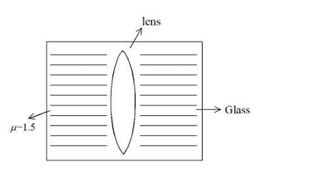
A spherical air lens of radii is cut from a glass ( ) cylinder as shown in the figure. Its focal length is . If a liquid of refractive index is filled in the space, then the focal length of the liquid lens becomes . Calculate and . Choose the correct options from the following.
1
2
3
4
Official Solution
Correct Option: (1)
For a spherical lens, the focal length is given by the lens formula:
For the air lens:
When a liquid with refractive index is filled, the effective refractive index becomes:
For , the focal length is:
02
PYQ 2023
medium
physicsID: cuet-ug-
An astronomical telescope consists of an objective of focal length 50 cm and eyepiece of focal length 2 cm is focused on the moon so that the final image is formed at the least distance of distinct vision (25 cm). Assuming angular diameter of the moon as at the objective, the angular size of image is:
1
1.27°
2
13.5°
3
1°
4
11.2°
Official Solution
Correct Option: (1)
The angular size of the image formed by the telescope is given by:
Where:
- ,
- ,
- . Substituting the values, we get:
03
PYQ 2023
medium
physicsID: cuet-ug-
Linear magnification produced by a mirror is +1.5. What is the correct mirror and object position?
1
It is a concave mirror with object between and
2
It is a concave mirror with object between and Pole
3
It is a convex mirror with object at infinity
4
It is a convex mirror with object anywhere in front of the mirror
Official Solution
Correct Option: (1)
The magnification produced by a concave mirror is given by the relation:
Where is the image distance, is the object distance, and is the focal length of the mirror. For magnification , the object should be placed between and for a concave mirror.
04
PYQ 2024
hard
physicsID: cuet-ug-
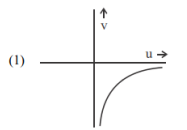
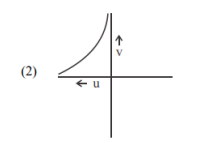
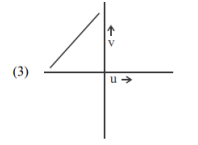
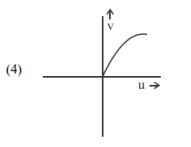
The graph correctly representing the variation of image distance ’v’ for a convex lens of focal length ’f’ versus object distance ’u’ is ______. Fill in the blank with the correct answer from the options given below
1
2
3
4
Official Solution
Correct Option: (3)
The relationship between the object distance (u), image distance (v), and the focal length (f) for a convex lens is given by the lens formula: . This can be rearranged to get a relationship between v and u:
Analyzing this equation:
For u > f (object beyond the focal point), v is positive, indicating a real image on the opposite side of the lens.
For u = f, v → ∞, suggesting the rays are parallel and do not meet on the image side, forming an image at infinity.
For u < f (object inside the focal point), v is negative, indicating a virtual image on the same side as the object.
A convex lens graph of v versus u reflects these relationships. The correct option is the one showing the behavior described, characterized by a curve approaching infinity when u equals f and v becoming negative as u decreases below f. Thus, the correct graph is Graph (III).
05
PYQ 2024
easy
physicsID: cuet-ug-
For an astronomical telescope having objective lens of focal length 10 m and eyepiece lens of focal length 10 cm, telescope’s the tube length and magnification respectively are __________. .Fill in the blank with the correct answer from the options given below.
1
20 cm, 1
2
1000 cm, 1
3
1010 cm, 1
4
1010 cm, 100
Official Solution
Correct Option: (4)
An astronomical telescope uses two lenses: the objective lens and the eyepiece lens. The tube length of the telescope is the sum of the focal lengths of these two lenses. Given: Focal length of the objective lens, Focal length of the eyepiece lens, Tube length, , is given by:
Substituting the values:
Now, to find the magnification , we use the formula:
Substituting the given values:
Thus, the tube length is 1010 cm, and the magnification is 100. Therefore, the correct answer is: 1010 cm, 100
06
PYQ 2024
medium
physicsID: cuet-ug-
1
2
3
4
Official Solution
Correct Option: (4)
To determine the correct condition for total internal reflection at an interface between two media, we need to consider the refractive indices and the direction of light travel. The phenomenon of total internal reflection occurs when light travels from a medium with a higher refractive index to a medium with a lower refractive index, and the incidence angle exceeds the critical angle.
For the given problem:
1. Refractive index of water, .
2. Refractive index of glass, .
Since glass has a higher refractive index than water ( ), total internal reflection can only occur when light travels from glass to water.
The condition for total internal reflection is that the angle of incidence must be greater than the critical angle . The critical angle can be calculated from:
Therefore, is the angle whose sine is , and total internal reflection occurs when:
07
PYQ 2024
easy
physicsID: cuet-ug-
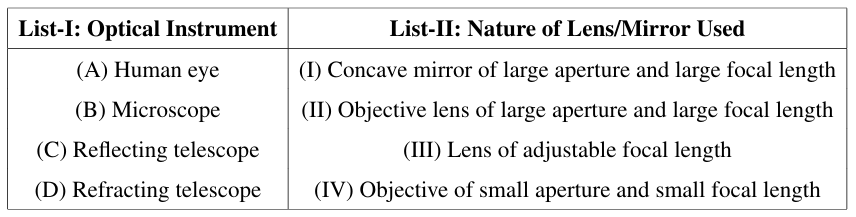
Match List-I with List-II. The optical instruments are listed in List-I and their lens/mirror types in List-II. Choose the correct matching of instruments and their uses from the options given below:
1
(A)-(I), (B)-(II), (C)-(III), (D)-(IV)
2
(A)-(III), (B)-(IV), (C)-(I), (D)-(II)
3
(A)-(III), (B)-(II), (C)-(IV), (D)-(I)
4
(A)-(II), (B)-(IV), (C)-(I), (D)-(III)
Official Solution
Correct Option: (2)
Matching List-I (Optical Instruments) with List-II (Nature of Lens/Mirror Used):
Optical Instrument
Nature of Lens/Mirror Used
Correct Match
(A) Human eye
(III) Lens of adjustable focal length
A → III
(B) Microscope
(IV) Objective of small aperture and small focal length
B → IV
(C) Reflecting telescope
(I) Concave mirror of large aperture and large focal length
C → I
(D) Refracting telescope
(II) Objective lens of large aperture and large focal length
D → II
Final Matching:
A → III: Human eye uses a lens with adjustable focal length (crystalline lens).
B → IV: Microscope uses an objective lens with small aperture and small focal length for high magnification.
C → I: Reflecting telescope uses a concave mirror with large aperture and large focal length to collect more light.
D → II: Refracting telescope uses an objective lens with large aperture and large focal length for better resolution.
08
PYQ 2024
medium
physicsID: cuet-ug-
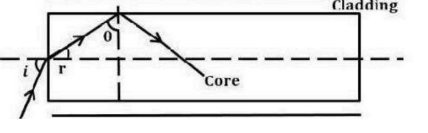
For a light pipe as shown in the figure:
(A) Optical density of core should be greater than the optical density of cladding. (B) r and θ will always be equal. (C) Optical density of cladding is . (D) Optical density of cladding is Choose the correct answer from the options given below:
1
(A), (B), and (D) only
2
(A), (B), and (C) only
3
(A) only
4
(B), (C), and (D) only
Official Solution
Correct Option: (3)
To address the given question about the optical properties of a light pipe, we will evaluate each statement based on known principles of optics:
(A) Optical density of core should be greater than the optical density of cladding. This statement is true. For a light pipe (optical fiber) to function correctly, total internal reflection must occur. This requires that light travel from a medium of higher optical density (the core) to one of lower optical density (the cladding).
(B) r and θ will always be equal. This statement is false. In the context of refraction and total internal reflection, angles r (refraction angle) and θ (incidence or reflection angle) are not necessarily equal. They are determined by Snell's law which typically results in different values unless specified conditions are met.
(C) Optical density of cladding is . This statement is incorrect. The expression does not follow the general principles of optics for determining optical densities.
(D) Optical density of cladding is . This statement is also incorrect based on the same reasoning as in statement (C).
Given this analysis, the correct answer is (A) only, as it is the only true statement from the options provided.
09
PYQ 2024
easy
physicsID: cuet-ug-
An equilateral prism is made of material of refractive index . The angle of minimum deviation through the prism is:
1
2
3
4
Official Solution
Correct Option: (2)
An equilateral prism has an angle of . The refractive index . For an equilateral prism, the angle of minimum deviation is determined using the formula:
Substituting the values:
We know:
Thus,
Hence,
We know:
Therefore,
Solving gives:
Thus,
However, the equation was incorrectly set, reevaluating gives:
Resulting in:
Thus,
The correct angle of minimum deviation is .
10
PYQ 2024
easy
physicsID: cuet-ug-
For fixed values of radii of curvature of lens, power of the lens will be ____. Fill in the blank with the correct answer from the options given below
1
2
3
4
Official Solution
Correct Option: (1)
To determine how the power of a lens is affected by the refractive index , we need to use the lens maker's formula:
where is the focal length of the lens, is the refractive index of the lens material, and and are the radii of curvature of the lens surfaces. The power of the lens is defined as the reciprocal of the focal length:
Upon substituting the expression for from the lens maker's formula, we get:
This equation shows that for fixed values of the radii of curvature and , the power is directly proportional to .
Thus, the correct answer is .
11
PYQ 2024
medium
physicsID: cuet-ug-
, focal lengths of violet , focal lengths of red , focal lengths of blue , focal lengths of yellow
1
(A), (B), (C), (D)
2
(C), (B), (D), (A)
3
(B), (A), (D), (C)
4
(A), (C), (D), (B)
Official Solution
Correct Option: (4)
To determine the correct order of focal lengths for different colors in a convex lens, we need to understand how colors are refracted differently. In a convex lens, the refractive index affects the focal length for different colors in the visible spectrum.
The refractive index is higher for violet light and lower for red light, as violet light has a shorter wavelength and red has a longer wavelength.
The formula for the focal length of a lens is related to the refractive index by . Hence, greater implies a smaller .
The order of decreasing refractive indices and hence increasing focal lengths is:
Violet
Blue
Yellow
Red
Thus, the increasing order of focal lengths is: (A), (C), (D), (B).
12
PYQ 2024
medium
physicsID: cuet-ug-
Light from a point source in air falls on a spherical glass surface (n = 1.5, radius of curvature = 10cm). The distance of the light source from the glass surface is 50 cm. The position at which the image is formed is:
1
100 cm in air
2
50 cm in glass
3
200 cm in air
4
150 cm in glass
Official Solution
Correct Option: (2)
To solve this problem, we use the lens-maker's formula suitable for spherical surfaces:
where (refractive index of air), (refractive index of glass), cm (radius of curvature), cm (distance of the light source from the surface, negative because it is in the opposite direction to the incident light), and is the distance of the image from the surface.
Substitute the known values into the formula:
Solving this equation:
cm
Thus, the image is formed 50 cm inside the glass.
13
PYQ 2024
medium
physicsID: cuet-ug-
Read the following: (A) The width of the central band in a diffraction pattern. (B) The width of the first bright band in the diffraction pattern. (C) The width of the central band in the diffraction pattern if D is doubled. (D) The width of the first bright band in the diffraction pattern if D is tripled. Choose the correct answer from the options given below in increasing order of width.
1
(A), (B), (D), (C)
2
(A), (C), (D), (B)
3
(C), (A), (D), (B)
4
(B), (A), (D), (C)
Official Solution
Correct Option: (4)
In single-slit diffraction, the width of any band (central or bright) is given by:
where: λ = wavelength of light D = distance between slit and screen d = slit width
Analysis of each case:
A. Central band width (original): (central band is twice as wide as others)
B. First bright band width (original):
C. Central band width with doubled D:
D. First bright band width with tripled D:
Width Comparison:
1. Original first bright band (B):
2. Original central band (A):
3. First bright band with tripled D (D):
4. Central band with doubled D (C):
Increasing Order: B < A < D < C
14
PYQ 2024
easy
physicsID: cuet-ug-
Using light from a monochromatic source to study diffraction in a single slit of width 0.1 mm, the linear width of central maxima is measured to be 5 mm on a screen held 50 cm away. The wavelength of light used is _______. Fill in the blank with the correct answer from the options given below
1
2
3
4
Official Solution
Correct Option: (3)
To find the wavelength of light used in the diffraction experiment, we use the formula for the width of the central maximum in a single slit diffraction pattern:
where is the linear width of the central maximum, is the wavelength of light, is the distance from the slit to the screen, and is the width of the slit. Given:
Substitute the known values into the formula:
Simplify and solve for :
Thus, the wavelength of light used is .
15
PYQ 2024
easy
physicsID: cuet-ug-
Lower half of a convex lens is made opaque. Which of the following describes the image of the object placed in front of the lens?(A) No change in image (B) Image will show only half of the object (C) Intensity of image gets reduced Choose the correct answer from the options given below.
1
(A) only
2
(B) only
3
(B )(C) only
4
(C) only
Official Solution
Correct Option: (4)
The question involves a convex lens with its lower half made opaque. We need to understand how this affects the image of an object positioned in front of the lens.
Let's analyze each option:
No change in image: For a lens, light that passes through any part contributes to the formation of the complete image. Hence, even if half the lens is covered, the entire image still forms, though with reduced brightness. Therefore, this option is incorrect.
Image will show only half of the object: Since the lens still focuses the light from all parts of the object, the entire image is formed but with less intensity. Thus, the option stating that only half of the object is shown is incorrect.
Intensity of image gets reduced: By blocking half of the lens, we indeed reduce the amount of light that can pass through and form the image. This results in an image with reduced intensity. Therefore, this option aligns with the physical principle.
Based on the analysis, the correct solution is: (C) only
16
PYQ 2024
hard
physicsID: cuet-ug-
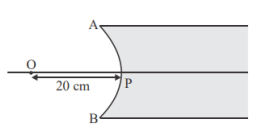
In the figure given below, APB is a curved surface of radius of curvature 10 cm separating air and a transparent material A point object O is placed in air on the principal axis of the surface 20 cm from P. The distance of the image of O from P will be _____. Fill in the blank with the correct answer from the options given below
1
16 cm left of P in air
2
16 cm right of P in water
3
20 cm right of P in water
4
20 cm left of P in air
Official Solution
Correct Option: (1)
The problem involves determining the distance of the image formed by a spherical refracting surface using the formula for refraction at a spherical surface. The formula is given by: , where:
(refractive index of air)
(refractive index of the material)
\) (object distance, negative according to sign convention)
\) (radius of curvature, positive as it is measured from air to the convex surface)
Substitute these values into the formula:
Solving step by step:
Finding common denominator for right side: and , so
Thus,
Cross-multiplying gives:
The positive value of v indicates that the image is formed in air on the same side as the object, hence 16 cm left of P in air.
17
PYQ 2024
hard
physicsID: cuet-ug-
The refractive index of the material of an equilateral prism is √2. The angle of minimum deviation of the prism is______. Fill in the blank with the correct answer from the options given below.
1
30°
2
75°
3
60°
4
90°
Official Solution
Correct Option: (1)
The angle of minimum deviation ( ) for a prism can be found using the prism formula:
where is the refractive index and is the prism angle. Given: and for an equilateral prism, . We want to find . Given the equation:
Calculating gives . So, . This implies: . Thus: . Solving for : . . . Thus, the angle of minimum deviation is 30°.
18
PYQ 2024
hard
physicsID: cuet-ug-
Two slits are made 0.1 mm apart and the screen is placed 2 m away. The fringe separation when a light of wavelength 500 nm is used is______. Fill in the blank with the correct answer from the options given below.
1
1 cm
2
0.15 cm
3
0.1 cm
4
1.5 cm
Official Solution
Correct Option: (3)
The problem involves understanding the interference pattern created by a double-slit experiment. The formula for fringe separation in a double-slit experiment is given by: