The tool of ‘Analysis of Financial Statements’ which indicates the trend and direction of financial position and operating results is:
1
Ratio Analysis
2
Cash Flow Analysis
3
Common Size Statements
4
Comparative Statements
Official Solution
Correct Option: (4)
Comparative Statements show data for two or more periods side-by-side to evaluate trends and changes. They help analyze financial direction over time.
02
PYQ 2025
hard
accountancyID: cbse-cla
Which of the following statements is correct?
1
Proceeds from sale of goods and services will result in cash outflow from operating activities.
2
Payment of dividend will result in cash outflow from investing activities.
3
Sale of machinery will result in cash outflow from investing activities.
4
Payment of employee benefit expenses will result in cash outflow from operating activities.
Official Solution
Correct Option: (4)
Employee expenses are day-to-day operational costs and are classified under Operating Activities. The other options are either incorrect classification or state “outflow” where “inflow” applies.
03
PYQ 2025
hard
accountancyID: cbse-cla
From the following information obtained from the books of KVK Ltd., calculate Net Assets Turnover Ratio and Debt Equity Ratio:
Information Table
Information
Amount (₹)
Preference Share Capital
8,00,000
Equity Share Capital
12,00,000
General Reserve
2,00,000
Balance in Statement of Profit and Loss
6,00,000
15% Debentures
4,00,000
12% Loan
4,00,000
Revenue from Operations
72,00,000
Official Solution
Correct Option: (1)
Net Assets = Equity Share Capital + Reserves + Surplus + Preference Share Capital ⇒ 12,00,000 + 2,00,000 + 6,00,000 + 8,00,000 = 28,00,000
Net Assets Turnover Ratio = Revenue from Operations / Net Assets ⇒ 72,00,000 / 28,00,000 = 2.57 times
Classify the following items under major heads and sub-heads (if any) in the Balance Sheet of the company as per Schedule III, Part I of the Companies Act, 2013:
(a) Prepaid expenses
(b) Capital Work-in-Progress
(c) Interest accrued and due on debentures
Official Solution
Correct Option: (1)
- Prepaid Expenses are short-term prepayments and are classified under Other Current Assets.
- Capital Work-in-Progress is part of fixed asset construction and shown under Non-Current Assets.
- Interest accrued and due on debentures is a liability and comes under Other Current Liabilities.
05
PYQ 2025
medium
accountancyID: cbse-cla
The tool of analysis of financial statements which indicates the trend and direction of financial position and operating results is _______.
1
Comparative Statements
2
Common Size Statements
3
Cash Flow Analysis
4
Ratio Analysis
Official Solution
Correct Option: (1)
The correct answer is (A) Comparative Statements. Explanation: Comparative statements present financial data of two or more periods side by side to show trends and changes over time. This helps analysts and management to identify how the financial position and performance of a business is moving—whether upwards, stable or downwards. It is particularly useful for spotting trends in revenues, expenses, profits, and key balances such as assets and liabilities.
06
PYQ 2025
easy
accountancyID: cbse-cla
Calculate Current Ratio and Quick Ratio from the following:
- Current Assets: Rs 2,50,000
- Inventory: Rs 70,000 - Prepaid Expenses: Rs 10,000 - Current Liabilities: Rs 1,00,000
Official Solution
Correct Option: (1)
Step 1: Calculate Current Ratio
Step 2: Calculate Quick Assets
Step 3: Calculate Quick Ratio
Final Answer:
Current Ratio: 2.5:1 Quick Ratio: 1.7:1
07
PYQ 2026
medium
accountancyID: cbse-cla
From the following information obtained from the books of accounts of Ananda Ltd., calculate 'Quick Ratio' of the company:Total Current Assets (including stock and prepaid expenses) ₹ 2,00,000; Stock ₹ 20,000; Prepaid expenses ₹ 10,000; Current liabilities ₹ 1,70,000.
1
20 : 17
2
1 : 1
3
18 : 17
4
19 : 17
Official Solution
Correct Option: (2)
We need to calculate the Quick Ratio (also known as Acid-Test Ratio or Liquid Ratio) for Ananda Ltd. Step 1: Recall the formula for Quick Ratio. Quick Assets = Current Assets - (Stock + Prepaid Expenses) Quick assets are those current assets that can be converted into cash quickly without much loss. Stock and prepaid expenses are excluded because:
Stock may not be readily convertible into cash
Prepaid expenses cannot be converted into cash at all
Step 2: Calculate Quick Assets. Given:
Total Current Assets = ₹ 2,00,000
Stock = ₹ 20,000
Prepaid Expenses = ₹ 10,000
Step 3: Identify Current Liabilities. Given: Current Liabilities = ₹ 1,70,000 Step 4: Calculate Quick Ratio. In ratio form, 1 : 1 Step 5: Analyze each option.
(A) 20 : 17 = 1.176 : 1 ✗
(B) 1 : 1 = 1 : 1 ✓ Correct
(C) 18 : 17 = 1.058 : 1 ✗
(D) 19 : 17 = 1.117 : 1 ✗
Final Answer: (B) 1 : 1
08
PYQ 2026
medium
accountancyID: cbse-cla
The following information is obtained from the books of Devdutt Ltd. :Working capital - ₹ 4,00,000 Trade Payables - ₹ 50,000 Other Current liabilities - ₹ 1,00,000 Current assets of Devdutt Ltd. are :
1
₹ 2,50,000
2
₹ 4,50,000
3
₹ 5,00,000
4
₹ 5,50,000
Official Solution
Correct Option: (4)
We need to find the Current Assets of Devdutt Ltd. given Working Capital, Trade Payables, and Other Current Liabilities. Step 1: Recall the formula for Working Capital. Step 2: Calculate Total Current Liabilities. Current Liabilities include Trade Payables and Other Current Liabilities.
Step 3: Use the Working Capital formula to find Current Assets. Step 4: Verify. Current Assets = ₹ 5,50,000
Current Liabilities = ₹ 1,50,000
Working Capital = ₹ 5,50,000 - ₹ 1,50,000 = ₹ 4,00,000 ✓ Final Answer: (D) ₹ 5,50,000
09
PYQ 2026
medium
accountancyID: cbse-cla
'Analysis of financial statements is useful and significant to different users.' Which of the following users is concerned with a firm's long-term solvency and survival?
1
Labour unions
2
Trade payables
3
Finance manager
4
Lenders
Official Solution
Correct Option: (4)
We need to identify which user of financial statements is primarily concerned with a firm's long-term solvency and survival. Step 1: Understand the different users of financial statements and their interests.
Labour unions: Interested in the firm's profitability and ability to pay wages, bonuses, and provide job security. They focus on short-term to medium-term viability rather than long-term solvency.
Trade payables (Creditors): Interested in the firm's short-term liquidity and ability to pay amounts due in the near future (usually 30-90 days). They focus on current ratio, quick ratio, etc.
Finance manager: Interested in overall financial health for decision-making, including profitability, efficiency, and both short-term and long-term aspects. However, their concern is internal management.
Lenders (Long-term creditors): Lenders include banks, financial institutions, and debenture holders who have provided long-term loans. They are primarily concerned with the firm's long-term solvency and survival because:
They need assurance that the firm will be able to pay interest regularly
They need assurance that the principal amount will be repaid at maturity
They analyze ratios like debt-equity ratio, interest coverage ratio, and profitability over the long term
Step 2: Match with the given options.
(A) Labour unions: Concerned with wages and job security, not primarily long-term solvency.
(B) Trade payables: Concerned with short-term liquidity, not long-term solvency.
(C) Finance manager: Concerned with overall management, not specifically as an external user.
(D) Lenders: ✓ Correct. Lenders are most concerned with long-term solvency and survival.
Final Answer: (D) Lenders
10
PYQ 2026
medium
accountancyID: cbse-cla
Which of the following is not a feature of Tailored accounting software?
1
Designed specially for large enterprises
2
Requires minimal or no support from system
3
Requires special training before use
4
Needs technical installation efforts
Official Solution
Correct Option: (2)
Concept: Tailored Accounting Software Tailored software is custom-built according to the specific needs of an organization. Analysis of Options: (A) Designed for large enterprises → True feature (custom solutions) (B) Requires minimal support → Not true. Tailored software needs continuous technical support. (C) Requires special training → True (custom interface). (D) Needs technical installation → True (custom deployment). Hence, the correct answer is:
11
PYQ 2026
medium
accountancyID: cbse-cla
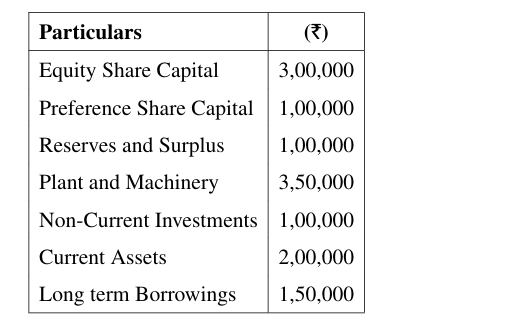
From the following information, calculate 'Proprietary Ratio' and 'Debt-to-Equity Ratio':
Official Solution
Correct Option: (1)
1. Calculation of Proprietary Ratio
Formula:
Proprietary Ratio = Shareholders' Funds / Total Assets
Step 1: Calculation of Shareholders' Funds
Particulars
Amount (₹)
Equity Share Capital
3,00,000
Preference Share Capital
1,00,000
Reserves and Surplus
1,00,000
Shareholders' Funds
5,00,000
Step 2: Calculation of Total Assets
Particulars
Amount (₹)
Plant and Machinery
3,50,000
Non-Current Investments
1,00,000
Current Assets
2,00,000
Total Assets
6,50,000
Step 3: Calculation
Proprietary Ratio = 5,00,000 / 6,50,000
Proprietary Ratio = 0.77 : 1 (approximately)
2. Calculation of Debt-to-Equity Ratio
Formula:
Debt-to-Equity Ratio = Long Term Debts / Shareholders' Funds
A Proprietary Ratio of 0.77 : 1 indicates that 77% of total assets are financed by shareholders’ funds.
A Debt-to-Equity Ratio of 0.30 : 1 shows that for every ₹1 of shareholders’ funds, the company has ₹0.30 of long-term debt. This reflects low financial leverage and a strong equity position.
12
PYQ 2026
medium
accountancyID: cbse-cla
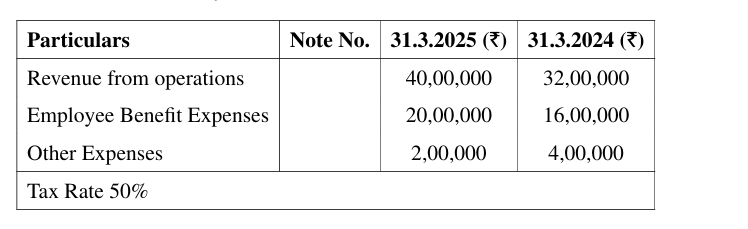
The following information was extracted from the Statement of Profit and Loss of Chaman Ltd. for the year ended 31st March, 2025:Prepare a Comparative Statement of Profit and Loss.
Official Solution
Correct Option: (1)
Chaman Ltd.
Comparative Statement of Profit and Loss
For the Year Ended 31st March, 2024 and 2025
Particulars
2023-24 (₹)
2024-25 (₹)
Absolute Change (₹)
Percentage Change (%)
I. Revenue from Operations
32,00,000
40,00,000
8,00,000
25%
II. Total Revenue
32,00,000
40,00,000
8,00,000
25%
III. Expenses:
Employee Benefit Expenses
16,00,000
20,00,000
4,00,000
25%
Other Expenses
4,00,000
2,00,000
(2,00,000)
(50%)
Total Expenses
20,00,000
22,00,000
2,00,000
10%
IV. Profit before Tax (II – III)
12,00,000
18,00,000
6,00,000
50%
V. Less: Tax @ 50%
6,00,000
9,00,000
3,00,000
50%
VI. Profit after Tax
6,00,000
9,00,000
3,00,000
50%
Working Notes
1. Absolute Change = Current Year − Previous Year
Revenue from Operations = 40,00,000 − 32,00,000 = ₹8,00,000
‘Net Asset Turnover’ ratio of a company is 2 times. State with reason whether the following transactions will increase, decrease or not affect the ratio: Cash sales ₹ 3,00,000 Issue of equity shares ₹ 10,00,000 Issue of 9% debentures ₹ 5,00,000 Credit purchase of goods ₹ 50,000
Official Solution
Correct Option: (1)
We need to analyze the impact of each transaction on the Net Asset Turnover Ratio. Step 1: Understand the formula for Net Asset Turnover Ratio. Where:
Net Sales = Gross Sales - Sales Returns
Net Assets = Total Assets - Current Liabilities (or alternatively, Capital Employed = Shareholders' Funds + Long-term Debts)
Alternatively, Net Assets = Non-Current Assets + Working Capital Step 2: Analyze each transaction. (i) Cash sales ₹ 3,00,000
Cash sales increase Net Sales by ₹ 3,00,000.
Cash sales also increase Cash (Current Asset) by ₹ 3,00,000, so Net Assets increase by ₹ 3,00,000.
Effect on Ratio:
Numerator (Net Sales) increases
Denominator (Net Assets) also increases
Percentage increase in numerator vs denominator? If initial Net Sales and Net Assets are in proportion (ratio 2:1), then:
Suppose initial Net Sales = 2x, Net Assets = x
New Net Sales = 2x + 3,00,000
New Net Assets = x + 3,00,000
New Ratio = (2x + 3,00,000)/(x + 3,00,000)
Compare with 2 = 2x/x
If x>3,00,000, the new ratio& Lt;2; if x& Lt;3,00,000, new ratio>2
Since we don't know x, but generally sales are revenue items and assets increase by same amount, the ratio may decrease slightly because the incremental ratio (1) is less than the existing ratio (2)
Reason: Both numerator and denominator increase by the same amount, but since the existing ratio is >1, the addition of equal amounts will decrease the ratio.
Effect: Decrease
(ii) Issue of equity shares ₹ 10,00,000
Issue of shares increases Shareholders' Funds, hence Net Assets increase by ₹ 10,00,000.
Net Sales are not affected by this transaction.
Numerator (Net Sales) remains unchanged.
Denominator (Net Assets) increases.
Therefore, the ratio decreases.
Effect: Decrease
(iii) Issue of 9% debentures ₹ 5,00,000
Issue of debentures increases Long-term Debts, hence Net Assets increase by ₹ 5,00,000 (since Net Assets = Shareholders' Funds + Long-term Debts).
Net Sales are not affected.
Numerator unchanged, Denominator increases.
Therefore, the ratio decreases.
Effect: Decrease
(iv) Credit purchase of goods ₹ 50,000
Credit purchase of goods increases Inventory (Current Asset) by ₹ 50,000 and also increases Trade Payables (Current Liability) by ₹ 50,000.
Net Assets = Total Assets - Current Liabilities
Total Assets increase by ₹ 50,000 (Inventory)
Current Liabilities increase by ₹ 50,000 (Trade Payables)
Net Assets = (Assets↑ by 50,000) - (Liabilities↑ by 50,000) = No change
Net Sales are not affected (purchase is not sales).