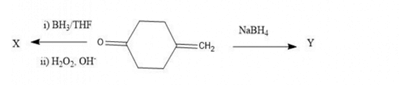
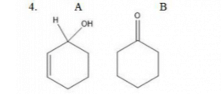
In this reaction, reacts with X (a carbonyl group) to reduce the carbonyl group to a secondary alcohol. Then, further reaction with and converts the alcohol group to a hydroxy group, leading to the product Y.
02
PYQ 2024
medium
chemistryID: cuet-pg-
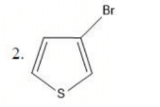
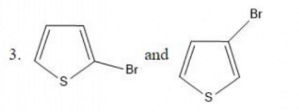
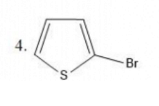
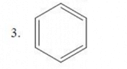
Which one is not an electrophile?
1
2
3
4
Official Solution
Correct Option: (4)
An electrophile is a species that accepts an electron pair. is not an electrophile as it has no vacant orbital for accepting electron pairs.
03
PYQ 2024
medium
chemistryID: cuet-pg-
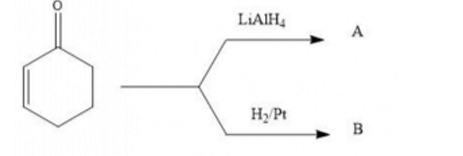
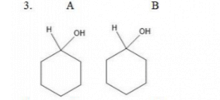
In the following reaction, identify the product A and B:
1
2
3
4
Official Solution
Correct Option: (1)
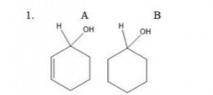
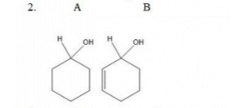
The reaction involves the reduction of cyclohexanone using , which reduces the carbonyl group to a hydroxyl group, resulting in compound A. The hydrogenation of A with reduces the double bond, forming compound B, a cyclohexane derivative.
04
PYQ 2024
medium
chemistryID: cuet-pg-
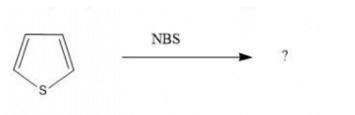
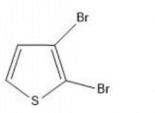
Identify the product in the following chemical reaction:
1
2
3
4
Official Solution
Correct Option: (4)
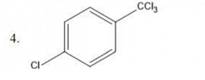
The reaction involves electrophilic substitution, resulting in the correct product shown in Option 4.
05
PYQ 2024
medium
chemistryID: cuet-pg-
Consider the following statements: (A). 1,2-addition reaction occurs faster as compared to 1,4-addition reaction but the 1,4- addition product is more stable. (B). Formation of 1,2-addition product is kinetic or rate-controlled. (C). Formation of 1,4-addition product is thermodynamic or equilibrium controlled. (D). At low temperature, the formation of the 1,2-addition product from allyl cation is a reversible reaction. Choose the correct answer from the options given below:
1
(A), (B), and (D) only.
2
(A), (B), and (C) only
3
(A), (B), (C), and (D)
4
(B), (C), and (D) only
Official Solution
Correct Option: (2)
The 1,2-addition product forms faster and is a kinetic product, while the 1,4-addition product is more stable and is the thermodynamic product. The reaction is reversible at low temperature, and the 1,2-addition product is controlled by the rate.
06
PYQ 2024
medium
chemistryID: cuet-pg-
In SN1 and SN2 reactions: (A). SN1 is a unimolecular reaction with first-order kinetics, while SN2 is a bimolecular reaction with second-order kinetics. (B). In SN2, the reaction proceeds through the formation of a carbocation, while SN1 does not. (C). SN2 is a stereospecific reaction. The product forms with inversion of configuration only. (D). SN1 reaction is favored in the presence of a weak base or poor nucleophile. Choose the correct answer from the options given below:
1
(A), (B), and (D) only.
2
(A), (B), and (C) only.
3
(A), (C), and (D) only.
4
(B), (C), and (D) only.
Official Solution
Correct Option: (3)
reactions are unimolecular with first-order kinetics, while reactions are bimolecular.
reactions occur with inversion of configuration, while reactions do not involve the formation of a carbocation.
reactions are favored by poor nucleophiles.
07
PYQ 2024
medium
chemistryID: cuet-pg-
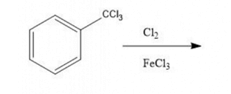
Find the major product in the following reaction:
1
2
3
4
Official Solution
Correct Option: (2)
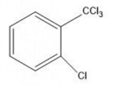
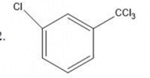
The reaction involves a chlorination of the given compound in the presence of , which is a Lewis acid. In this reaction, the generated from the reagent will attack the aromatic ring. The chlorine atom will substitute the position of the hydrogen atom in a regioselective manner. The position where chlorine attaches is primarily influenced by the electron-withdrawing effect of the group, making the ortho and para positions more reactive.
08
PYQ 2025
medium
chemistryID: cuet-pg-
Consider the following statements with respect to citral: Choose the correct answer from the options given below:
1
(A), (B) and (D) only
2
(C) and (D) only
3
(A) and (C) only
4
(C) only
Official Solution
Correct Option: (1)
Step 1: Geranial and Neral. Geranial and Neral are indeed geometrical isomers of citral, as they differ only in the orientation of the double bond at the aldehyde group. Hence, statement (A) is correct.
Step 2: Formation of Geranic acid. Citral, on heating with potassium hydrogen sulfate, undergoes dehydration to form geranic acid, so statement (B) is also correct.
Step 3: Formation of 6-methylhept-5-en-2-one. Citral does not form 6-methylhept-5-en-2-one when treated with potassium carbonate, making statement (C) incorrect.
Step 4: Oxidation to Laevolic acid. On oxidation with silver oxide, citral undergoes cleavage to form Laevolic acid, making statement (D) correct.
Final Answer:
09
PYQ 2025
medium
chemistryID: cuet-pg-
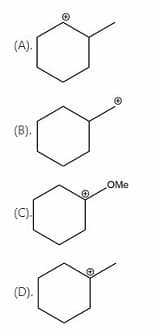
Arrange the following set of carbocations in order of decreasing stability.
Choose the correct answer from the options given below:
1
(C), (A), (D), (B)
2
(D), (A), (C), (B)
3
(B), (A), (D), (C)
4
(C), (B), (D), (A)
Official Solution
Correct Option: (1)
Step 1: Carbocation Stability.
The stability of a carbocation increases with the degree of alkyl substitution and resonance stabilization. The most stable carbocation is the one with the highest resonance stabilization.
Step 2: Analysis of Options.
- (C) - is the most stable due to resonance stabilization with the aromatic ring. - (A) - is slightly less stable than (C) because the methyl group in (C) offers more stabilization. - (D) - has less resonance stabilization. - (B) - is the least stable.
Step 3: Conclusion. Thus, the correct order of decreasing stability is (C), (A), (D), (B).
Final Answer:
10
PYQ 2026
medium
chemistryID: cuet-pg-
The number of total valence electrons in the following complex is
Official Solution
Correct Option: (1)
Step 1: Understanding the Concept:
The 18-electron rule is evaluated by counting valence electrons from the metal and those donated by ligands. Step 2: Detailed Explanation:
Using the neutral atom counting method:
- Osmium (Os): Group 8 element 8e.
- Nitrido (N): Terminal triply bonded ligand 3e.
- Bromine ( ): 2 halogen atoms .
- Phosphine ( ): Neutral 2-electron donor 2e.
- Amido ( ): Radical amido ligand 1e.
- Negative charge: Adds 1e.
Total = electrons. Step 3: Final Answer:
The total valence electron count is 17.
11
PYQ 2026
medium
chemistryID: cuet-pg-
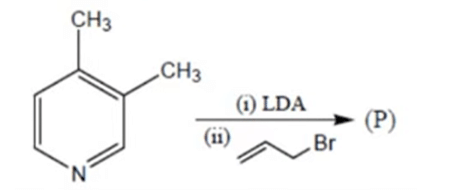
The major product P is
Official Solution
Correct Option: (1)
Step 1: Understanding the Concept:
The acidity of alkyl groups on a pyridine ring depends on the position relative to the nitrogen atom. Benzylic-type carbanions at the 2- ( ) and 4- ( ) positions are stabilized by resonance involving the electronegative nitrogen. Step 2: Key Formula or Approach:
Acidity order of methyl groups in pyridines: .
LDA (Lithium diisopropylamide) is a strong, hindered base used for kinetic deprotonation. Step 3: Detailed Explanation:
1. Deprotonation: In 3,4-dimethylpyridine, the methyl group at the 4-position ( ) is significantly more acidic than the one at the 3-position ( ). This is because the negative charge on the 4-picolyl carbanion can be delocalized directly onto the nitrogen atom, whereas the 3-picolyl carbanion cannot.
2. Reaction with LDA: LDA selectively removes a proton from the more acidic C4-methyl group to form a stabilized organolithium intermediate.
3. Alkylation: This nucleophilic carbanion then attacks allyl bromide ( ) via an mechanism, attaching the allyl group to the C4 position. Step 4: Final Answer:
The product P is 3-methyl-4-(but-3-enyl)pyridine.