CUET-PG SERIES
Chemistry

Organic Reactions

11 previous year questions.

Volume: 11 Ques
Yield: Medium

High-Yield Trend

11
2025

Chapter Questions
11 MCQs

01
PYQ 2025
hard
chemistry ID: cuet-pg-

Which of the following amino compound(s) CANNOT be prepared by Gabriel phthalimide synthesis?

(A) n-Butylamine
(B) Alanine
(C) Aniline
(D) t-Butylamine
Choose the correct answer from the options given below:

1
(B) and (D) only
2
(C) and (D) only
3
(A) and (B) only
4
(B), (C) and (D) only
02
PYQ 2025
medium
chemistry ID: cuet-pg-

The major product (P) in the following transformation is: 
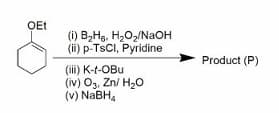
1
Hexane-1,6-diol
2
1,6-Dihydroxyhexan-2-one
3
Hexane-1,2,6-triol
4
2-Ethoxyhexane-1,6-diol
03
PYQ 2025
medium
chemistry ID: cuet-pg-
Which of the following compound is not formed during Kolbe's electrolysis of ethyl propionate?
1
n-Butane
2
Ethane
3
Ethylene
4
n-Propane
04
PYQ 2025
medium
chemistry ID: cuet-pg-

The final product (D) in the above sequential reaction is: 
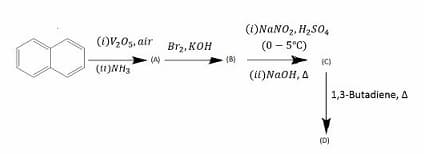
1
1
2
2
3
3
4
4
05
PYQ 2025
medium
chemistry ID: cuet-pg-
Match List-I with List-II: Choose the correct answer from the options given below:
1
(A) - (I), (B) - (II), (C) - (III), (D) - (IV)
2
(A) - (I), (B) - (III), (C) - (IV), (D) - (II)
3
(A) - (I), (B) - (II), (C) - (IV), (D) - (III)
4
(A) - (III), (B) - (IV), (C) - (I), (D) - (II)
06
PYQ 2025
medium
chemistry ID: cuet-pg-
The following transformation is carried out by: \includegraphics[width=0.5\textwidth]{08.jpeg} Choose the correct answer from the options given below:
1
(i) Cyclic polymerization, (ii) Gatterman-Koch's reaction, (iii) Bischler-Napieralski's reaction
2
(i) Cycloaddition, (ii) Etard's reaction, (iii) Pomeranz-Fritsch's reaction
3
(i) Cyclic polymerization, (ii) Etard's reaction, (iii) Doebner-Miller's synthesis
4
(i) Cyclic polymerization, (ii) Gatterman-Koch's reaction, (iii) Pomeranz-Fritsch's reaction
07
PYQ 2025
medium
chemistry ID: cuet-pg-
Consider the following statements with respect to Benzil-Benzylic acid rearrangement and Cannizzaro's reaction: Choose the correct answer from the options given below:
1
(A) and (B) only
2
(A), (B) and (D) only
3
(A) and (D) only
4
(B), (C) and (D) only
08
PYQ 2025
medium
chemistry ID: cuet-pg-
Arrange the following compounds in decreasing order of their rates of hydrolysis with water. (A) Acetamide
(B) Acetyl chloride
(C) Ethyl acetate
(D) Acetic anhydride
Choose the correct answer from the options given below:
1
(A), (C), (D), (B)
2
(A), (B) and (D) only
3
(A), (C) only
4
(B), (D), (A), (C)
09
PYQ 2025
medium
chemistry ID: cuet-pg-

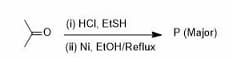
The reaction is carried out by: 

1
Diethyldimethyl mercaptol
2
Propane
3
2-Methylbutan-2-ol
4
Propan-2-thiol
10
PYQ 2025
medium
chemistry ID: cuet-pg-
Which correct sequence of reactions are applied to achieve the following transformation? Choose the correct sequence of reactions from the options given below:
1
Bouveault-Blanc's reduction followed by Kolbe-Schmidt's reaction
2
Rosenmund's reduction followed by Claisen-Schmidt's reaction
3
Bouveault-Blanc's reduction followed by Claisen-Schmidt's reaction
4
Rosenmund's reduction followed by Perkin's reaction
11
PYQ 2025
medium
chemistry ID: cuet-pg-

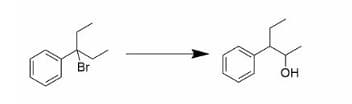
Above conversion is carried out using: 

1
(I) KOH (alc.), (II) oxymurcuration-demercuration
2
(I) KOH (aq.), (II) Conc. H SO
3
(I) KOH (alc.), (II) Hydroboration-oxidation
4
(I) Nucleophilic addition-elimination, (II) oxymurcuration-demercuration

About Organic Reactions - CUET-PG

Organic Reactions is a vital chapter for CUET-PG aspirants. Mastering the concepts covered in this chapter is essential for securing a top rank.

By rigorously practicing the previous year questions associated with this chapter, you can identify high-yield topics, understand the examiner's perspective, and boost your confidence during the actual exam.

Frequently Asked Questions

Why focus on Organic Reactions PYQs?

Analyzing PYQs for this specific chapter reveals the most frequently tested concepts and the typical complexity of questions, allowing you to tailor your study plan efficiently.

How to best use this analysis?

Review the topic breakdown to see which sub-topics within Organic Reactions carry the most weight. Then, tackle the questions iteratively to solidify your understanding.