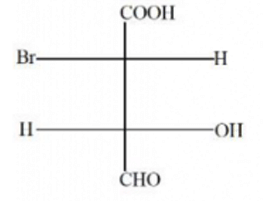
Assign the R and S configuration to the following molecule. Choose the correct answer from the options given below:
1
2S, 3R
2
2R, 3S
3
2S, 3S
4
2R, 3R
Official Solution
Correct Option: (1)
To assign the R and S configuration, we must follow the Cahn-Ingold-Prelog rules, assigning priorities based on atomic number and ensuring the lowest priority group is in the back.
02
PYQ 2024
medium
chemistryID: cuet-pg-
The correct order of the stability of different conformations of cyclohexane is: (A). chair (B). boat (C). twist boat (D). half chair Choose the correct answer from the options given below:
1
(A) > (B) > (C) > (D)
2
(A) > (C) > (B) > (D)
3
(A) > (D) > (C) > (B)
4
(D) > (C) > (B) > (A)
Official Solution
Correct Option: (2)
The correct order of stability for cyclohexane conformations is as follows:
The chair conformation (A) is the most stable because it minimizes both steric and torsional strain.
The twist boat conformation (C) is more stable than the boat conformation because it reduces some of the steric strain.
The boat conformation (B) is less stable due to its "flagpole" interactions, which cause steric strain.
The half-chair conformation (D) is the least stable, as it suffers from the highest steric and torsional strain.
03
PYQ 2025
medium
chemistryID: cuet-pg-
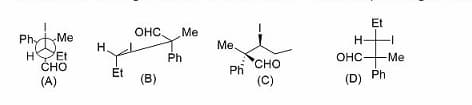
Which of the following is true for the stereochemical relationship of the given structures (A-D)?
1
(A) and (C) are homomers
2
(B) and (C) are enantiomers
3
(B) and (D) are homomers
4
(A) and (D) are diastereomers
Official Solution
Correct Option: (4)
Step 1: Analysis of Stereochemistry. The structures (A) and (D) are non-mirror image stereoisomers that differ in the spatial arrangement of groups around a chiral center. This makes them diastereomers.
Step 2: Conclusion. Thus, option (4) is correct, as (A) and (D) are diastereomers, while the other options do not represent accurate stereochemical relationships.
Final Answer:
04
PYQ 2026
medium
chemistryID: cuet-pg-
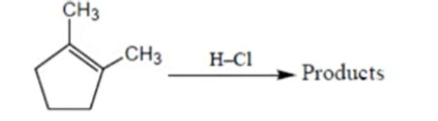
Consider the following reaction The number of stereoisomer(s) formed during this reaction will be
Official Solution
Correct Option: (1)
Step 1: Understanding the Concept:
Electrophilic addition of HCl to an alkene proceeds via a carbocation intermediate, following Markovnikov's rule. Step 2: Detailed Explanation:
1. Mechanism: Protonation of the double bond gives a stable tertiary carbocation at one of the ring carbons.
2. Product: Chloride ion then attacks the carbocation, yielding 1-chloro-1,2-dimethylcyclopentane.
3. Stereocenters: The product has two chiral carbons: C1 (bonded to Cl, Me, C2, C5) and C2 (bonded to H, Me, C1, C3).
4. Counting Isomers: With 2 chiral centers and no plane of symmetry (due to Cl vs H at the two sites), the total number of stereoisomers is . These comprise two pairs of enantiomers (RR/SS and RS/SR). Step 3: Final Answer:
The number of stereoisomers formed is 4.