For irrotational flow, the vorticity ( ) must be zero: In three-dimensional flow, this condition implies that each component of vorticity must vanish. For the specific component: Thus, for irrotational flow:
02
PYQ 2024
medium
water-engineering-and-managementID: cuet-pg-
The gauge pressure at the surface of a liquid of density is . If the atmospheric pressure is , calculate the absolute pressure at a depth of .
1
5.8145 bar
2
2.5245 bar
3
7.3242 bar
4
4.3647 bar
Official Solution
Correct Option: (1)
The absolute pressure is calculated as:
where: , , , , . Substitute the values:
Convert to bar:
03
PYQ 2024
medium
water-engineering-and-managementID: cuet-pg-
In a static fluid with as the vertical direction, the pressure variation is given by:
1
2
3
4
Official Solution
Correct Option: (4)
In a static fluid, the pressure variation is governed by the equation:
where: is the pressure, is the vertical direction, is the specific weight of the fluid , sign indicates that pressure decreases as we move upward. The specific weight is the product of the fluid density and gravitational acceleration , so the pressure variation depends on both.
04
PYQ 2024
medium
water-engineering-and-managementID: cuet-pg-
1 Stoke is equal to:
1
2
3
4
Official Solution
Correct Option: (1)
1 Stoke is a unit of kinematic viscosity, commonly used in fluid mechanics. It is defined as: This unit is based on the centimeter-gram-second (CGS) system.
05
PYQ 2024
medium
water-engineering-and-managementID: cuet-pg-
What will be the maximum capillary rise for a tube having an internal diameter of mm, when it is held vertical with the bottom end dipped in pure water taken in a trough? Consider the temperature of water to be C, the value of surface tension ( ) is kN/m, and kN/m3.
1
0.2974 m
2
0.3867 m
3
0.5671 m
4
0.6782 m
Official Solution
Correct Option: (1)
The capillary rise ( ) is calculated using the formula:
where: (surface tension), (unit weight of water), (diameter of the tube). Substitute the values:
06
PYQ 2025
medium
water-engineering-and-managementID: cuet-pg-
An open channel of symmetric right-angled triangular cross-section is conveying a discharge . If is the acceleration due to gravity, what is the critical depth for this channel?
1
2
3
4
Official Solution
Correct Option: (1)
The formula for critical depth in an open channel with a triangular cross-section is given by: Where: - = discharge - = acceleration due to gravity This formula is derived from the specific energy considerations of open channel flow. Final Answer:
07
PYQ 2025
medium
water-engineering-and-managementID: cuet-pg-
The sequent ratio in a hydraulic jump formed in a horizontal rectangular channel is 16.48. The Froude number of the Supercritical stream is:
1
4.0
2
3.0
3
12.0
4
14.0
Official Solution
Correct Option: (1)
The sequent depth ratio for a hydraulic jump is related to the Froude number of the supercritical flow by the equation: Given:
Using the sequent ratio equation and solving for , we get: Final Answer:
08
PYQ 2025
medium
water-engineering-and-managementID: cuet-pg-
Which one of the following condition is a typical characteristics of critical flow? (Symbols have their usual meaning)
1
2
3
4
Official Solution
Correct Option: (2)
The equation for critical flow is given by:
This equation represents the condition for the critical flow in an open channel where: - = discharge - = cross-sectional area - = acceleration due to gravity When this equation holds true, the flow is considered to be critical. Final Answer:
09
PYQ 2025
medium
water-engineering-and-managementID: cuet-pg-
Match List-I with List-II
1
(A) - (I), (B) - (II), (C) - (IV), (D) - (III)
2
(A) - (I), (B) - (III), (C) - (II), (D) - (IV)
3
(A) - (I), (B) - (III), (C) - (II), (D) - (V)
4
(A) - (III), (B) - (IV), (C) - (I), (D) - (II)
Official Solution
Correct Option: (1)
Step 1: Understanding the Dimensionless Numbers and Forces. - (A) Euler's number: Euler's number is often used in fluid mechanics to describe the behavior of fluid flows under certain conditions, but it is not directly associated with any particular force type.
- (B) Froude's number: The Froude number is a dimensionless number used to describe the influence of gravity forces in fluid flow.
- (C) Mach number: The Mach number compares the speed of an object to the speed of sound in the surrounding medium. It is often associated with compressibility effects.
- (D) Weber number: The Weber number relates to the ratio of inertial forces to surface tension forces in fluid dynamics. Step 2: Matching the Forces. - (A) Euler's number: Matches with (I) Pressure force. - (B) Froude's number: Matches with (II) Gravity force. - (C) Mach number: Matches with (IV) Compressibility force. - (D) Weber number: Matches with (III) Surface Tension. Step 3: Conclusion. The correct matching is (1) (A) - (I), (B) - (II), (C) - (IV), (D) - (III).
10
PYQ 2025
medium
water-engineering-and-managementID: cuet-pg-
Dynamic viscosity of a fluid is 2.2 poise and specific gravity is 0.7. Then kinematic viscosity in SI units is:
1
2
3
4
Official Solution
Correct Option: (1)
Step 1: Formula for Kinematic Viscosity. The kinematic viscosity is given by the formula:
Where: - is the kinematic viscosity (in ) - is the dynamic viscosity (in or poise) - is the density (in ) Step 2: Converting units. - The given dynamic viscosity poise. - , so:
- The specific gravity , and density . Step 3: Calculating Kinematic Viscosity. Using the formula for kinematic viscosity: Step 4: Conclusion. Therefore, the correct kinematic viscosity is , and the correct answer is (1).
11
PYQ 2025
medium
water-engineering-and-managementID: cuet-pg-
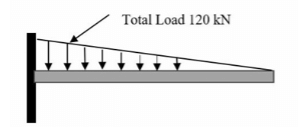
What are the support reactions at the fixed end of the cantilever beam of 3 m length as shown in the diagram below?
1
120 kN, 120 kN-m
2
120 kN, 240 kN-m
3
240 kN, 120 kN-m
4
120 kN, 60 kN-m
Official Solution
Correct Option: (2)
Step 1: Understanding the Problem. The beam is subjected to a uniformly distributed load of 120 kN. The length of the cantilever beam is 3 m. To find the support reactions, we need to calculate the vertical reaction and the moment at the fixed en(D) Step 2: Calculating the Vertical Reaction. The total vertical load on the beam is given as 120 kN. Since the beam is in static equilibrium, the vertical reaction at the fixed support must equal the total load: Step 3: Calculating the Moment Reaction. The moment reaction at the fixed end can be found by considering the moment equilibrium about the fixed en(D) For a uniformly distributed load, the moment at the fixed end is calculated as: The load is uniformly distributed over the beam, so the centroid of the load is at the midpoint of the beam, which is at 1.5 m. Thus, the moment at the fixed end is: Step 4: Conclusion. Thus, the support reactions at the fixed end are 120 kN vertical and 180 kN-m moment. Therefore, the correct answer is option (2).
Final Answer:
12
PYQ 2025
medium
water-engineering-and-managementID: cuet-pg-
A beam of triangular cross-section is subjected to a shear force of 50kN. The base width of the section is 250 mm and the height is 200 mm. The beam is placed with its base horizontal. The shear stress at the neutral axis will be nearly-
1
1.2 N/mm
2
3.2 N/mm
3
3.7 N/mm
4
2.4 N/mm
Official Solution
Correct Option: (2)
Step 1: Understanding Shear Stress Calculation. The formula for shear stress ( ) at the neutral axis in a beam is given by: Where:
- = Shear force = 50 kN = 50,000 N
- = Area of cross-section The triangular cross-section area is: Converting area to m , we get: Step 2: Calculating Shear Stress. Now, we calculate the shear stress: Step 3: Conclusion. Therefore, the shear stress at the neutral axis is 3.2 N/mm , making option (2) the correct answer.
Final Answer:
13
PYQ 2025
medium
water-engineering-and-managementID: cuet-pg-
The failure theory which is the most conservative for ductile materials is
1
Maximum principal stress theory
2
Maximum shear stress theory
3
Maximum shear strain energy theory
4
Maximum principal strain theory
Official Solution
Correct Option: (1)
Step 1: Understanding the Failure Theories. The maximum principal stress theory is considered the most conservative failure theory for ductile materials. This theory assumes that failure occurs when the maximum principal stress reaches the material's ultimate tensile strength. Step 2: Conclusion. Thus, the most conservative failure theory for ductile materials is the maximum principal stress theory, making option (1) the correct answer.
Final Answer:
14
PYQ 2025
medium
water-engineering-and-managementID: cuet-pg-
Match List-I with List-II
1
(A) - (I), (B) - (IV), (C) - (III), (D) - (II)
2
(A) - (IV), (B) - (II), (C) - (III), (D) - (I)
3
(A) - (III), (B) - (III), (C) - (II), (D) - (IV)
4
(A) - (II), (B) - (IV), (C) - (I), (D) - (II)
Official Solution
Correct Option: (1)
Step 1: Understanding the fluids and their characteristics. - (A) Newtonian fluid: A fluid where the relationship between shear stress and velocity gradient is linear, with constant viscosity, and a zero velocity gradient at no flow.
- (B) Non-Newtonian fluid: The relationship between shear stress and velocity gradient is non-linear, and they have a definite yield stress.
- (C) Ideal Fluid: This fluid is assumed to have a linear relationship between shear stress and velocity gradient, but is an idealized concept.
- (D) Ideal Plastic: For this fluid, the relationship is non-linear, with a definite yield stress. Step 2: Matching the relationships. - (A) Newtonian fluid: Matches with (I) Zero velocity gradient (because at no flow, the velocity gradient is zero). - (B) Non-Newtonian fluid: Matches with (IV) Non-linear relationship. - (C) Ideal Fluid: Matches with (III) Linear relationship. - (D) Ideal Plastic: Matches with (II) Non-linear with definite yield stress. Step 3: Conclusion. Therefore, the correct matching is (1) (A) - (I), (B) - (IV), (C) - (III), (D) - (II).