Which of the following genetic disorder is not a type of mendelian disorder?
1
colour blindness
2
Down's syndrome
3
Haemophilia
4
Thalassaemia
Official Solution
Correct Option:
(2)
The correct option is (B) : Down's syndrome
02
PYQ 2023
medium
biologyID: cuet-ug-
Identify the regions of the transcription unit Promoter Sigma Factor Terminator The structural gene Choose the correct answer from the option given below
1
(A), (B) and (D) only
2
(A), (B) and (C) only
3
(A), (C) and (D) only
4
(D), (C) and (D) only
Official Solution
Correct Option:
(3)
The correct option is (C) : (A), (C) and (D) only
03
PYQ 2023
medium
biologyID: cuet-ug-
Identify the enzyme used for the isolation of genetic from fungal cells.
1
Lysozyme
2
Pepsin
3
Cellulase
4
Chitinase
Official Solution
Correct Option:
(4)
The correct option is (D) : Chitinase
04
PYQ 2023
medium
biologyID: cuet-ug-
Match List I with List - II.
LIST I
LIST II
A
Down's syndrome
I
44+XX/XY
B
Klinefelter's syndrome
II
44+XO
C
Turner's syndrome
III
44+ XXY
D
Normal human
IV
45+XX/XY
Choose the correct answer from the options given below
1
(A)-(I), (B)-(III), (C)-(II), (D)-(IV)
2
(A)-(II), (B)-(IV), (C)-(III), (D)-(I)
3
(A)-(IV), (B)-(III), (C)-(II), (D)-(I)
4
(A)-(III), (B)-(II), (C)-(IV), (D)-(I)
Official Solution
Correct Option:
(3)
The correct option is (C) : (A)-(IV), (B)-(III), (C)-(II), (D)-(I)
05
PYQ 2024
hard
biologyID: cuet-ug-
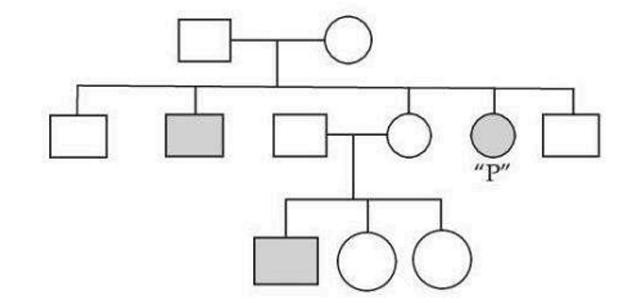
In the given pedigree chart, ‘P’ is a female suffering from a disease, which is denoted by ‘A’ (dominant allele) and ‘a’ (recessive allele). Find the genotype of ‘P’.
1
AA
2
XAX
3
XAXA
4
aa
Official Solution
Correct Option:
(4)
In a pedigree chart analysis, we need to determine the genotype of 'P', who is a female showing a disease. The disease present in ‘P’ is denoted by a recessive allele 'a'. To deduce the genotype of 'P', we consider the following points:
Inheritance Pattern: A disease caused by a recessive allele will only manifest in an individual if they have two copies of the allele, i.e., they are homozygous recessive ('aa').
Pedigree Analysis: Since 'P' is suffering from the disease, she must be homozygous for the recessive allele. This means 'P' can only have the genotype 'aa'.
Conclusion: As the disease is present in 'P' and is determined by a recessive allele, her genotype is inevitably 'aa'.
Therefore, the correct genotype of 'P', given that she is affected by the recessive disease, is aa.
06
PYQ 2024
medium
biologyID: cuet-ug-
Match List-I with List-II:
List-I
List-II
(A) Thalassemia
(I) 47, XXY
(B) Klinefelter’s syndrome
(II) Sex-linked recessive disorder
(C) Turner’s syndrome
(III) 45, XO
(D) Colour blindness
(IV) Autosomal recessive disease
1
(A)-(IV), (B)-(II), (C)-(I), (D)-(III)
2
(A)-(II), (B)-(I), (C)-(III), (D)-(IV)
3
(A)-(II), (B)-(IV), (C)-(III), (D)-(I)
4
(A)-(IV), (B)-(I), (C)-(III), (D)-(II)
Official Solution
Correct Option:
(4)
To correctly match List-I with List-II, we need to understand the characteristics of each term:
Thalassemia: This is an autosomal recessive disease caused by mutations affecting hemoglobin synthesis, leading to anemia.
Klinefelter’s syndrome: This genetic condition in males is due to the presence of an extra X chromosome, resulting in a karyotype of 47, XXY.
Turner’s syndrome: A chromosomal disorder where a female is missing part of or an entire X chromosome, leading to a 45, XO karyotype.
Colour blindness: A sex-linked recessive disorder typically affecting the ability to perceive certain colors correctly, most commonly red-green color blindness.
Using these descriptions, the correct matches are:
List-I
List-II
(A) Thalassemia
(IV) Autosomal recessive disease
(B) Klinefelter’s syndrome
(I) 47, XXY
(C) Turner’s syndrome
(III) 45, XO
(D) Colour blindness
(II) Sex-linked recessive disorder
The correct answer is: (A)-(IV), (B)-(I), (C)-(III), (D)-(II)
07
PYQ 2024
medium
biologyID: cuet-ug-
Of the following statements, which is/are correct? (A) During incomplete dominance, the modified allele is the dominant allele (B) In polygenic inheritance, the effect of each allele is additive (C) A gene is called pleiotropic when it exhibits multiple phenotypic expressions (D) Mutation means alteration of DNA sequence which ensures change only in the phenotype of an organism Choose the correct answer from the options given below:
1
(A), (B), and (C) only
2
(B) and (C) only
3
(D) only
4
(C) and (D) only
Official Solution
Correct Option:
(2)
To determine which statements are correct, we will evaluate each one based on biological principles:
(A) During incomplete dominance, the modified allele is the dominant allele: Incomplete dominance actually refers to a situation where neither allele is completely dominant over the other. Instead, the phenotype is a blend of the two alleles. Hence, statement (A) is incorrect.
(B) In polygenic inheritance, the effect of each allele is additive: Polygenic inheritance involves several genes contributing to a trait, with each allele adding a small amount to the phenotype. Thus, statement (B) is correct.
(C) A gene is called pleiotropic when it exhibits multiple phenotypic expressions: Pleiotropy occurs when one gene influences multiple phenotypic traits. Therefore, statement (C) is correct.
(D) Mutation means alteration of DNA sequence which ensures change only in the phenotype of an organism: Mutation involves changes in the DNA, but it does not guarantee a change in phenotype; it depends on many factors. Thus, statement (D) is incorrect.
Based on this analysis, the correct statements are (B) and (C) only.
08
PYQ 2024
medium
biologyID: cuet-ug-
The gene HBB for β-thalassemia is present on which chromosome?
1
5
2
22
3
11
4
9
Official Solution
Correct Option:
(3)
The gene HBB, which is responsible for the condition known as β-thalassemia, is associated with coding for the beta chains of hemoglobin. It is crucial for the synthesis of normal hemoglobin A, which is the predominant form of hemoglobin in adults. Mutations in this gene affect the production of these beta chains, leading to the disorder β-thalassemia. The HBB gene is located on chromosome 11. During genetic studies and diagnostics, understanding the chromosomal location of genes is vital for identifying genetic mutations and providing accurate genetic counseling. Thus, the correct answer is chromosome 11.
About Genetic Disorders - CUET-UG
Genetic Disorders is a vital chapter for CUET-UG aspirants. Mastering the concepts covered in this chapter is essential for securing a top rank.
By rigorously practicing the previous year questions associated with this chapter, you can identify high-yield topics, understand the examiner's perspective, and boost your confidence during the actual exam.
Frequently Asked Questions
Why focus on Genetic Disorders PYQs?
Analyzing PYQs for this specific chapter reveals the most frequently tested concepts and the typical complexity of questions, allowing you to tailor your study plan efficiently.
How to best use this analysis?
Review the topic breakdown to see which sub-topics within Genetic Disorders carry the most weight. Then, tackle the questions iteratively to solidify your understanding.