Individuals with karyotype of 44+XXY having overall masculine development with few feminine development like Gynaecomastia has _______ chromosomal disorder.
1
Klinefelter’s Syndrome
2
Turner's Syndrome
3
Down's Syndrome
4
Acquired Immuno Deficiency Syndrome
Official Solution
Correct Option: (1)
The correct option is (A): Klinefelter’s Syndrome
Klinefelter’s Syndrome
Klinefelter's syndrome is a genetic condition characterized by an additional X chromosome -XXY on the sex chromosome.
Because of the additional X chromosome, estrogen secretion is high, resulting in sterility, but overall masculine development.
02
PYQ 2022
hard
biologyID: cuet-ug-
Which of the following hormone is not produced by placenta ?
1
hCG
2
hPL
3
estrogen
4
androgens
Official Solution
Correct Option: (4)
Explanation: Among the hormones listed in the options, androgen (a group of male hormones) is the hormone that is produced by the ovaries in females in very minimal amounts, but it is not produced by the placenta. Meanwhile, other hormones like HCG (human chorionic gonadotropin), HPL (human placental lactogen), and estrogen are produced by the placenta. Their roles in supporting pregnancy are as follows:
HCG: HCG or Human Chorionic Gonadotrophin, has several functions, such as helping to maintain the corpus luteum in the early stages of pregnancy, preventing menstruation by helping in progesterone production, & supporting fetal development. HGC test is usually done to detect pregnancy.
HPL: HPL or Human Placental Lactogen, helps to support pregnancy by, regulating maternal metabolism, stimulating the development of maternal breast tissue, redistributing nutrients from mother to fetus, decreasing maternal insulin sensitivity, and stimulating fetal growth.
Estrogen: Estrogen is one of the major hormones that control menstrual cycle as well as pregnancy. During pregnancy, it supports uterine growth and its proper blood flow, helps to develop fetal organs, and prepares the birth canal during parturition. It also helps to develop breast tissues & maintains overall pregnancy.
So, the correct option is (D) : androgens.
03
PYQ 2022
hard
biologyID: cuet-ug-
Sequentially arrange the developmental stages of human spermatozoon : (A) Secondary Spermatocyte (B) Spermatid (C) Spermatozoa (D) Spermatogonia (E) Primary spermatocytes Choose the correct answer from the options given below :
1
(E), (A), (D), (B), (C)
2
(E) (A), (D), (C), (B)
3
(E), (A), (C), (D), (B)
4
(D), (E), (A), (B), (C)
Official Solution
Correct Option: (4)
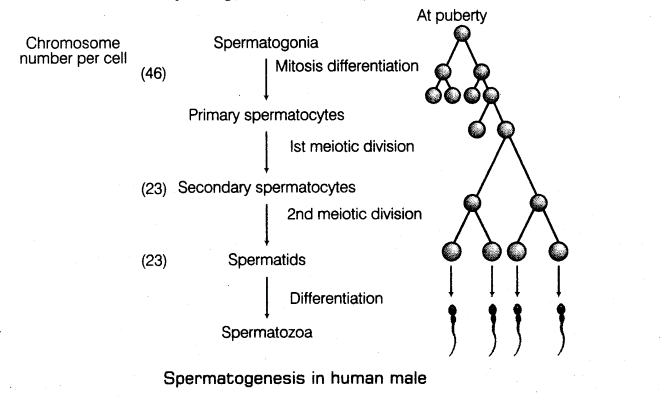
Spermatogenesis involves the creation of sperm in males, occurring within the seminiferous tubules located in the testes. During this process, (a) Spermatogonia, located on the inner wall of the seminiferous tubules, undergo mitotic division, resulting in an increase in their numbers. (b) Every spermatogonium is diploid, housing a total of 46 chromosomes. (c) Spermatogonia that periodically undergo meiosis are termed primary spermatocytes. (d) When a primary spermatocyte undergoes the first meiotic division, it results in the formation of two equal, haploid cells known as secondary spermatocytes, each containing only 23 chromosomes. (e) Secondary spermatocytes proceed to undergo the second meiotic division, giving rise to four equal, haploid spermatids. (f) Spermatids are transformed into spermatozoa (sperms) through the process known as spermiogenesis. Now, let's see the diagram : Hence, the correct sequence of spermatogenic stages culminating in the formation of sperm in a mature human testis is: Spermatogonia - Primary spermatocytes - secondary spermatocytes - spermatids - spermatozoa So, the correct option is (D) : (D), (E), (A), (B), (C).
04
PYQ 2022
medium
biologyID: cuet-ug-
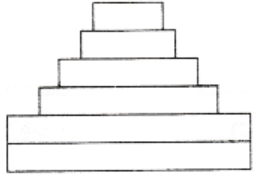
The shape of pyramids gives the reflection of growth status of a population. Identify the growth status depicted by the given pyramid.
1
Expanding
2
Declining
3
Exploding
4
Stable
Official Solution
Correct Option: (4)
A stable population pyramid typically has a more or less uniform distribution across age groups, with each age cohort representing a similar percentage of the total population.
So, the correct option is (D): Stable.
05
PYQ 2022
medium
biologyID: cuet-ug-
Match List - I with List - II.
List - I
List - II
A
Prostate gland
I
Store and transport sperms
B
Leydig cells
II
Male external genitilia
C
Ejaculatory duct
III
Male accessory gland
D
Penis
IV
Testicular hormones
Choose the correct answer from the options given below :
1
(A) - (III), (B) - (IV), (C) - (I), (D) - (II)
2
(A) - (IV), (B) - (III), (C) - (I), (D) - (II)
3
(A) - (I), (B) - (III), (C) - (IV), (D) - (II)
4
(A) - (IV), (B) - (II), (C) - (III), (D) - (I)
Official Solution
Correct Option: (1)
(A) - (III), (B) - (IV), (C) - (I), (D) - (II)
06
PYQ 2023
medium
biologyID: cuet-ug-
Which of the following statements are correct with respect to reproduction in human ? A. Menstrual cycle ceases during pregnancy B. Leydig cells found in ovary provide nourishment to the fertilized egg C. Androgens are produced by sertoli cells D. Zona pellucida is a membrane covering secondary oocyte Choose the correct answer from the options given below :
1
A, B only
2
B, C only
3
A, D only
4
B, D only
Official Solution
Correct Option: (3)
The correct option is (C) :A, D only.
07
PYQ 2023
medium
biologyID: cuet-ug-
The process of transformation of spermatids into spermatozoa is known as:
1
Spermatogenesis
2
Spermiogenesis
3
Spermiation
4
Spermation
Official Solution
Correct Option: (2)
The correct option is (B) : Spermiogenesis
08
PYQ 2023
medium
biologyID: cuet-ug-
Arrange the following events of human embryo development in a correct sequence: (A) Blastocyst Formation (B) Implantation (C) Formation of morula (D) Cleavage in zygote
1
C, D, B, A
2
D, C, A, B
3
D, B, C, A
4
A, C, D, B
Official Solution
Correct Option: (2)
The correct option is (B) : D, C, A, B
09
PYQ 2023
medium
biologyID: cuet-ug-
Which one is not a barrier method for birth control ?
1
Diaphragms
2
Cervical caps
3
Vaults
4
Intra Uterine Devices (IUDS)
Official Solution
Correct Option: (4)
The correct option is (D) : Intra Uterine Devices (IUDS)
10
PYQ 2024
easy
biologyID: cuet-ug-
Humans are sexually reproducing and viviparous. The male reproductive system is composed of a pair of testes, the male sex accessory ducts, the accessory glands, and external genitalia. The female reproductive system consists of a pair of ovaries, a pair of oviducts, a uterus, a vagina, external genitalia, and a pair of mammary glands. The reproductive cycle of female primates is called the menstrual cycle. The menstrual cycle starts only after attaining sexual maturation (puberty). Coitus followed by fertilization leads to the formation of a zygote. After 9 months of pregnancy, the fully developed foetus is ready for delivery.
Official Solution
Correct Option: (1)
11
PYQ 2024
medium
biologyID: cuet-ug-
Arrange the following stages of oogenesis in order of their occurrence: (A) Ovum (B) Oogonia (C) Primary oocyte (D) Secondary oocyte Choose the correct answer from the options given below:
1
(C), (B), (D), (A)
2
(B), (C), (D), (A)
3
(D), (C), (A), (B)
4
(A), (D), (C), (B)
Official Solution
Correct Option: (2)
To understand the correct order of the stages of oogenesis, we should first define each stage:
Oogonia (B): These are the initial germ cells in the ovaries, which proliferate by mitosis during fetal development.
Primary oocyte (C): Oogonia develop into primary oocytes that initiate meiosis but halt at prophase I until puberty.
Secondary oocyte (D): Upon maturation and ovulation, some primary oocytes resume meiosis and form secondary oocytes. This stage is arrested in metaphase II unless fertilization occurs.
Ovum (A): The final mature egg cell, formed only if the secondary oocyte completes meiosis II after fertilization.
Following the natural biological progression, the correct sequence of stages during oogenesis is:
Oogonia (B)
Primary oocyte (C)
Secondary oocyte (D)
Ovum (A)
Therefore, the correct answer is: (B), (C), (D), (A)
12
PYQ 2024
medium
biologyID: cuet-ug-
Sex in human embryos is determined by:
1
‘X’ chromosome of egg
2
‘X’ or ‘Y’ chromosome of sperm
3
Only ‘Y’ chromosome of sperm
4
Health of mother
Official Solution
Correct Option: (2)
In humans, the determination of an embryo's sex occurs at fertilization when the genetic material from the egg and sperm combine. The eggs produced by a female always contain an X chromosome. In contrast, a male's sperm can contain either an X or a Y chromosome. This means:
If a sperm carrying an X chromosome fertilizes the egg, the resulting zygote will have two X chromosomes (XX), resulting in a female embryo.
If a sperm carrying a Y chromosome fertilizes the egg, the zygote will have one X and one Y chromosome (XY), resulting in a male embryo.
Therefore, the sex of the human embryo is determined by whether the fertilizing sperm carries an X or a Y chromosome.