Planning
10 previous year questions.
High-Yield Trend
Chapter Questions 10 MCQs
(A) Developing premises
(B) Implementing the plan
(C) Setting objectives
(D) Identifying alternative courses of action and evaluating them
(E) Selecting an alternative
Choose the correct answer from the options given below:
A Maharatna Company, Indian Oil Indian Oil is India’s largest commercial organisation. It is the top-ranked Indian company in the Fortune ‘Global 500’ listings (2017). Indian Oil’s vision is driven by a group of dynamic leaders, who have made it a name to reckon with. With an over 34,000 strong workforce, a Maharatna Company, Indian Oil has been helping to meet India’s energy demands and reaching petroleum products in every part of India for over five decades.It plans to increase its business operations all around the world. The company plans to invest 20,000 crore in 2017 – 18 acquisitions and plans to expandoverseas. The company is always believed to be ahead of the demand. Last year too, IOC had invested close to 20,000 crore, including around 16,000 crore in various Indian projects and on acquisition for upstream in Russia. The company believed that if the goals are well defined, employees are aware of what the organisation has to do and what they must do to achieve those goals. Changes or events cannot be eliminated, but they can be anticipated and managerial responses to them can be developed. Policy formation serves as the basis of coordinating the activities and efforts of different divisions, departments and individuals. It helps in avoiding confusion and misunderstanding. Manager can look into the future and make a choice from amongst various alternative courses of action.
“Planning bridges the gap between where we are and where we want to go”. Identify the features of planning.
Match the features of planning in List I with their descriptions in List II
| List I | List II |
|---|---|
| A. Planning is Pervasive | I. It is required at all levels of management and in all departments of the organisation. |
| B. Planning is Continuous | II. It involves looking ahead and preparing for future events to the best advantage of an organisation. |
| C. Planning is a Primary Function | III. It lays down the base for other managerial functions. |
| D. Planning is Futuristic | IV. Plans are prepared for a specific period, and at the end of that period, new plans are drawn based on new requirements and future conditions. |
Match List I with List II. 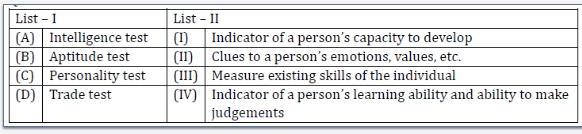
(A) - (I), (B) - (II), (C) - (III), (D) - (IV)
(A) - (I), (B) - (IV), (C) - (II), (D) - (III)
(A) - (II), (B) - (III), (C) - (I), (D) - (IV)
(A) - (I), (B) - (III), (C) - (IV), (D) - (II)
(A) Implementation of plan and follow-up action
(B) Developing Premises
(C) Identification and evaluation of alternative courses of action
(D) Setting up of objectives
(E) Selecting an alternative
Choose the correct answer from the options given below:
About Planning - CUET-UG
Planning is a vital chapter for CUET-UG aspirants. Mastering the concepts covered in this chapter is essential for securing a top rank.
By rigorously practicing the previous year questions associated with this chapter, you can identify high-yield topics, understand the examiner's perspective, and boost your confidence during the actual exam.
Frequently Asked Questions
Why focus on Planning PYQs?
Analyzing PYQs for this specific chapter reveals the most frequently tested concepts and the typical complexity of questions, allowing you to tailor your study plan efficiently.
How to best use this analysis?
Review the topic breakdown to see which sub-topics within Planning carry the most weight. Then, tackle the questions iteratively to solidify your understanding.