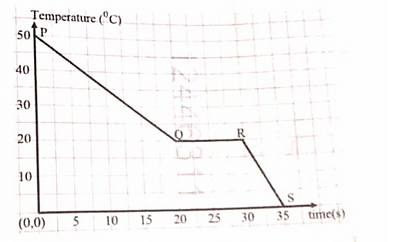
The given graph represents the cooling curve of a liquid. (a) State the freezing temperature of the liquid.
(b) Name the phase change happening at the region QR.
(c) In which state (solid / liquid) does the above substance liberate heat at a faster rate? Justify.
Official Solution
Correct Option:
(1)
(a) Freezing Temperature:
The freezing temperature is the temperature at which the liquid turns into a solid. During this phase change, the temperature remains constant even as heat is being liberated. The horizontal section of the graph, QR, represents this phase change. The temperature corresponding to this section is 20 C. (b) Phase Change at QR:
The substance is cooling. At the constant temperature region QR, the liquid is changing its state to solid. This process is called freezing or solidification. (c) State with faster heat liberation:
The substance liberates heat at a faster rate in the liquid state (region PQ). Justification: The rate of heat liberation is proportional to the rate of cooling. The rate of cooling is represented by the slope (steepness) of the temperature-time graph. The slope of the graph in the region PQ (liquid state) is steeper than the slope in the region RS (solid state). A steeper slope means a larger change in temperature per unit time, indicating a faster rate of heat loss.
02
PYQ 2026
medium
physicsID: icse-cla
(a) Atmospheric temperature after a hailstorm is greater than the temperature during the hailstorm. State True or False.
(b) Which thermal physical quantity of a frying pan changes by making the base heavier?
(c) State the principle of Calorimetry.
Official Solution
Correct Option:
(1)
(a) True or False:
The statement is False. After a hailstorm, the hailstones on the ground start to melt. Melting is a process that requires energy, specifically the latent heat of fusion. The hailstones absorb this heat from the surrounding atmosphere, causing the atmospheric temperature to drop further. Therefore, the temperature after a hailstorm is generally lower, not greater. (b) Thermal Physical Quantity:
Making the base of a frying pan heavier means increasing its mass ( ).
- Specific heat capacity ( ) is an intrinsic property of the material and does not change with mass.
- Heat capacity (or Thermal capacity, ) is the product of mass and specific heat capacity ( ). Since the mass ( ) increases, the heat capacity also increases.
The quantity that changes is the heat capacity. (c) Principle of Calorimetry:
The principle of calorimetry, also known as the law of heat exchange, states that when two bodies at different temperatures are in thermal contact, the heat lost by the hotter body is equal to the heat gained by the colder body, provided there is no heat loss to the surroundings.
03
PYQ 2026
medium
physicsID: icse-cla
A metal piece of thermal capacity 40 JK , absorbs 800 J of heat. Calculate the rise in the temperature of this metal piece.
Official Solution
Correct Option:
(1)
Step 1: Identify the given quantities:
- Heat absorbed ( ) = 800 J
- Thermal capacity ( ) = 40 J K Step 2: Recall the relevant formula:
The relationship between heat absorbed ( ), thermal capacity ( ), and the change in temperature ( ) is given by: Step 3: Rearrange the formula to solve for the rise in temperature ( ): Step 4: Substitute the given values and calculate:
Since a change of 1 K is equal to a change of 1 C, the rise in temperature can also be expressed as 20 C.
04
PYQ 2026
medium
physicsID: icse-cla
Three substances A, B and C of same mass are present at their respective melting points. On heating, if they melt completely in 5 minutes, 7 minutes and 3 minutes respectively, then which substance has the highest specific latent heat? (Assume heat is absorbed at the same rate)
1
Substance A
2
Substance B
3
Substance C
4
All the substances have same specific latent heat
Official Solution
Correct Option:
(2)
Step 1: Understanding the Question:
The question asks to identify which substance has the highest specific latent heat of fusion, given that all substances have the same mass and are heated at the same rate, but take different times to melt completely. Step 2: Key Formula or Approach:
The heat energy ( ) required to melt a substance at its melting point is given by the formula:
where is the mass and is the specific latent heat of fusion.
Also, if heat is supplied at a constant rate ( ), then the heat absorbed in time ( ) is: Step 3: Detailed Explanation:
By equating the two expressions for heat ( ), we get:
The problem states that:
- The mass ( ) is the same for all three substances.
- The rate of heat absorption ( ) is the same for all three substances.
From the equation, we can write the specific latent heat ( ) as:
Since and are constants for this comparison, the specific latent heat ( ) is directly proportional to the time ( ) taken to melt.
This means the substance that takes the longest time to melt will have the highest specific latent heat.
The melting times are:
- Substance A: minutes
- Substance B: minutes
- Substance C: minutes
Since , it follows that .
Therefore, Substance B has the highest specific latent heat. Step 4: Final Answer:
The substance that takes the longest time to melt (Substance B) has absorbed the most heat, and therefore has the highest specific latent heat.
About Calorimetry - ICSE-CLASS-X-BOARD
Calorimetry is a vital chapter for ICSE-CLASS-X-BOARD aspirants. Mastering the concepts covered in this chapter is essential for securing a top rank.
By rigorously practicing the previous year questions associated with this chapter, you can identify high-yield topics, understand the examiner's perspective, and boost your confidence during the actual exam.
Frequently Asked Questions
Why focus on Calorimetry PYQs?
Analyzing PYQs for this specific chapter reveals the most frequently tested concepts and the typical complexity of questions, allowing you to tailor your study plan efficiently.
How to best use this analysis?
Review the topic breakdown to see which sub-topics within Calorimetry carry the most weight. Then, tackle the questions iteratively to solidify your understanding.