A fast-moving cyclist stops pedalling on reaching a hilly track. If he continues to move with the acquired energy, then assuming no loss of energy:
1
his kinetic energy remains constant at all times.
2
his potential energy remains constant at all times.
3
his total mechanical energy continuously increases.
4
his total mechanical energy remains constant.
Official Solution
Correct Option:
(4)
Step 1: Understanding the Question:
The question describes a cyclist moving up a hill without pedaling, and we must consider the situation under the assumption of "no loss of energy" (i.e., no friction or air resistance). We need to determine what happens to the cyclist's energy. Step 2: Key Formula or Approach:
The Principle of Conservation of Mechanical Energy states that if there are no non-conservative forces (like friction or air resistance) doing work, the total mechanical energy of a system remains constant.
Total Mechanical Energy (TME) = Kinetic Energy (KE) + Potential Energy (PE). Step 3: Detailed Explanation:
The problem explicitly states to assume "no loss of energy". This means we can apply the Principle of Conservation of Mechanical Energy.
As the cyclist moves up the hilly track, his height (h) above the starting point increases.
- Because height (h) increases, his potential energy ( ) increases.
- Since the total mechanical energy ( ) must remain constant, and PE is increasing, his kinetic energy ( ) must decrease. This means his speed (v) decreases.
- Let's analyze the options:
(A) his kinetic energy remains constant: Incorrect. It decreases as he goes up.
(B) his potential energy remains constant: Incorrect. It increases as he goes up.
(C) his total mechanical energy continuously increases: Incorrect. It is conserved (remains constant).
(D) his total mechanical energy remains constant: Correct. This is the direct consequence of the conservation of energy principle. Step 4: Final Answer:
According to the law of conservation of energy, with no energy loss, the total mechanical energy of the cyclist remains constant. The energy transforms from kinetic to potential energy as he moves uphill.
02
PYQ 2026
hard
physicsID: icse-cla
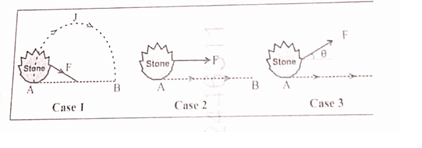
A stone is tied to a string and displaced from A to B by application of a constant force F in three different ways as shown in the diagram below. Arrange the three cases in ascending order of the work done by the force. (Given AJB is a semi-circle, 0 < <90 and AB = 20 m)
Official Solution
Correct Option:
(1)
Step 1: Understanding Work Done:
Work done ( ) by a force depends on the force applied and the displacement of the object along the direction of the force.
- If the force vector is constant and the displacement is , then work done is , where is the angle between the force and displacement vectors.
- If the force is applied along a path, the work done is the integral of the force component along the path, . Step 2: Calculating Work Done for Each Case:
The net displacement from A to B is a straight line of length m. Case 1: The force F is applied tangentially along the semi-circular path AJB.
The length of the path is the circumference of the semi-circle, . The radius is m.
So, path length m.
Since the force is always in the direction of motion, the work done is force distance.
Case 2: The constant force F is applied horizontally, parallel to the displacement AB.
The displacement is m. The angle between force and displacement is .
Case 3: The constant force F is applied at an angle to the horizontal displacement AB.
The displacement is m. The angle between force and displacement is .
Given that , we know that .
Therefore, is less than . For example, if , . Step 3: Comparing the Work Done:
We have:
-
-
- , which is less than .
Comparing the three values, we get: .
The ascending order is Case 3, Case 2, Case 1.
03
PYQ 2026
medium
physicsID: icse-cla
A ball of mass 20 g falls from a height of 45 m. It rebounds from the ground to a height of 40 m. Calculate:
(a) the initial potential energy of the ball.
(b) the speed of the ball at which it hits the ground.
(c) the loss in kinetic energy on striking the ground.
[g = 10 m/s ]
Official Solution
Correct Option:
(1)
Step 1: List the given data and convert units:
- Mass ( ) = 20 g = 0.02 kg
- Initial height ( ) = 45 m
- Rebound height ( ) = 40 m
- Acceleration due to gravity ( ) = 10 m/s (a) Initial Potential Energy:
The potential energy (PE) of an object is given by the formula .
(b) Speed on hitting the ground:
By the principle of conservation of energy (assuming no air resistance), the initial potential energy is completely converted into kinetic energy (KE) just before the ball hits the ground.
(c) Loss in kinetic energy:
The loss in kinetic energy during the collision is the difference between the kinetic energy just before hitting the ground and the kinetic energy just after rebounding.
- Kinetic energy just before impact: J.
- The kinetic energy just after rebound is equal to the potential energy it gains on reaching the rebound height .
- The loss in kinetic energy is:
04
PYQ 2026
medium
physicsID: icse-cla
Name the unit of work done, used in subatomic scale.
Official Solution
Correct Option:
(1)
Step 1: Understanding the Scale:
The subatomic scale refers to particles smaller than an atom, like electrons, protons, and neutrons. The energies and work done involved at this level are extremely small compared to macroscopic standards. Step 2: Defining the Unit:
The standard SI unit for work and energy is the Joule (J). However, the Joule is too large for convenient use on the subatomic scale. A more practical unit is the electron-volt (eV).
One electron-volt is defined as the amount of kinetic energy gained (or work done) by a single electron when it is accelerated through an electric potential difference of one volt.
.
About Work Energy And Power - ICSE-CLASS-X-BOARD
Work Energy And Power is a vital chapter for ICSE-CLASS-X-BOARD aspirants. Mastering the concepts covered in this chapter is essential for securing a top rank.
By rigorously practicing the previous year questions associated with this chapter, you can identify high-yield topics, understand the examiner's perspective, and boost your confidence during the actual exam.
Frequently Asked Questions
Why focus on Work Energy And Power PYQs?
Analyzing PYQs for this specific chapter reveals the most frequently tested concepts and the typical complexity of questions, allowing you to tailor your study plan efficiently.
How to best use this analysis?
Review the topic breakdown to see which sub-topics within Work Energy And Power carry the most weight. Then, tackle the questions iteratively to solidify your understanding.