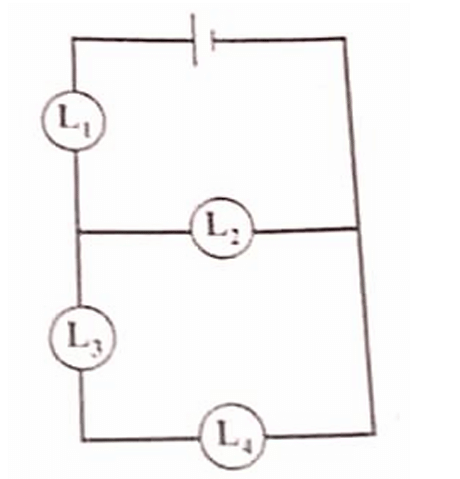
In the circuit given below, identify the lamp (L1, L2, L3 or L4) whose failure would not interrupt the power supply to the other lamps.
1
L1
2
L2
3
L3
4
L4
Official Solution
Correct Option: (2)
Step 1: Understanding the Question:
We need to analyze the given electrical circuit and determine which single lamp's failure (becoming an open circuit) would still allow current to flow to the other lamps in the circuit. Step 2: Detailed Explanation:
Let's analyze the circuit configuration:
- Lamp L1 is in series with the rest of the circuit.
- The rest of the circuit consists of two parallel branches.
- Branch 1 contains only lamp L2.
- Branch 2 contains lamps L3 and L4 connected in series. Now let's consider the failure of each lamp one by one:
- If L1 fails: It is in series with the entire combination. An open circuit at L1 would break the main path for the current from the power supply. No current would flow to L2, L3, or L4. All other lamps would go out.
- If L2 fails: The parallel branch containing L2 would become an open circuit. Current would stop flowing through this branch. However, the main circuit is still complete. Current would flow from the supply, through L1, and then through the other parallel branch containing L3 and L4. So, L1, L3, and L4 would remain lit. The power supply to these lamps is not interrupted.
- If L3 fails: The series combination of L3 and L4 would become an open circuit. No current would flow through this branch, so L4 would also go out. However, current would still flow from the supply, through L1, and then through the parallel branch containing L2. So, L1 and L2 would remain lit. The power supply to L4 is interrupted.
- If L4 fails: This is similar to L3 failing. The series branch containing L3 and L4 would open. L3 would go out. Current would still flow through L1 and L2. The power supply to L3 is interrupted. Step 3: Final Answer:
The failure of L2 is the only case where all the other lamps (L1, L3, and L4) continue to receive power and stay lit. Therefore, the failure of L2 does not interrupt the power supply to the other lamps.
02
PYQ 2026
easy
physicsID: icse-cla
The correct formula to calculate the equivalent resistance of R and R when connected in parallel, is:
1
2
3
4
Official Solution
Correct Option: (2)
Step 1: Understanding the Question:
The question asks for the standard formula for the equivalent resistance ( ) of two resistors, R and R , connected in a parallel arrangement. Step 2: Key Formula or Approach:
For resistors connected in parallel, the reciprocal of the equivalent resistance is equal to the sum of the reciprocals of the individual resistances. Step 3: Detailed Explanation:
For two resistors R and R in parallel, the formula is:
To find , we first need to combine the fractions on the right side. The common denominator is .
Now, to solve for , we take the reciprocal of both sides of the equation:
This is often referred to as the "product over sum" rule for two parallel resistors.
Comparing this result with the given options, it matches option (B). Step 4: Final Answer:
The correct formula for the equivalent resistance of two resistors in parallel is the product of their resistances divided by the sum of their resistances.
03
PYQ 2026
medium
physicsID: icse-cla
An electric iron rated 1100 W, 220 V is operated for 5 hours.
Calculate:
(a) the minimum rating of the fuse required.
(b) the energy consumed in kWh.
(c) the cost of the energy consumed, if the rate is Rupees 10 per unit.
Official Solution
Correct Option: (1)
(a) Minimum rating of the fuse required: Step 1: Formula to find the current.
The current ( ) drawn by the iron can be calculated from its power ( ) and voltage ( ) rating using the formula:
Step 2: Calculation.
Given W and V.
A fuse is a safety device with a rating slightly higher than the normal operating current of the appliance. Therefore, the minimum standard fuse rating required would be just above 5 A. However, the safe current limit for the appliance is 5 A. (b) Energy consumed in kWh: Step 1: Formula for energy consumption.
The electrical energy ( ) consumed is given by:
To get the energy in kWh (kilowatt-hours), the power must be in kilowatts (kW) and time in hours (h).
Step 2: Unit conversion and calculation.
- Power = 1100 W = kW = 1.1 kW.
- Time = 5 hours.
(c) Cost of the energy consumed: Step 1: Formula for cost.
One unit of electrical energy is equal to 1 kWh.
Step 2: Calculation.
- Energy consumed = 5.5 units.
- Rate = Rupees 10 per unit.
04
PYQ 2026
medium
physicsID: icse-cla
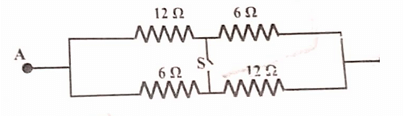
In the combinations of resistors shown below, calculate:
(a) the resistance across AB when the switch S is open.
(b) the resistance across AB when the switch S is closed.
Official Solution
Correct Option: (1)
(a) Resistance when switch S is open:
When the switch S is open, there is no connection between the upper and lower branches at the center. The circuit consists of two parallel branches between points A and B.
- Upper branch: A 12 resistor and a 6 resistor are in series. .
- Lower branch: A 6 resistor and a 12 resistor are in series. .
The total resistance across AB ( ) is the equivalent resistance of these two branches in parallel. (b) Resistance when switch S is closed:
When the switch S is closed, it connects the midpoint of the upper branch to the midpoint of the lower branch. This reconfigures the circuit into two parallel combinations connected in series. This is a Wheatstone bridge configuration.
- Left side of S: The 12 resistor and the 6 resistor are in parallel.
- Right side of S: The 6 resistor and the 12 resistor are in parallel.
The total resistance across AB is the sum of these two combinations in series.
05
PYQ 2026
medium
physicsID: icse-cla
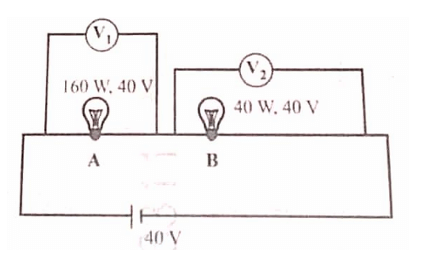
Bulb A rated 160 W, 40 V and Bulb B rated 40 W, 40 V are connected as shown in the diagram.
(a) Calculate the ratio V : V
(b) If the bulb A fuses, the current in the circuit remains the same. State True or False.
Official Solution
Correct Option: (1)
Step 1: Calculate the resistance of each bulb.
The resistance ( ) of a bulb can be calculated from its power ( ) and voltage ( ) rating using the formula , so .
- For Bulb A:
- For Bulb B: (a) Calculate the ratio V : V :
The bulbs A and B are connected in series. In a series circuit, the same current ( ) flows through all components. The voltage across each component is given by Ohm's law, .
- Voltage across A:
- Voltage across B:
The ratio of the voltages is:
So, the ratio is 1 : 4. (b) True or False:
The statement is False. The bulbs are connected in a series circuit. If bulb A fuses, its filament breaks, creating an open circuit. In an open circuit, no current can flow. Therefore, the current in the circuit will drop to zero, not remain the same.
06
PYQ 2026
medium
physicsID: icse-cla
A resistance R is connected across a cell with a switch and a rheostat in series. A voltmeter is connected parallel across the cell. Current in the circuit is increased using the rheostat.
(a) How will the voltmeter reading change? (increase / decrease / remain the same)
(b) Justify your answer stated in (a) above.
Official Solution
Correct Option: (1)
(a) How will the voltmeter reading change?
The voltmeter reading will decrease. (b) Justification: Step 1: Understanding the Measurement:
The voltmeter connected in parallel across the cell measures the terminal voltage ( ) of the cell. Step 2: The Terminal Voltage Formula:
The terminal voltage ( ) of a cell is related to its electromotive force (e.m.f. or ) and internal resistance ( ) by the equation:
where is the current drawn from the cell. The term represents the potential drop across the internal resistance of the cell, often called "lost volts". Step 3: Analyzing the Change:
The problem states that the current ( ) in the circuit is increased (by adjusting the rheostat).
According to the equation :
- (the e.m.f. of the cell) is a constant.
- (the internal resistance) is a constant.
- As the current increases, the product (the lost volts) also increases.
- Since we are subtracting a larger value ( ) from a constant value ( ), the resulting terminal voltage ( ) must decrease.