An object placed in front of a convex lens, forms an image of same size on a screen. Moving the object 12 cm closer to the lens results in the formation of a real image which is three times the size of the object. Calculate the focal length of the lens.
Official Solution
Correct Option:
(1)
Step 1: Analyze the initial condition.
A convex lens forms a real image of the same size as the object only when the object is placed at a distance of twice the focal length (2f) from the optical center.
Initial object distance, .
The image is also formed at 2f on the other side. Step 2: Analyze the second condition.
The object is moved 12 cm closer to the lens.
New object distance, . (The negative sign is included in the value).
A real image is formed, which is three times the size. For a real image from a convex lens, the magnification ( ) is negative (inverted).
Magnification, . Step 3: Use the magnification formula.
This is the new image distance. Since is positive, the image is real, which matches the problem description. Step 4: Use the lens formula.
Substitute the expressions for and :
Find a common denominator:
Cross-multiply:
The focal length of the lens is 18 cm.
02
PYQ 2026
medium
physicsID: icse-cla
What would be the magnification (more than 1 / less than 1 / equal to 1) if the object is placed between F and 2F of the above lens?
Official Solution
Correct Option:
(1)
Step 1: Recall Image Formation by a Convex Lens:
For a convex lens, when an object is placed between the focal point (F) and twice the focal length (2F), the image is formed beyond 2F. The image is real, inverted, and magnified. Step 2: Define Magnification:
The linear magnification ( ) produced by a lens is given by the ratio of the image distance ( ) to the object distance ( ).
The size of the magnification (magnitude) is given by . Step 3: Apply the Condition:
When the object is placed between F and 2F:
- Object distance:
- Image distance:
Comparing the magnitudes, we clearly see that the image distance is greater than the object distance:
Therefore, the magnitude of the magnification will be: Step 4: Final Answer:
Since the image is magnified, the magnification is more than 1.
03
PYQ 2026
medium
physicsID: icse-cla
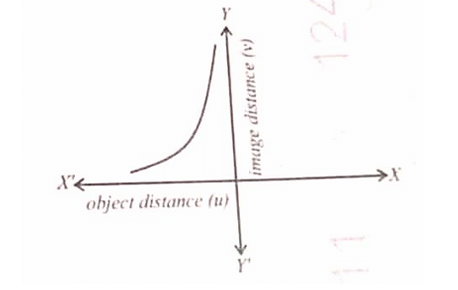
The graph below shows the variation of image distance (v) with the object distance (u) when an object is kept in front of a lens. Identify the type of lens used.
Official Solution
Correct Option:
(1)
Step 1: Analyzing the Graph:
The graph shows the relationship between the object distance ( ) and the image distance ( ).
- Object distance ( ) is plotted on the negative X-axis, which is consistent with the sign convention that real objects have a negative object distance.
- Image distance ( ) is plotted on the positive Y-axis. A positive image distance signifies that a real image is formed.
- As the magnitude of the object distance decreases (i.e., the object moves closer to the lens), the image distance increases. Step 2: Relating Graph to Lens Properties:
- A lens that forms a real image for a real object must be a converging lens. A concave (diverging) lens always forms a virtual image for a real object, for which would be negative.
- The behavior shown in the graph (real image formation, with increasing as decreases towards the focal point) is the characteristic property of a convex lens. Step 3: Final Answer:
Since the lens forms a real image ( ) for a real object ( ), the lens used is a convex lens.
04
PYQ 2026
medium
physicsID: icse-cla
The distance (v) of a virtual image formed by a lens of focal length 15 cm can never exceed a certain finite value, then this value will be:
1
less than 15 cm
2
between 15 cm to 30 cm
3
less than or equal to 30 cm
4
less than or equal to 15 cm
Official Solution
Correct Option:
(4)
Step 1: Understanding the Question:
The question asks for the limit on the distance of a virtual image formed by a lens. A convex lens can form a virtual image whose distance can be very large (approaching infinity). However, a concave lens always forms a virtual image within a specific range. Given the options, the question is likely about a concave lens. Step 2: Key Formula or Approach:
We will analyze the image formation by a concave lens using the lens formula:
For a concave lens, the focal length ( ) is negative. By convention, the object distance ( ) is also negative. The image formed is always virtual, so the image distance ( ) will also be negative. Step 3: Detailed Explanation:
Let the focal length be cm.
The lens formula is .
Substituting :
Since the object is real, can range from 0 to . Case 1: Object is at infinity ( ).
This means the image is formed at the focus. The image distance is 15 cm. Case 2: Object is at the optical center ( ).
This limit is not practical, but as the object moves from infinity towards the lens, the image moves from the focus towards the optical center.
For any real object placed in front of a concave lens, the virtual image is always formed between the optical center (O) and the principal focus (F).
Therefore, the image distance |v| will always be less than the focal length |f|.
So, .
Given cm, the image distance will be less than or equal to 15 cm. Step 4: Final Answer:
For a concave lens of focal length 15 cm, the virtual image is always formed between the optical center and the focus, so its distance from the lens can never exceed 15 cm.
About Lenses - ICSE-CLASS-X-BOARD
Lenses is a vital chapter for ICSE-CLASS-X-BOARD aspirants. Mastering the concepts covered in this chapter is essential for securing a top rank.
By rigorously practicing the previous year questions associated with this chapter, you can identify high-yield topics, understand the examiner's perspective, and boost your confidence during the actual exam.
Frequently Asked Questions
Why focus on Lenses PYQs?
Analyzing PYQs for this specific chapter reveals the most frequently tested concepts and the typical complexity of questions, allowing you to tailor your study plan efficiently.
How to best use this analysis?
Review the topic breakdown to see which sub-topics within Lenses carry the most weight. Then, tackle the questions iteratively to solidify your understanding.