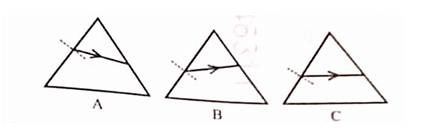
A monochromatic ray strikes the surface of identical prisms (A, B and C) at different angles of incidence. The diagram below shows their refracted rays. Study the path of these refracted rays and identify in which of the diagrams
(a) the angle of incidence is maximum.
(b) the angle of incidence is minimum.
(c) the angle of incidence is equal to the angle of emergence.
Official Solution
Correct Option:
(1)
(a) The angle of incidence is maximum:
The angle of incidence is maximum in Diagram C. In this diagram, the incident ray is bent the least upon entering the prism (it is furthest from the normal), which corresponds to the largest angle of incidence. (b) The angle of incidence is minimum:
The angle of incidence is minimum in Diagram B. In this diagram, the incident ray is bent the most upon entering the prism (it is closest to the normal), which corresponds to the smallest angle of incidence. (c) The angle of incidence is equal to the angle of emergence:
The angle of incidence is equal to the angle of emergence in Diagram A. This is the specific condition for the angle of minimum deviation. A key feature of this condition is that the refracted ray inside the prism travels parallel to the base of the prism, which is clearly depicted in Diagram A.
02
PYQ 2026
hard
physicsID: icse-cla
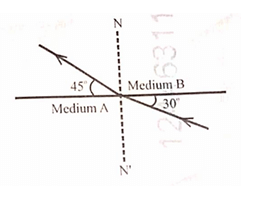
From the figure given below, the refractive index of medium B with respect to medium A ( ) is:
1
2
3
4
Official Solution
Correct Option:
(1)
Step 1: Understanding the Question:
The question asks to find the refractive index of medium B relative to medium A, using the angles of incidence and refraction shown in the diagram. Step 2: Key Formula or Approach:
We will use Snell's Law of refraction, which relates the angles of incidence and refraction to the refractive indices of the two media. Snell's Law is stated as:
where:
= refractive index of the first medium (medium A, denoted as ).
= refractive index of the second medium (medium B, denoted as ).
= angle of incidence.
= angle of refraction.
The refractive index of medium B with respect to medium A is given by . Step 3: Detailed Explanation:
From the given figure:
The light ray travels from Medium A to Medium B.
The angle of incidence ( ) is the angle between the incident ray and the normal (N). From the diagram, .
The angle of refraction ( ) is the angle between the refracted ray and the normal (N'). From the diagram, . Applying Snell's Law:
Substituting the given values:
We need to find the refractive index of medium B with respect to medium A ( ), which is the ratio .
Rearranging the equation to solve for :
So, . Step 4: Final Answer:
Comparing our result with the given options, the correct choice is (A).
03
PYQ 2026
hard
physicsID: icse-cla
(a) Name the electromagnetic radiation used to detect fake currency.
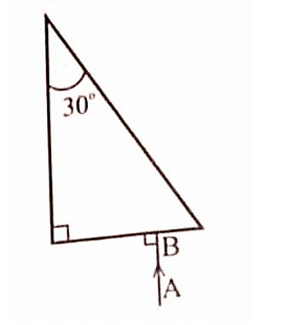
(b) Redraw the diagram given below and complete the path of the light ray AB through the glass prism till it emerges out of the prism. Critical angle of the glass is 42 .
Official Solution
Correct Option:
(1)
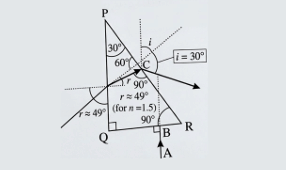
(a) Electromagnetic Radiation: Ultraviolet (UV) radiation is used to detect fake currency. Genuine banknotes often have fluorescent security features that are invisible in normal light but glow under UV light. (b) Path of the light ray: Explanation of the path:
1. Entry at the first surface: The light ray AB strikes the vertical face of the prism normally (at 90 ). Therefore, its angle of incidence is 0 , and it passes into the prism without any deviation.
2. Incidence at the hypotenuse: The ray travels horizontally inside the prism and strikes the hypotenuse. The angles of the prism are 90 , 30 , and 60 . The angle of incidence ( ) at the hypotenuse is 60 .
3. Check for Total Internal Reflection (TIR): The critical angle ( ) for the glass is given as 42 . Since the angle of incidence ( ) is greater than the critical angle ( ), the ray undergoes Total Internal Reflection.
4. Reflection: The ray reflects from the hypotenuse following the laws of reflection, so the angle of reflection is also 60 .
5. Emergence from the base: The reflected ray travels downwards and strikes the horizontal base of the prism at 90 (normally). Therefore, it emerges from the prism without any deviation.
04
PYQ 2026
medium
physicsID: icse-cla
A type of glass block has a refractive index of 1.8.
(a) Calculate the speed of light in this glass. (Given speed of light in air ms )
(b) If the width of this block is doubled, then what will be the speed of light in the block?
Official Solution
Correct Option:
(1)
(a) Calculation of speed of light in glass: Step 1: Formula for Refractive Index
The refractive index ( ) of a medium is the ratio of the speed of light in a vacuum/air ( ) to the speed of light in the medium ( ).
Step 2: Given values
- Refractive index of glass,
- Speed of light in air, m/s Step 3: Calculation
Rearranging the formula to find the speed of light in glass ( ):
The speed of light in the glass is m/s. (b) Effect of doubling the width:
The speed of light in a medium is an intrinsic property of that medium. It depends only on the optical density of the material, not on its physical dimensions like width, length, or thickness. Therefore, if the width of the block is doubled, the speed of light inside the block will remain the same ( m/s).
05
PYQ 2026
medium
physicsID: icse-cla
A ray of light enters a glass block from air and comes out from the opposite surface. If the angle of refraction at the first surface is not the same as the angle of incidence at the second surface, then:
(a) What is the product of the ratio at the first surface and at the second surface?
(b) State whether the opposite surfaces are parallel or not parallel.
(c) How did you reach the conclusion in (b) above?
Official Solution
Correct Option:
(1)
(a) Product of the ratios:
Let be the refractive index of air ( ) and be the refractive index of glass.
- At the first surface (air to glass): Let the angle of incidence be and the angle of refraction be . According to Snell's law:
- At the second surface (glass to air): Let the angle of incidence be and the angle of refraction (emergence) be . According to Snell's law:
The question asks for the product of the ratio at the first surface and at the second surface.
The product is 1. (b) Parallel or not parallel:
The opposite surfaces are not parallel. (c) Conclusion:
If the opposite surfaces of the glass block were parallel, then the normal to the first surface would be parallel to the normal to the second surface. In this case, the refracted ray from the first surface and the incident ray at the second surface would form alternate interior angles with the parallel normals. Therefore, the angle of refraction at the first surface ( ) would be equal to the angle of incidence at the second surface ( ).
The question explicitly states that . Since this geometric condition for parallel lines is not met, we can conclude that the surfaces are not parallel.
06
PYQ 2026
medium
physicsID: icse-cla
Complete the following: When a ray of light passes from a denser to a rarer medium, its wavelength __________.
1
decreases
2
increases
Official Solution
Correct Option:
(2)
When a wave, including light, passes from one medium to another, its frequency remains constant. The speed of light is greater in a rarer medium than in a denser medium. The relationship between speed ( ), frequency ( ), and wavelength ( ) is . Since is constant and increases as light enters the rarer medium, the wavelength ( ) must also increase to maintain the equality.
About Refraction Of Light - ICSE-CLASS-X-BOARD
Refraction Of Light is a vital chapter for ICSE-CLASS-X-BOARD aspirants. Mastering the concepts covered in this chapter is essential for securing a top rank.
By rigorously practicing the previous year questions associated with this chapter, you can identify high-yield topics, understand the examiner's perspective, and boost your confidence during the actual exam.
Frequently Asked Questions
Why focus on Refraction Of Light PYQs?
Analyzing PYQs for this specific chapter reveals the most frequently tested concepts and the typical complexity of questions, allowing you to tailor your study plan efficiently.
How to best use this analysis?
Review the topic breakdown to see which sub-topics within Refraction Of Light carry the most weight. Then, tackle the questions iteratively to solidify your understanding.