Case 1: Lata cuts a potato into two halves, using a cutter which belongs to a Class II lever. She needed effort E .
Case 2: Then she cuts one half of this potato again, but this time she needed effort E .
If E > E then:
(a) In which case (1st or 2nd) was the potato closer to her hand applying the effort? (Assume normal reaction of the surface of the potato is same in both cases)
(b) Give a reason for your answer in (a) above.
Official Solution
Correct Option:
(1)
(a) In which case was the potato closer to her hand?
The potato was closer to her hand in Case 1. (b) Reason: Step 1: Understanding the Lever System:
A cutter is a Class II lever, where the Load (the resistance from the potato) is between the Fulcrum (the pivot of the cutter) and the Effort (the force applied by the hand). Step 2: Principle of Levers:
The principle of moments for a lever in equilibrium is:
This can be rearranged to find the effort required: Step 3: Applying the given conditions:
- The Effort Arm is the distance from the fulcrum to the hand, which we can assume remains constant.
- The question states to assume the normal reaction (which is the Load) is the same in both cases. So, Load = Load .
- With the Load and Effort Arm being constant, the formula simplifies to:
- We are given that . Since the effort is directly proportional to the load arm, this implies that the Load Arm in Case 1 was greater than the Load Arm in Case 2. Step 4: Conclusion:
The Load Arm is the distance from the fulcrum to the potato. A larger load arm means the potato is placed further from the fulcrum. Since the hand is at the other end of the lever, placing the potato further from the fulcrum means placing it closer to the hand. Therefore, the potato was closer to the hand in Case 1, which required a greater effort.
02
PYQ 2026
hard
physicsID: icse-cla
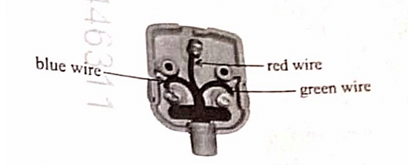
The reverse side of a three-pin plug with incorrect connection of wires is shown in the diagram below.
(a) Identify the fault in the above connection.
(b) Mention a risk factor involved, if the user operates the appliance with correcting it.
(c) Will the appliance function in the present situation? (Yes or No)
Official Solution
Correct Option:
(1)
(a) Identify the fault:
The standard wiring convention for a three-pin plug is:
- Live wire (Red or Brown) to the right pin (marked L).
- Neutral wire (Blue or Black) to the left pin (marked N).
- Earth wire (Green or Yellow/Green) to the top pin (marked E).
In the given diagram, the blue wire (Neutral) is connected to the live pin and the red wire (Live) is connected to the neutral pin. The fault is that the Live and Neutral wires have been swapped. (b) Mention a risk factor:
The switch of an appliance is always placed in the live wire to disconnect the high potential from the appliance's circuit when it is turned off. With the wires swapped, the neutral wire is now switched, while the live wire is permanently connected to the appliance's circuitry. This means that even when the appliance switch is in the 'off' position, the internal components are still at a high potential (live). If a user touches any part of the internal circuit (e.g., during cleaning or minor repair), they could complete the circuit to the earth and receive a severe or fatal electric shock. (c) Will the appliance function? Yes. An AC appliance requires a potential difference across its terminals to function. Since there is still a potential difference between the live and neutral pins of the socket, the appliance will function. However, it will be extremely unsafe.
03
PYQ 2026
easy
physicsID: icse-cla
The energy transformation taking place during photosynthesis in plants is:
1
heat to chemical
2
chemical to light
3
light to chemical
4
chemical to heat
Official Solution
Correct Option:
(3)
Step 1: Understanding the Question:
The question asks to identify the type of energy conversion that occurs during the process of photosynthesis in plants. Step 2: Detailed Explanation:
Photosynthesis is a biological process used by plants, algae, and some bacteria to convert light energy into chemical energy.
During this process, plants capture sunlight (light energy) using chlorophyll, a green pigment found in chloroplasts.
This captured light energy is then used to convert carbon dioxide ( ) and water ( ) into glucose ( ), a sugar molecule that stores energy in its chemical bonds (chemical energy), and oxygen ( ) as a byproduct.
The overall chemical equation for photosynthesis is:
Thus, the fundamental energy transformation is from light energy to chemical energy. Let's evaluate the options:
(A) heat to chemical: While some heat may be involved, the primary energy source is light, not heat. Incorrect.
(B) chemical to light: This describes processes like bioluminescence, which is the reverse of what happens in photosynthesis. Incorrect.
(C) light to chemical: This accurately describes the conversion of sunlight into the chemical energy stored in glucose. Correct.
(D) chemical to heat: This describes cellular respiration or combustion, where stored chemical energy is released as heat. Incorrect. Step 3: Final Answer:
Photosynthesis converts light energy from the sun into chemical energy stored in glucose molecules.
04
PYQ 2026
easy
physicsID: icse-cla
To lift a load of 30 kgf, Suhas uses a single fixed pulley, while Radha uses a single movable pulley. The displacement of efforts in both the cases are equal. In an ideal situation calculate the ratio of:
(a) the efforts in the two cases.
(b) the potential energy gained by the loads in the two cases.
(c) the efficiencies in the two cases.
Official Solution
Correct Option:
(1)
Step 1: Analyze the setup for Suhas and Radha:
- Load ( ) = 30 kgf
- Suhas: Single fixed pulley. Ideal Mechanical Advantage ( ) = 1. Velocity Ratio ( ) = 1.
- Radha: Single movable pulley. Ideal Mechanical Advantage ( ) = 2. Velocity Ratio ( ) = 2.
- Let the displacement of effort be for both. (a) Ratio of efforts:
Effort ( ) = Load ( ) / MA.
- Effort by Suhas:
- Effort by Radha:
- The ratio . (b) Ratio of potential energy gained:
Potential Energy Gained ( ) = Work done on Load = , where is the displacement of the load.
From the Velocity Ratio formula, .
- Displacement of Suhas's load: .
- Displacement of Radha's load: .
Now, calculate the potential energy gained:
- .
- .
- The ratio . (c) Ratio of efficiencies:
The problem states it is an "ideal situation". In an ideal situation, there is no energy loss due to friction or other factors. The efficiency of any ideal machine is 100\%, or 1.
- Efficiency for Suhas ( ) = 1.
- Efficiency for Radha ( ) = 1.
- The ratio .
05
PYQ 2026
medium
physicsID: icse-cla
To which class of lever does a pair of scissors belong?
Official Solution
Correct Option:
(1)
Step 1: Identifying the Components of a Lever:
A lever has three main components:
- Fulcrum (F): The pivot point.
- Effort (E): The point where force is applied.
- Load (L): The point where the resistance (or object to be moved) is located. Step 2: Analyzing a Pair of Scissors:
In a pair of scissors:
- The Fulcrum is the pin or screw that joins the two blades.
- The Effort is applied by the fingers on the handles.
- The Load is the object (e.g., paper or cloth) being cut by the blades. Step 3: Classifying the Lever:
Levers are classified based on the relative positions of F, L, and E.
- Class I: The Fulcrum is between the Effort and the Load (E-F-L).
- Class II: The Load is between the Fulcrum and the Effort (F-L-E).
- Class III: The Effort is between the Fulcrum and the Load (F-E-L).
Since the fulcrum (pivot) of the scissors is located between the effort (handles) and the load (material being cut), a pair of scissors is an example of a Class I lever. In fact, it is a double Class I lever.
About Simple Machines - ICSE-CLASS-X-BOARD
Simple Machines is a vital chapter for ICSE-CLASS-X-BOARD aspirants. Mastering the concepts covered in this chapter is essential for securing a top rank.
By rigorously practicing the previous year questions associated with this chapter, you can identify high-yield topics, understand the examiner's perspective, and boost your confidence during the actual exam.
Frequently Asked Questions
Why focus on Simple Machines PYQs?
Analyzing PYQs for this specific chapter reveals the most frequently tested concepts and the typical complexity of questions, allowing you to tailor your study plan efficiently.
How to best use this analysis?
Review the topic breakdown to see which sub-topics within Simple Machines carry the most weight. Then, tackle the questions iteratively to solidify your understanding.