Equal volumes of water are added to three cylindrical jars A, B and C of the same height and radii , and respectively with . If you blow across the mouth of these jars, which tube will produce the shrillest note?
1
A
2
B
3
C
4
All will produce the notes of same shrillness
Official Solution
Correct Option:
(1)
Step 1: Understanding the Question:
The question is about the sound produced by blowing over the top of three cylindrical jars with different radii but filled with the same volume of water. We need to find which jar produces the shrillest note (highest frequency). Step 2: Key Formula or Approach:
The sound is produced by the resonance of the air column above the water. The pitch (frequency) of the sound produced by a vibrating air column in a closed pipe (like a jar) is inversely proportional to the length of the air column.
where is the frequency and is the length of the air column. A shriller note corresponds to a higher frequency. Step 3: Detailed Explanation:
Let H be the total height of each cylindrical jar.
Let V be the equal volume of water added to each jar.
The volume of water in a cylinder is given by .
Since V is the same for all jars, the height of the water ( ) is .
This means .
We are given the radii are in the order .
Therefore, the heights of the water will be in the reverse order: .
The length of the vibrating air column ( ) in each jar is the total height minus the water height: .
Since is the largest water height, the corresponding air column length will be the smallest.
So, the lengths of the air columns are in the order .
The frequency is inversely proportional to the length of the air column ( ).
Therefore, the frequencies will be in the order .
A higher frequency means a shriller note. Since is the highest frequency, jar A will produce the shrillest note. Step 4: Final Answer:
Jar A has the smallest radius, so for the same volume of water, it will have the highest water level, leaving the shortest air column. A shorter air column vibrates at a higher frequency, producing a shriller sound.
02
PYQ 2026
medium
physicsID: icse-cla
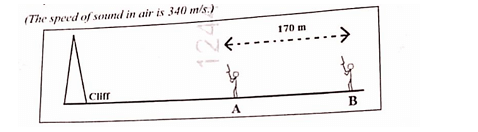
Two persons A and B are standing in front of a cliff in the same line 170 m apart as shown in the diagram. Person B fires the gun and hears the echo in 3 s. Then the person A standing in front of the person B fires the gun. (The speed of sound in air is 340 m/s.)
(a) Calculate:
1. the distance of the person B from the cliff.
2. the minimum time in which B hears the gunshot fired by A.
(b) Fill in the blank. The echo is softer (less loud) than the original sound due to the decrease in __________ of the wave. (amplitude / frequency)
Official Solution
Correct Option:
(1)
(a) 1. Distance of person B from the cliff:
Let the distance of person B from the cliff be . When B fires a gun, the sound travels to the cliff and reflects back to B. The total distance traveled by the sound is .
- Time taken for the echo, s.
- Speed of sound, m/s.
Using the formula, Distance = Speed Time:
So, person B is 510 m from the cliff. (a) 2. Minimum time for B to hear gunshot from A:
The minimum time is the time taken for the sound to travel directly from person A to person B.
- Distance between A and B = 170 m.
- Speed of sound = 340 m/s.
(b) Fill in the blank:
The loudness of a sound wave is determined by its amplitude. An echo is the reflection of sound. During reflection, some of the sound energy is absorbed by the reflecting surface, and the energy also spreads out over a larger area. This results in the reflected wave having a smaller amplitude than the original wave. Therefore, the echo is softer due to the decrease in amplitude.
03
PYQ 2026
medium
physicsID: icse-cla
(a) One end of a plastic foot ruler is held tightly at the edge of a table and the other end is plucked. Name the vibrations produced in the ruler.
(b) Now the ruler is pushed inside partially and plucked again from its free end. State with a reason whether the frequency of vibration increases or decreases.
Official Solution
Correct Option:
(1)
(a) Name the vibrations:
When the ruler is plucked and then allowed to vibrate on its own, it undergoes free vibrations. However, in reality, forces like air resistance and internal friction in the material will cause the amplitude of these vibrations to gradually decrease. Therefore, the vibrations produced are more accurately called damped vibrations. (b) Change in frequency: Statement: The frequency of vibration increases. Reason: The frequency of vibration of a cantilever (like a ruler held at one end) is inversely related to the square of its vibrating length ( ), i.e., . When the ruler is pushed inside, its effective vibrating length ( ) decreases. Since the frequency is inversely proportional to the length squared, a shorter length results in a significantly higher frequency of vibration. A higher frequency corresponds to a shriller sound.
04
PYQ 2026
medium
physicsID: icse-cla
(a) Define natural vibrations.
(b) How is this vibration different from damped vibrations in terms of their amplitudes?
Official Solution
Correct Option:
(1)
(a) Definition of Natural Vibrations:
Natural vibrations (or free vibrations) are the periodic vibrations of a body that occur in the complete absence of any external resistive or driving forces. The body vibrates at its own characteristic frequency, known as its natural frequency. (b) Difference from Damped Vibrations:
The key difference between natural vibrations and damped vibrations lies in the behavior of their amplitudes over time:
- Natural Vibrations: In an ideal scenario of natural vibrations, there is no energy loss. As a result, the amplitude of vibration remains constant indefinitely.
- Damped Vibrations: In damped vibrations, resistive forces (like friction or air resistance) are present. These forces dissipate the energy of the vibrating system. Consequently, the amplitude of vibration continuously decreases over time, eventually becoming zero.
05
PYQ 2026
medium
physicsID: icse-cla
Complete the following: Quality of sound depends on its __________.
1
amplitude
2
waveform
Official Solution
Correct Option:
(2)
The characteristics of sound are pitch, loudness, and quality (or timbre).
- Pitch depends on the fundamental frequency.
- Loudness depends on the amplitude of the wave.
- Quality or timbre is the characteristic that allows us to distinguish between two sounds of the same pitch and loudness, produced by different instruments or voices. This difference is due to the presence of various overtones (harmonics) and their relative intensities, which together determine the overall shape of the sound wave, known as the waveform.
About Sound - ICSE-CLASS-X-BOARD
Sound is a vital chapter for ICSE-CLASS-X-BOARD aspirants. Mastering the concepts covered in this chapter is essential for securing a top rank.
By rigorously practicing the previous year questions associated with this chapter, you can identify high-yield topics, understand the examiner's perspective, and boost your confidence during the actual exam.
Frequently Asked Questions
Why focus on Sound PYQs?
Analyzing PYQs for this specific chapter reveals the most frequently tested concepts and the typical complexity of questions, allowing you to tailor your study plan efficiently.
How to best use this analysis?
Review the topic breakdown to see which sub-topics within Sound carry the most weight. Then, tackle the questions iteratively to solidify your understanding.