Applied Geology
78 previous year questions.
High-Yield Trend
Chapter Questions 78 MCQs
Dashed lines in the figures given below represent joints. Considering only the orientations of the joints and the slope face, which one of the following represents the most stable slope? 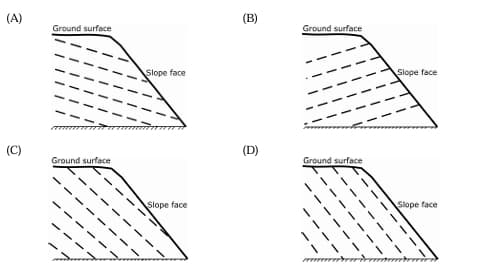
A block of rock with a mass of 72 kg slides on a surface inclined at an angle of 30° as shown in the figure. Assuming no cohesion and friction, the force is ........... Newton (answer in one decimal place; acceleration due to gravity = 9.8 m/s²). 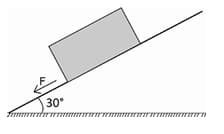
| Group I | Group II | ||
| P | Shear modulus | 1 | |
| Q | Hydraulic conductivity | 2 | |
| R | Volumetric strain | 3 | |
| S | Dry density | 4 | |
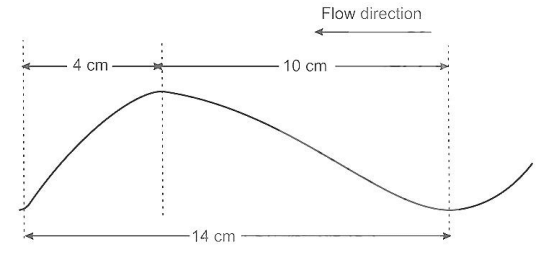
(Round off to three places of decimals)
(Use decay constant for 147Sm = 6.54 × 10⁻¹² y-1)
Two boreholes A and B, both inclined towards 270°, penetrate a dipping coal bed at the same point and pass through it entirely in the sub-surface as shown in the figure below. The bed dips towards 270°. The thickness of the coal bed, measured along the borehole A is 10 m and along borehole B is 8 m. The angle between the two boreholes is 20°. The orthogonal thickness of the coal bed is ........ m. (Round off to one decimal place) 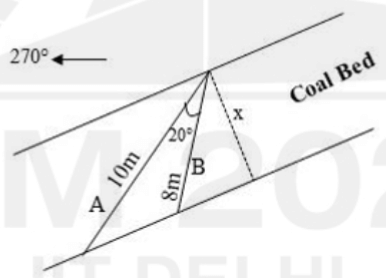
The data tabulated below are for flooding events in the last 400 years.
The probability of a large flood accompanied by a glacial lake outburst flood (GLOF) in 2025 is ........... . (Round off to one decimal place)
| Year | Flood Size | Magnitude rank |
|---|---|---|
| 1625 | Large | 2 |
| 1658 | Large + GLOF | 1 |
| 1692 | Small | 4 |
| 1704 | Large | 2 |
| 1767 | Large | 2 |
| 1806 | Small | 4 |
| 1872 | Large + GLOF | 1 |
| 1909 | Large | 2 |
| 1932 | Large | 2 |
| 1966 | Medium | 3 |
| 2023 | Large + GLOF | 1 |
A satellite launching vehicle is carrying a lander for Moon mapping.
As shown in the figure below, P is the position where the gravitational forces exerted by Earth and Moon on the vehicle balance out.
The distance from the center of the Earth is ........... km. (Round off to two decimal places)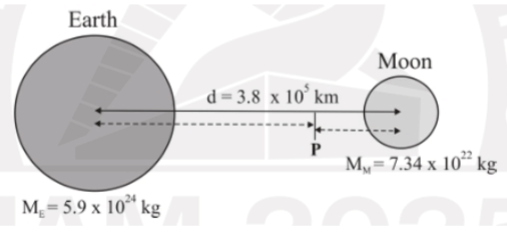
The isobaric temperature-composition (T–X) phase diagram given below shows the phase relation between components M and N. The equilibrium melting undergone by the rock R to generate the liquid of composition L is .............. % (In integer )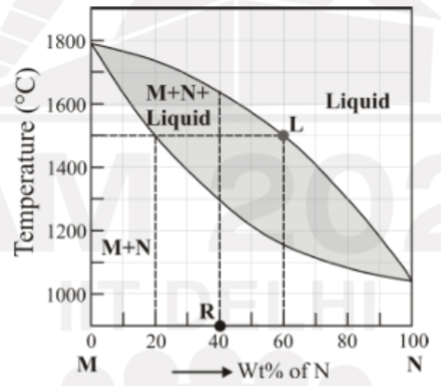
Which of the following stereographic projections represent(s) an upright plunging fold? 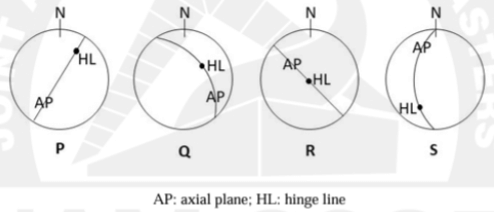
Match the morphological features in Group I with their corresponding descriptions given in Group II.
| Group I | Group II |
|---|---|
| P. Hyponome | 3. Long tubular structure |
| Q. Myophore | 4. Shaft with a head |
| R. Hypostome | 1. A large plate |
| S. Myostracum | 2. Irregular prismatic crystals |
Refer the dam section shown below. Which one of the following conditions represents the most stable state of the dam against rotation about its center of gravity? 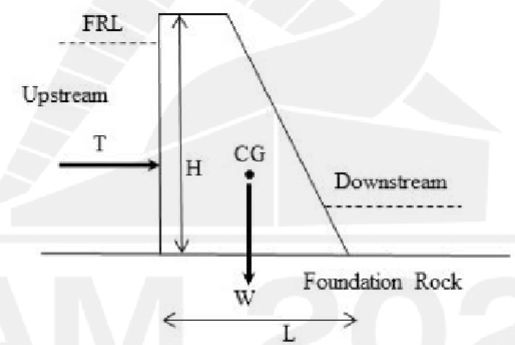
The following map shows an outcrop of a coal bed that intersects the elevation contours. Which one of the following statements is CORRECT? 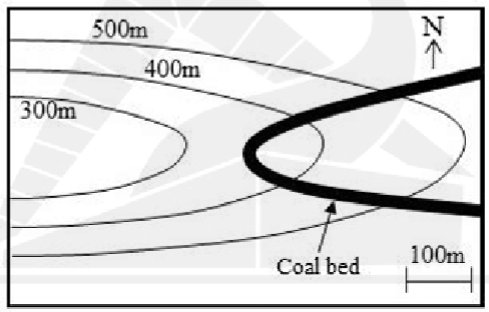
Match the cycles in Group I with the corresponding processes in Group II.
| Group I | Group II |
|---|---|
| P. Hydrological cycle | 1. Regolith formation |
| Q. Biogeochemical cycle | 2. Ocean closure |
| R. Rock cycle | 3. Infiltration |
| S. Wilson cycle | 4. Denitrification |
Considering ideal mixing of Fe and Mg in orthopyroxene and ilmenite solid solutions, the mole fractions are and . The equilibrium constant of the above reaction is ............. (Round off to two decimal places)
\hline P. 3A2, 3m, 4A3+i & 1. Orthorhombic
Q. i, 1A4, m & 2. Hexagonal
R. i, 3A2, 3m & 3. Tetragonal
S. 1A3+m, 3m, 3A2 & 4. Cubic
\hline \end{tabular}
About Applied Geology - IIT-JAM-GG
Applied Geology is a vital chapter for IIT-JAM-GG aspirants. Mastering the concepts covered in this chapter is essential for securing a top rank.
By rigorously practicing the previous year questions associated with this chapter, you can identify high-yield topics, understand the examiner's perspective, and boost your confidence during the actual exam.
Frequently Asked Questions
Why focus on Applied Geology PYQs?
Analyzing PYQs for this specific chapter reveals the most frequently tested concepts and the typical complexity of questions, allowing you to tailor your study plan efficiently.
How to best use this analysis?
Review the topic breakdown to see which sub-topics within Applied Geology carry the most weight. Then, tackle the questions iteratively to solidify your understanding.