Metamorphic Petrology
20 previous year questions.
High-Yield Trend
Chapter Questions 20 MCQs
A schematic deformation (D)-metamorphism (M)-time map of a metamorphic belt is shown below. The belt recorded two phases of deformation, D₁-D₂ and attendant schistosity, S₁-S₂ and metamorphism, M₁-M₂. The metamorphic minerals stable during these events are shown by solid lines. On the basis of this information, which of the following statement(s) is/are correct? 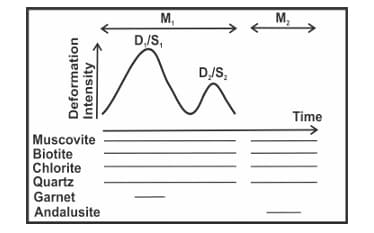
The following diagram represents the prograde sequence of metamorphic zones that develop during Buchan-type of metamorphism (<4 kbar) of typical pelites. Identify the zones labelled P, Q, and R. 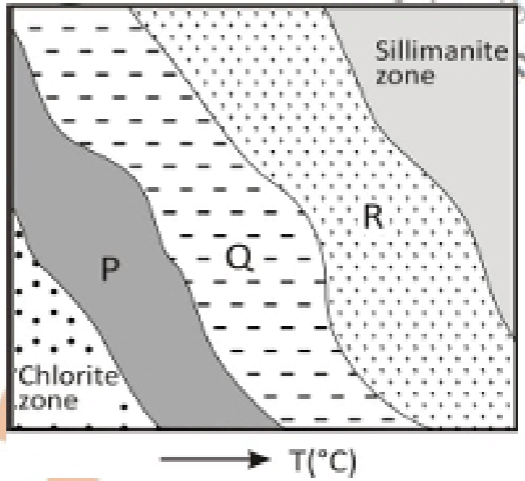
The shaded region (P) in the given ACF diagram represents the compositional range of mafic rocks that have undergone granulite facies metamorphism. Which of the following equilibrium mineral assemblages is/are identified in these mafic rocks? 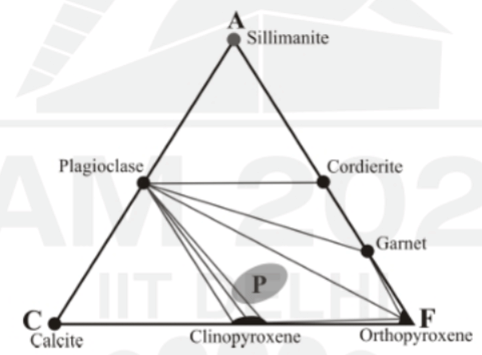
The schematic diagram given below shows textual relationship among garnet, muscovite, biotite and kyanite in a metapelite. Biotite defines S1 foliation and muscovite defines S2 and S3 foliations. S1, S2, and S3 fabrics were developed during distinct deformation events D1, D2, and D3, respectively. Which one of the following represents the pre-D3 mineral assemblage? 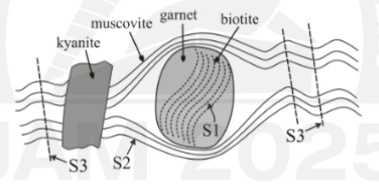
About Metamorphic Petrology - IIT-JAM-GG
Metamorphic Petrology is a vital chapter for IIT-JAM-GG aspirants. Mastering the concepts covered in this chapter is essential for securing a top rank.
By rigorously practicing the previous year questions associated with this chapter, you can identify high-yield topics, understand the examiner's perspective, and boost your confidence during the actual exam.
Frequently Asked Questions
Why focus on Metamorphic Petrology PYQs?
Analyzing PYQs for this specific chapter reveals the most frequently tested concepts and the typical complexity of questions, allowing you to tailor your study plan efficiently.
How to best use this analysis?
Review the topic breakdown to see which sub-topics within Metamorphic Petrology carry the most weight. Then, tackle the questions iteratively to solidify your understanding.