Structural Geology
74 previous year questions.
High-Yield Trend
Chapter Questions 74 MCQs
The schematic map given below shows intersecting strike lines of the same lithological contact. In the map, AB and CD are 5 cm and 3.5 cm, respectively. The scale of the map is 1 cm = 100 m. The plunge of the fold axis is (give answer in one decimal place). 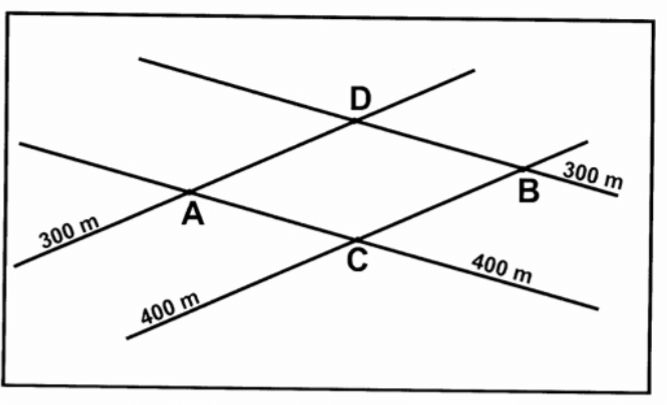
The schematic map given below shows intersecting strike lines of the same lithological contact. In the map, AB and CD are 5 cm and 3.5 cm, respectively. The scale of the map is 1 cm = 100 m. The plunge of the fold axis is ....... degrees (give answer in one decimal place).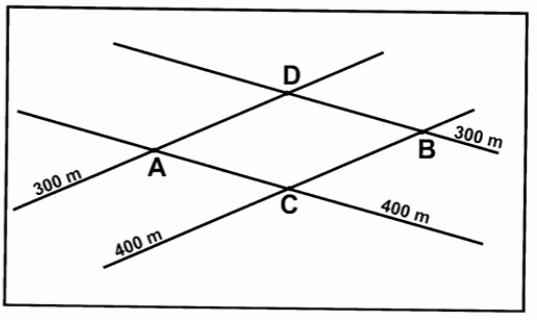
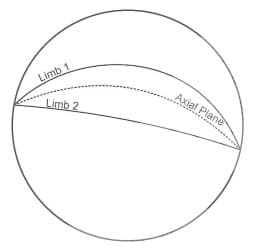
The orientations of the fold axis and axial plane in the given figure indicate 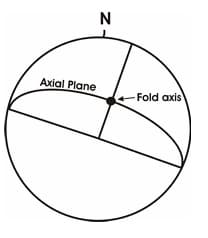
Attitudes of beds in sequences A (younger) and B (older), separated by an unconformity UU, are given in the following sectional view. If UU was horizontal when sequence A was deposited, the dip amount of beds in sequence B at that time was ...... (answer in one decimal place). 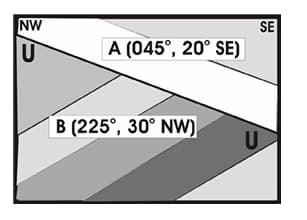
Attitudes of the two limbs of a non-plunging kink fold shown below are 045°, 20°SE and 045°, 40°NW. The dip amount (in degrees) of the axial plane of the kink fold is ............ (answer in one decimal place). 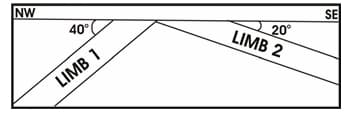
The true thickness of Bed A in the map given below is ......... m (answer in one decimal place). 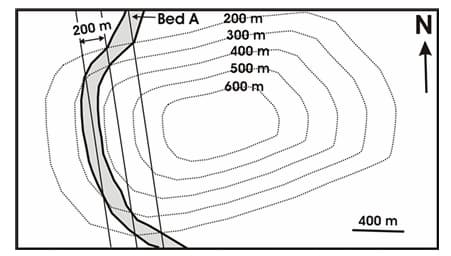
The geological map shows the contact between sandstone and limestone. The two dotted curves are the contours of 400 m and 500 m, respectively. The difference between the dip angles of the contact surface along the AB and AC directions is _________ degrees (rounded to two decimal places). 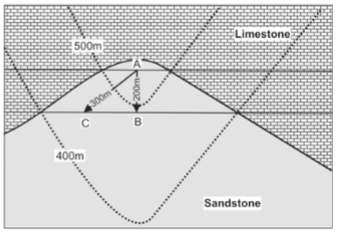
Figures X and Y show profile sections of folds traced by two cross-bedded sandstone beds. Which one of the following is the correct interpretation? 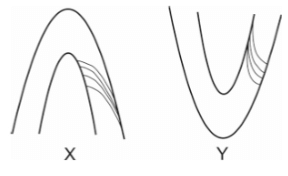
The figure shows stereographic projections of the axial plane and the hinge line of a fold. Which one of the following folds is represented in the figure? 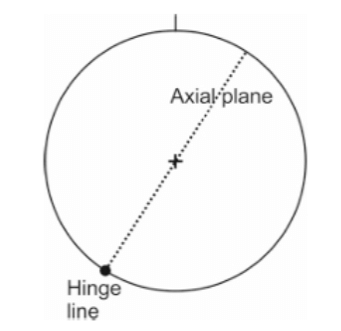
Figures I, II and III are the outcrop patterns of three inclined beds P, Q and R on a flat ground. P is the oldest and R is the youngest amongst these beds. Identify the correct option that explains repetition of beds in the figures. 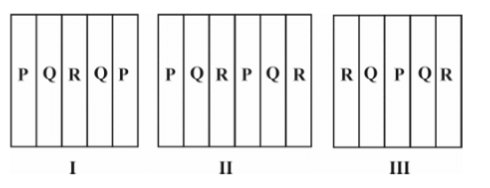
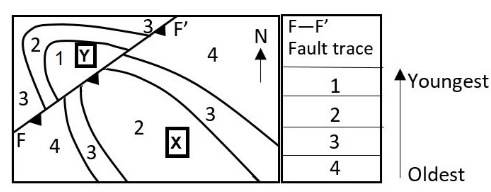
A set of sedimentary rocks A, B, and C are affected by a fault F-F. The amount of vertical throw (in m) along the fault is ............ 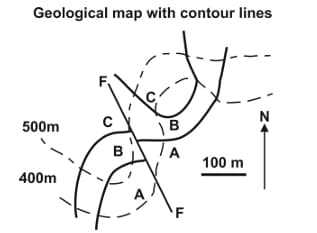
Identify the fold in the given figure, where T₀ and Tα represent the axial plane thicknesses at the hinge and limb, respectively. 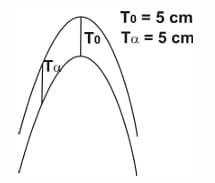
Identify the type of fault in the given figure. 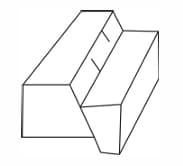
A northerly dipping fault (F-F) has displaced beds P, Q and R. The thickness of the beds across the fault is same. Identify the fault type(s). 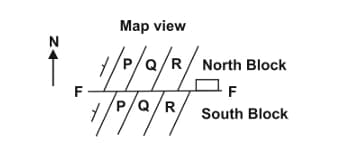
A bedding plane, pictorially represented at X, will be plotted in stereonet as 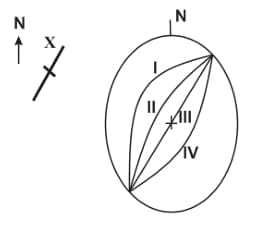
In the block diagram, the net slip (=100 m) is resolved into strike slip (s) and dip slip (d) components. The value (in m, correct to two decimal places) of "s" is ..... 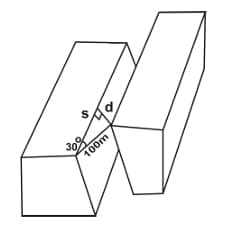
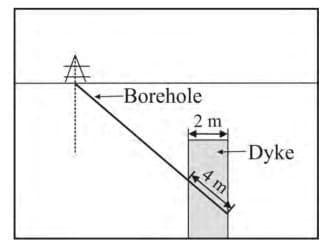
The true thickness (t, in m) of bed B in the given diagram is ..... 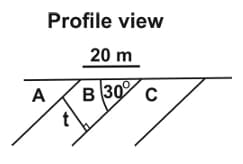
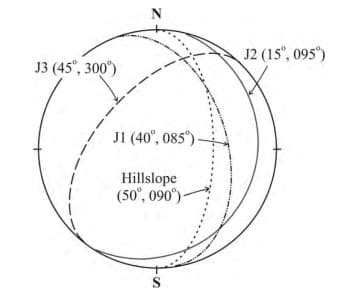
On the basis of the following schematic diagram, choose the CORRECT statement(s). 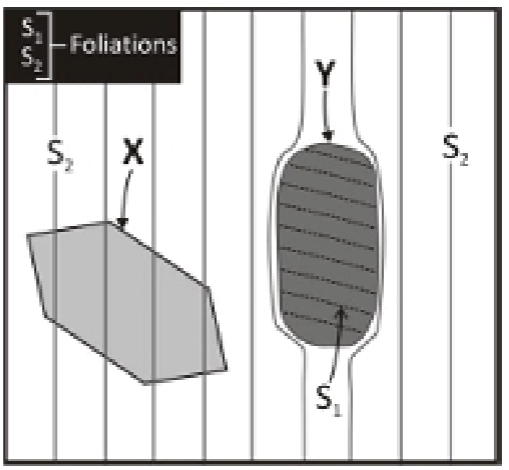
Select the answer that is a CORRECT match for the three types of unconformities. (Grey bands = sediments, [ + ] = igneous rock). 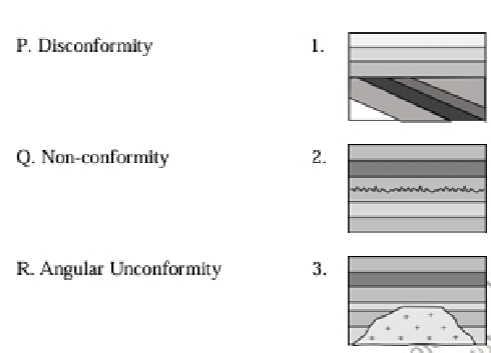
\includegraphics[width=0.5\linewidth]{50.jpeg}
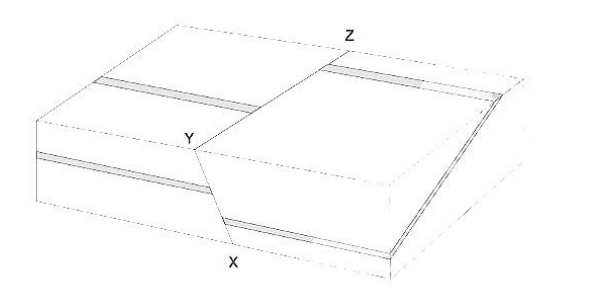
About Structural Geology - IIT-JAM-GG
Structural Geology is a vital chapter for IIT-JAM-GG aspirants. Mastering the concepts covered in this chapter is essential for securing a top rank.
By rigorously practicing the previous year questions associated with this chapter, you can identify high-yield topics, understand the examiner's perspective, and boost your confidence during the actual exam.
Frequently Asked Questions
Why focus on Structural Geology PYQs?
Analyzing PYQs for this specific chapter reveals the most frequently tested concepts and the typical complexity of questions, allowing you to tailor your study plan efficiently.
How to best use this analysis?
Review the topic breakdown to see which sub-topics within Structural Geology carry the most weight. Then, tackle the questions iteratively to solidify your understanding.