Petrology
51 previous year questions.
High-Yield Trend
Chapter Questions 51 MCQs
Identify the rocks P and Q in the diagram as per the IUGS classification. 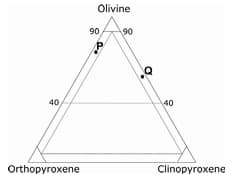
Group I
P. Granite
Q. Syenite
R. Diorite
S. Gabbro
Group II
1. Andesite
2. Basalt
3. Rhyolite
4. Trachyte
P-4, Q-3, R-1, S-2
P-3, Q-4, R-2, S-1
Match the sedimentary structures in Group I with the corresponding processes in Group II.
Group I Group II
P. Stromatolite 1. Desiccation
Q. Flute cast 2. Liquefaction
R. Mud crack 3. Bioturbation
S. Dish and pillar 4. Erosion
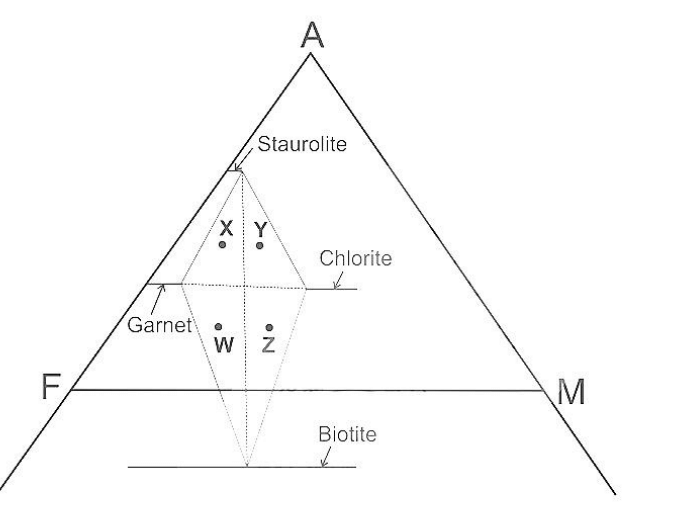
Match the metamorphic rocks in Group I with corresponding parent rocks in Group II. 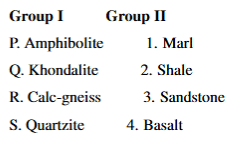
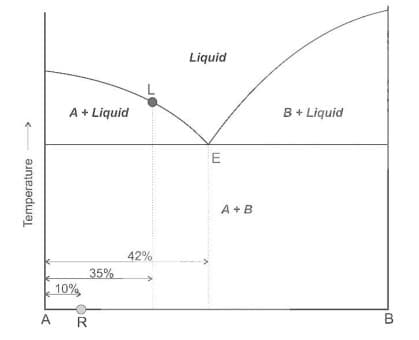
Consider the schematic isobaric T-X phase diagram in the binary forsterite (Fo)-fayalite (Fa) chemical system. If there is equilibrium crystallization of melt (L), the wt.% of olivine crystallized from a melt of composition "a" at a temperature T2 is ......... 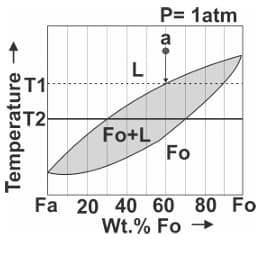
Consider a schematic isobaric ternary phase diagram A-B-C, shown below, which is contoured with isopleths of liquidus temperatures (in ), reveals crystallization behaviour of melt (L) of different compositions during cooling. When a melt of composition "a" lies at a temperature of 1800 , the variance (or degree of freedom) of the magmatic system is ........ 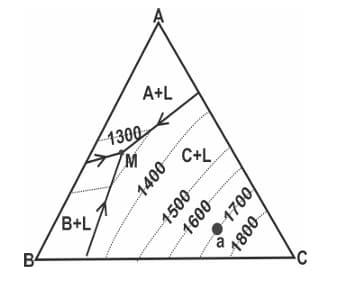
The following table shows modal abundance and mineral composition data of a plutonic igneous rock. The amount of SiO2 in bulk composition of the rock is ________ %. (Round off to two decimal places.)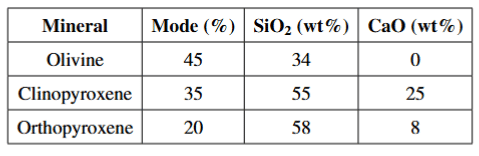
In the following isobaric temperature–composition diagram, the number of common phases in all the invariant points is ________ (Answer in integer). 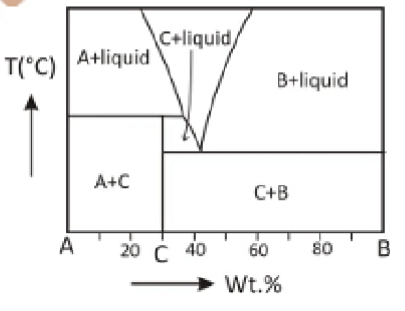
| Group I | Group II | ||
| P | Packstone | 1 | < I5% matrix, > 25% rock fragments |
| Q | Cirainstone | 2 | > 15<½! matrix, >259t feldspar |
| R | Lithic arenite | 3 | Grain supported, contains no mud |
| S | Arkosic wacke | 4 | Grain supported, contains mud |
| Group I | Group II | ||
| P | Diorite | 1 | plagioclase-orthopyroxene clinopyroxene |
| Q | Tole | 2 | olivine-orthopyroxene-clinopyroxene |
| R | Norite | 3 | plagioclase-homblonde + quartz |
| S | Lherzolite | 4 | quarte-plagioclase K-feldspar |
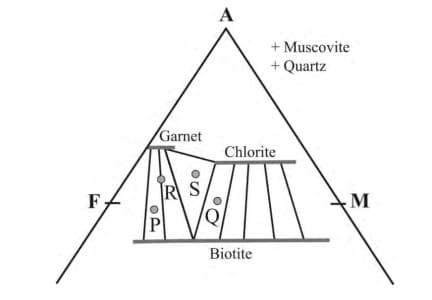
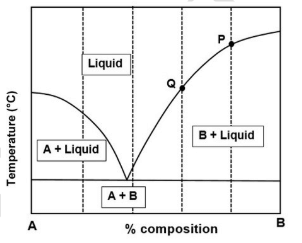
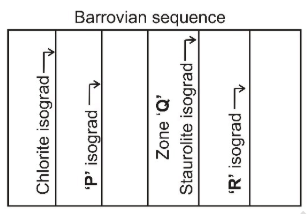
| Group I | Group II |
| P. Stylolite | 1. Liquefaction |
| Q. Pseudonodule | 2. Diagenesis |
| R. Current crescent | 3. Organo-sedimentary binding |
| S. Stromatolite | 4. Scouring |
About Petrology - IIT-JAM-GG
Petrology is a vital chapter for IIT-JAM-GG aspirants. Mastering the concepts covered in this chapter is essential for securing a top rank.
By rigorously practicing the previous year questions associated with this chapter, you can identify high-yield topics, understand the examiner's perspective, and boost your confidence during the actual exam.
Frequently Asked Questions
Why focus on Petrology PYQs?
Analyzing PYQs for this specific chapter reveals the most frequently tested concepts and the typical complexity of questions, allowing you to tailor your study plan efficiently.
How to best use this analysis?
Review the topic breakdown to see which sub-topics within Petrology carry the most weight. Then, tackle the questions iteratively to solidify your understanding.