Mineralogy
82 previous year questions.
High-Yield Trend
Chapter Questions 82 MCQs
Core: Ca₀.₆Na₀.₄Al₁.₆Si₂.₄O₈
Rim: Ca₀.₄Na₀.₆Al₁.₄Si₂.₆O₈
The amount of increase of Na atom from core to rim per formula unit of plagioclase is (give answer in one decimal place).
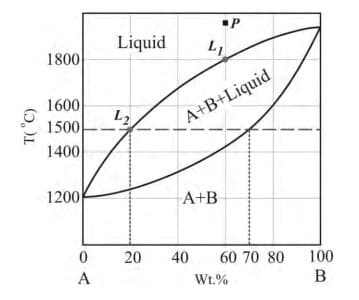
Considering garnet chemical formula in 12 oxygen basis, the number of Mg cations in a garnet of chemical composition P (as shown in the figure) is ........ (give answer in two decimal places).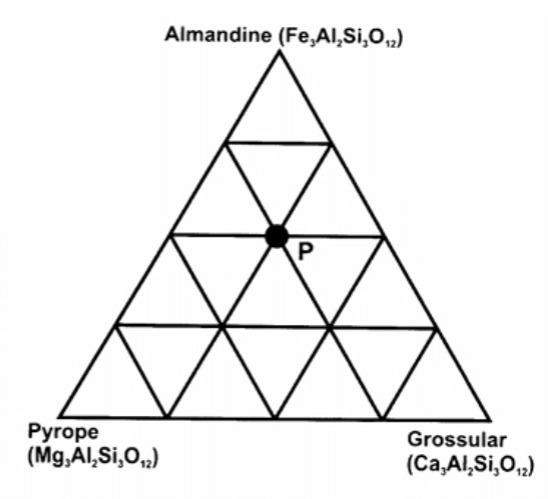
Match the mineral deposits in Group I with their Indian occurrences in Group II.
Group I Group II
P. Chromite 1. Jhamarkotra, Rajasthan
Q. Magnesite 2. Gudur, Andhra Pradesh
R. Mica 3. Byrapur, Karnataka
S. Phosphorite 4. Chalk Hills, Tamil Nadu
\includegraphics[width=0.5\linewidth]{57.jpeg}
P ( , , ),
Q ( , ),
R ( , , ),
S ( , ).
The value of maximum birefringence among all the minerals is ......... (give answer in three decimal places).
\includegraphics[width=0.5\linewidth]{57.jpeg}
P ( ),
Q ( ),
R ( ) and
S ( )
The value of maximum birefringence among all the minerals is (give answer in three decimal places).
Core: Ca₀.₆Na₀.₄Al₁.₆Si₂.₄O₈
Rim: Ca₀.₄Na₀.₆Al₁.₄Si₂.₆O₈
The amount of increase of Na atom from core to rim per formula unit of plagioclase is (give answer in one decimal place).
Apatite, Corundum, Gypsum, Talc, Topaz
Which one of the following minerals has isolated (SiO ) tetrahedra linked by divalent cations in octahedral coordination?
The given P-T diagram shows the relative stability ranges of andalusite, sillimanite, and kyanite. The difference in degrees of freedom at points X and Y is _________. 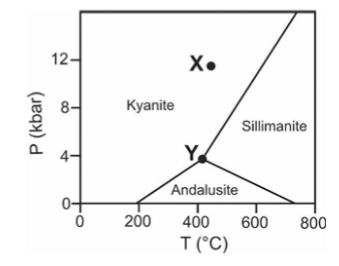
The difference between and in a feldspar represented by in the given triangular diagram is _________ (answer in one decimal place). 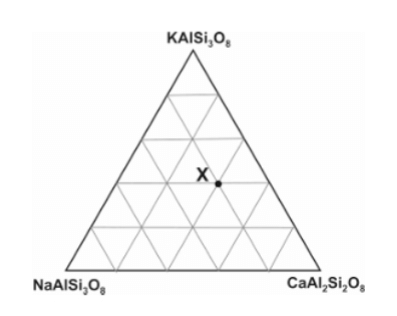
The radii of and ions are 1.12 AA and 1.31AA respectively. The coordination number of in mineral AB is _________
Match the minerals in Group I with corresponding characteristic properties in Group II. 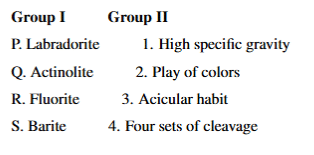
Which of the following minerals exhibits the optic interference figure given below? 
The general formula of an amphibole mineral is A₀₋1B₂C₅T₃O₂₂(OH)₂, where A, B, C, and T are cationic sites with different co-ordination numbers as stated below: A=12, B=6-8, C=6, T=4. The amount of octahedral Al in an amphibole of composition Na₀.₆Ca₂Mg3.8Al₃Si₆O₂₂(OH)₂ is ......
Match the minerals in Group I with the corresponding composition in Group II.
Group I Group II
P. Leucite 1. (K,Na)AlSi3O8
Q. Andradite 2. NaAlSi2O6
R. Sanidine 3. KAlSi2O6
S. Jadeite 4. Ca3Fe2Si3O12
| Group I | Group II | ||
| P | Sodalite | 1 | Mottled extinction |
| Q | Tourmaline | 2 | Isotropic |
| R | Calcite | 3 | Pleochroic from blue to brown |
| S | Muscovite | 4 | Twinkling effect |
(Round off to one decimal place)
| Group I | Group II |
| P. Sillimanite | 1. First order |
| Q. Quartz | 2. Second order |
| R. Muscovite | 3. Greater than third order |
| S. Calcite | 4. Third order variegated |
| Group I | Group II |
| P. Bababudan Group | 1. Eastern Dharwar |
| Q. Banded Gneissic Complex-I | 2. Western Dharwar |
| R. Bonai Granite | 3. Aravalli |
| S. Kolar Group | 4. Singhbhum |
About Mineralogy - IIT-JAM-GG
Mineralogy is a vital chapter for IIT-JAM-GG aspirants. Mastering the concepts covered in this chapter is essential for securing a top rank.
By rigorously practicing the previous year questions associated with this chapter, you can identify high-yield topics, understand the examiner's perspective, and boost your confidence during the actual exam.
Frequently Asked Questions
Why focus on Mineralogy PYQs?
Analyzing PYQs for this specific chapter reveals the most frequently tested concepts and the typical complexity of questions, allowing you to tailor your study plan efficiently.
How to best use this analysis?
Review the topic breakdown to see which sub-topics within Mineralogy carry the most weight. Then, tackle the questions iteratively to solidify your understanding.