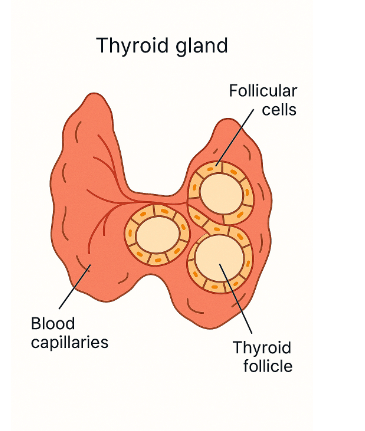
Draw a neat diagram of thyroid gland and label thyroid follicle, follicular cells, and blood capillaries.
Official Solution
Correct Option:
(1)
Diagram shows thyroid gland with thyroid follicle (central cavity), follicular cells (surrounding the follicle), and blood capillaries (adjacent vessels).
02
PYQ 2023
medium
biologyID: maharash
Calcium and Phosphate ions are balanced between blood and other tissues by ______.
1
Thymosin and Parathormone
2
Calcitonin and Somatostatin
3
Collip’s hormone and Calcitonin
4
Calcitonin and Thymosin
Official Solution
Correct Option:
(3)
Collip’s hormone (parathormone) increases blood calcium and phosphate levels, while calcitonin decreases them, maintaining balance. Thymosin affects immunity, and somatostatin regulates other hormones. Answer: Collip’s hormone and Calcitonin.
03
PYQ 2023
medium
biologyID: maharash
Identify the INCORRECT statement.
1
In a flaccid cell, T.P. is zero
2
In a turgid cell, DPD is zero
3
In a fully turgid cell, TP = OP
4
Water potential of pure water is negative
Official Solution
Correct Option:
(4)
- (A) True: In a flaccid cell, turgor pressure (T.P.) is zero due to no water pressure against the cell wall. - (B) True: In a turgid cell, diffusion pressure deficit (DPD) is zero as the cell is fully saturated. - (C) True: In a fully turgid cell, turgor pressure (TP) equals osmotic pressure (OP). - (D) False: Water potential of pure water is zero (maximum), not negative. Answer: Water potential of pure water is negative.
04
PYQ 2023
medium
biologyID: maharash
In Hamburger’s phenomenon, _______.
1
Cl diffuse into WBCs
2
Cl diffuse into RBCs
3
Na diffuse into RBCs
4
Na diffuse into WBCs
Official Solution
Correct Option:
(2)
Hamburger’s phenomenon (chloride shift) involves the diffusion of chloride ions (Cl ) into red blood cells (RBCs) to balance the movement of bicarbonate ions out of RBCs during CO transport in blood. Answer: Cl diffuse into RBCs.
05
PYQ 2023
medium
biologyID: maharash
What is blood pressure?
Give the name of the instrument which is used to measure the blood pressure.
Differentiate between an artery and a vein with reference to lumen and thickness of wall.
Official Solution
Correct Option:
(1)
i. Blood Pressure: The force exerted by circulating blood against the walls of blood vessels, primarily arteries, measured as systolic (during heart contraction) and diastolic (during heart relaxation) pressures, typically in mmHg.
ii. Instrument: Sphygmomanometer
iii. Differentiation:
Feature
Artery
Vein
Lumen
Narrow, smaller diameter
Wider, larger diameter
Thickness of Wall
Thicker, with more muscle and elastic tissue
Thinner, with less muscle and elastic tissue
Answer: i. Force of blood on vessel walls; ii. Sphygmomanometer; iii. Artery: narrow lumen, thick wall; Vein: wide lumen, thin wall.
06
PYQ 2023
medium
biologyID: maharash
Explain three main functions of free antibodies produced by B-lymphocytes.
Official Solution
Correct Option:
(1)
1. Neutralization: Antibodies bind to pathogens or toxins, preventing them from infecting cells or causing harm. 2. Opsonization: Antibodies mark pathogens for phagocytosis by immune cells like macrophages. 3. Complement Activation: Antibodies trigger the complement system, leading to pathogen lysis or enhanced immune response. Answer: Neutralization, opsonization, complement activation.
07
PYQ 2023
medium
biologyID: maharash
Give any two functions of cerebellum.
Write the names of any four motor cranial nerves with their appropriate serial number.
Which hormones stimulate liver for glycogenesis and glycogenolysis?
Official Solution
Correct Option:
(1)
i. Cerebellum Functions: 1. Coordinates voluntary movements and balance. 2. Regulates muscle tone and motor learning. ii. Motor Cranial Nerves: 1. Oculomotor (III) 2. Trochlear (IV) 3. Abducens (VI) 4. Hypoglossal (XII) iii. Hormones: - Glycogenesis: Insulin (promotes glucose storage as glycogen). - Glycogenolysis: Glucagon (promotes glycogen breakdown to glucose). Answer: i. Movement coordination, muscle tone; ii. Oculomotor (III), Trochlear (IV), Abducens (VI), Hypoglossal (XII); iii. Insulin, Glucagon.
08
PYQ 2023
medium
biologyID: maharash
Differentiate between sympathetic and parasympathetic nervous system with reference to:
a. Pre and post ganglionic nerve fibres.
b. Effect on heart beat.
Give reason – All spinal nerves are of mixed type.
Official Solution
Correct Option:
(1)
i. Differentiation:
Feature
Sympathetic
Parasympathetic
Pre and Post Ganglionic Fibres
Short pre-ganglionic, long post-ganglionic
Long pre-ganglionic, short post-ganglionic
Effect on Heart Beat
Increases heart rate
Decreases heart rate
ii. Reason: Spinal nerves are mixed because they contain both sensory (afferent) and motor (efferent) fibres, carrying sensory signals to the spinal cord and motor signals to muscles/glands. Answer: i. Sympathetic has short pre-ganglionic, increases heart rate; parasympathetic has long pre-ganglionic, decreases heart rate; ii. Spinal nerves carry both sensory and motor fibres.
09
PYQ 2023
medium
biologyID: maharash
Describe the steps in breathing.
Official Solution
Correct Option:
(1)
Breathing involves: 1. Inspiration: Diaphragm contracts, thoracic cavity expands, intrapulmonary pressure decreases, air enters lungs. 2. Expiration: Diaphragm relaxes, thoracic cavity contracts, intrapulmonary pressure increases, air is expelled. Answer: Inspiration (air intake via diaphragm contraction) and expiration (air expulsion via relaxation).
10
PYQ 2023
medium
biologyID: maharash
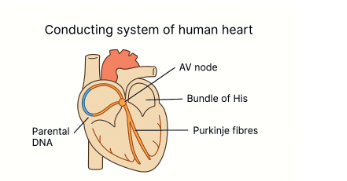
Draw a neat diagram of the conducting system of human heart and label AV node, Bundle of His, and Purkinje fibres.
Official Solution
Correct Option:
(1)
Answer: Diagram shows AV node (central relay), Bundle of His (conduction pathway), and Purkinje fibres (ventricular spread).
11
PYQ 2025
medium
biologyID: maharash
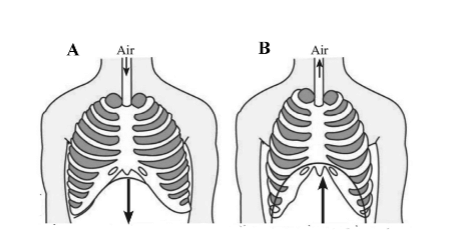
Interpret the given diagrams A and B. Enlist the changes occurring during inspiration and expiration.
Official Solution
Correct Option:
(1)
Interpretation of Diagrams
Diagram A – Inspiration (Inhalation): Air enters the lungs as shown by arrows pointing inward. The diaphragm contracts and flattens downward, while the rib cage moves upward and outward. This increases the volume of the thoracic cavity.
Diagram B – Expiration (Exhalation): Air leaves the lungs as shown by arrows pointing outward. The diaphragm relaxes and arches upward, while the rib cage moves downward and inward. This decreases the volume of the thoracic cavity.
Changes during Inspiration and Expiration
Feature
Inspiration (Active Process)
Expiration (Passive Process)
Diaphragm
Contracts and flattens
Relaxes and arches upwards
External Intercostal Muscles
Contract
Relax
Ribs and Sternum
Move upwards and outwards
Move downwards and inwards
Volume of Thoracic Cavity
Increases
Decreases
Pressure in Lungs
Decreases (becomes negative compared to atmosphere)
Increases (becomes positive compared to atmosphere)
Movement of Air
Air rushes into the lungs
Air is forced out of the lungs
12
PYQ 2025
medium
biologyID: maharash
Give the name and type of I, IV and VII cranial nerves.
Official Solution
Correct Option:
(1)
The cranial nerves are a set of 12 paired nerves that emerge directly from the brain. The name and type of the requested nerves are:
Cranial Nerve I:
Name: Olfactory Nerve Type: Sensory (Specifically, special visceral sensory). It is responsible for the sense of smell.
Cranial Nerve IV:
Name: Trochlear Nerve Type: Motor (Somatic motor). It controls a single extrinsic eye muscle, the superior oblique, which helps in eye movement.
Cranial Nerve VII:
Name: Facial Nerve Type: Mixed (both Sensory and Motor).
Its motor functions include controlling the muscles of facial expression. Its sensory functions include carrying taste sensations from the anterior two-thirds of the tongue. It also has parasympathetic motor functions to stimulate salivary and lacrimal (tear) glands.
13
PYQ 2025
medium
biologyID: maharash
Name and describe hormones secreted by ovaries.
Official Solution
Correct Option:
(1)
The ovaries are the female gonads that secrete two main groups of steroid hormones: estrogens and progesterone.
Estrogen:
Source: It is primarily synthesized and secreted by the growing ovarian follicles (granulosa cells). Functions: Estrogen is responsible for a wide range of functions, including:
Stimulating the growth, maturation, and maintenance of female reproductive organs like the uterus and vagina. Development of female secondary sexual characteristics at puberty, such as the growth of breasts and pubic hair, and the characteristic female body shape. Regulating the menstrual cycle, specifically by causing the proliferation (thickening) of the uterine lining (endometrium) during the follicular phase.
Progesterone:
Source: It is mainly secreted by the corpus luteum, which forms from the ruptured follicle after ovulation. Functions: Progesterone is often called the "pregnancy hormone" because its primary role is to prepare the body for and support pregnancy. Its functions include:
Preparing the endometrium for the implantation of a fertilized egg by making it more glandular and vascular (secretory phase). Inhibiting uterine contractions to maintain pregnancy. Promoting the development of the mammary glands (alveoli) in preparation for milk production.
Ovaries also produce smaller amounts of hormones like inhibin (which inhibits FSH secretion) and relaxin (which relaxes pelvic ligaments during childbirth).
14
PYQ 2025
medium
biologyID: maharash
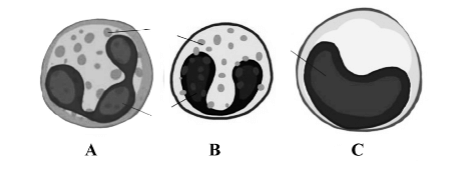
Identify A, B, and C from the above diagrams and give their functions.
Official Solution
Correct Option:
(1)
The diagrams show three different types of white blood cells (leukocytes).
A is a Neutrophil:
Identification: It is identified by its multi-lobed nucleus (typically 3-5 lobes connected by thin strands) and fine, granular cytoplasm. Function: Neutrophils are highly phagocytic cells. They are the most abundant type of WBC and act as the first line of defense against bacterial infections by engulfing and destroying pathogens.
B is an Eosinophil:
Identification: It is characterized by its bilobed nucleus (resembling headphones or spectacles) and large, coarse cytoplasmic granules that stain reddish-pink with acidic dyes like eosin. Function: Eosinophils are primarily involved in combating parasitic infections (especially helminths or worms) and also play a significant role in modulating allergic inflammatory responses.
C is a Monocyte:
Identification: It is the largest of all WBCs and is identified by its large, kidney-bean or C-shaped nucleus and abundant, non-granular (agranular) cytoplasm. Function: Monocytes are also phagocytic. They circulate in the blood for a few days before migrating into tissues, where they differentiate into macrophages. Macrophages are powerful phagocytes that engulf pathogens, dead cells, and cellular debris.
15
PYQ 2025
medium
biologyID: maharash
Which cells of islets of Langerhans produce a hormone insulin?
Official Solution
Correct Option:
(1)
The cells of the Islets of Langerhans that produce the hormone insulin are called Beta cells.
Explanation:
The Islets of Langerhans are clusters of cells in the pancreas that are involved in the regulation of blood sugar levels. These clusters contain different types of cells, each of which produces a specific hormone:
Alpha cells - produce the hormone glucagon, which raises blood sugar levels.
Beta cells - produce the hormone insulin, which lowers blood sugar levels by facilitating the uptake of glucose into cells.
Delta cells - produce somatostatin, which inhibits the release of both insulin and glucagon.
F cells - produce pancreatic polypeptide, which is involved in regulating pancreatic enzyme secretion.
Role of Insulin:
Insulin is crucial for maintaining the balance of glucose in the blood. It helps cells absorb glucose from the bloodstream, thus lowering blood sugar levels and providing energy for the body. Deficiency or resistance to insulin leads to conditions like diabetes mellitus.
Conclusion:
Beta cells in the Islets of Langerhans are responsible for the production of insulin, a vital hormone for regulating blood sugar levels and overall metabolic function.
16
PYQ 2025
medium
biologyID: maharash
Give the name of endocrine gland which is prominent at birth but gets gradually atrophied in adult stage.
Official Solution
Correct Option:
(1)
The endocrine gland that is prominent at birth but gets gradually atrophied in the adult stage is the Thymus gland.
Explanation:
The thymus is an important part of the immune system, especially during early life. It is located behind the sternum and plays a key role in the development of T-cells, which are crucial for the immune response. At birth, the thymus is relatively large, but it starts to shrink and atrophy as a person matures. By adulthood, the thymus is much smaller and is largely replaced by fatty tissue.
Function of Thymus:
Production and maturation of T-lymphocytes (T-cells), which are essential for the immune system.
Helps in the development of self-tolerance to avoid autoimmune diseases.
Conclusion:
While the thymus plays a vital role in the immune system during childhood, its function diminishes with age, and it becomes less prominent in adulthood.
17
PYQ 2025
medium
biologyID: maharash
Which of the following divides nasal cavity?
1
Hyaline cartilage
2
Mesethmoid cartilage
3
Ligamentum arteriosum
4
Laryngopharynx
Official Solution
Correct Option:
(2)
The nasal cavity is divided into two halves by the nasal septum. The anterior part of the nasal septum is made of cartilage, specifically the septal cartilage, which is part of the mesethmoid cartilage complex (derived from the ethmoid bone). The posterior part is bony. Mesethmoid cartilage is the correct term for the cartilaginous structure that forms a significant part of the nasal septum.
18
PYQ 2025
easy
biologyID: maharash
Select and rewrite appropriate disorder of respiratory system with the given symptoms :
[ sinusitis, emphysema, silicosis and asbestosis, laryngitis ]
Official Solution
Correct Option:
(1)
Below is a list of some common respiratory conditions along with their symptoms:
Breakdown of alveoli, shortness of breath. Emphysema
Inflammation of the sinuses, mucous discharge. Sinusitis
Inflammation of larynx, vocal cord, sore throat, hoarseness of voice, mucous build up, and cough. Laryngitis
Inflammation of fibrosis, lung damage. Silicosis and Asbestosis
About Human Physiology - MAHARASHTRA-CLASS-XII
Human Physiology is a vital chapter for MAHARASHTRA-CLASS-XII aspirants. Mastering the concepts covered in this chapter is essential for securing a top rank.
By rigorously practicing the previous year questions associated with this chapter, you can identify high-yield topics, understand the examiner's perspective, and boost your confidence during the actual exam.
Frequently Asked Questions
Why focus on Human Physiology PYQs?
Analyzing PYQs for this specific chapter reveals the most frequently tested concepts and the typical complexity of questions, allowing you to tailor your study plan efficiently.
How to best use this analysis?
Review the topic breakdown to see which sub-topics within Human Physiology carry the most weight. Then, tackle the questions iteratively to solidify your understanding.