- Sea anemones exhibit biradial symmetry, meaning they have characteristics of both bilateral and radial symmetry. - Radial symmetry is seen in jellyfish. - Bilateral symmetry is common in vertebrates. - Asymmetry is seen in sponges.
02
PYQ 2024
medium
zoologyID: ts-eamce
Auricularia is the larval form of:
1
Sea stars
2
Sea cucumbers
3
Sea urchins
4
Sea lilies
Official Solution
Correct Option:
(2)
Step 1: Understanding Echinoderm Larvae
- Auricularia larva is found in Holothuroidea (Sea Cucumbers). - Other Echinoderm larval forms include: - Bipinnaria in Sea stars. - Pluteus in Sea urchins. - Doliolaria in Sea lilies.
03
PYQ 2024
medium
zoologyID: ts-eamce
Assertion (A): Some adult gastropods (e.g., snail) are asymmetrical. Reason (R): Torsion takes place during the development of gastropods.
1
Both (A) and (R) are correct, and (R) is the correct explanation of (A).
2
Both (A) and (R) are correct, but (R) is not the correct explanation of (A).
3
(A) is correct, but (R) is incorrect.
4
(A) is incorrect, but (R) is correct.
Official Solution
Correct Option:
(1)
Step 1: Understanding Gastropod Development
- Gastropods undergo torsion, where the visceral mass twists during larval development, making them asymmetrical as adults. - Since torsion explains asymmetry, (R) is the correct explanation of (A).
04
PYQ 2024
medium
zoologyID: ts-eamce
Flagellum in Peranema is:
1
Stichonematic
2
Pantonematic
3
Acronematic
4
Pantacronematic
Official Solution
Correct Option:
(2)
Step 1: Understanding Flagellar Types
- Pantonematic flagella have both mastigonemes and smooth regions. - Stichonematic flagella have only mastigonemes. - Acronematic flagella have only smooth regions. - Pantacronematic flagella have multiple rows of mastigonemes.
05
PYQ 2024
medium
zoologyID: ts-eamce
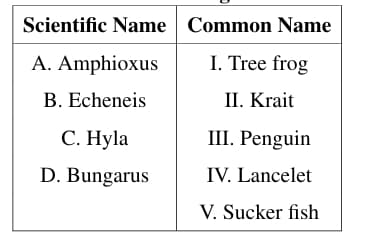
Match the following:
1
A-IV, B-V, C-III, D-II
2
A-IV, B-V, C-I, D-II
3
A-I, B-III, C-V, D-IV
4
A-III, B-I, C-IV, D-I
Official Solution
Correct Option:
(2)
Step 1: Understanding Scientific and Common Names
- Amphioxus (IV) is called Lancelet. - Echeneis (V) is called Sucker fish. - Hyla (I) is called Tree frog. - Bungarus (II) is called Krait (a venomous snake).
06
PYQ 2025
medium
zoologyID: ts-eamce
Gliding locomotion in protozoans is effected by:
1
Myonemes
2
Flagella
3
Cilia
4
Pseudopodia
Official Solution
Correct Option:
(1)
Step 1: Analyze Locomotion Types in Protozoa:
Pseudopodia: Amoeboid movement (e.g., \Amoeba).
Flagella: Flagellar movement (e.g., \Euglena).
Cilia: Ciliary movement (e.g., \Paramecium).
Gliding/Metaboly: Seen in Sporozoans (e.g., \Monocystis, \Plasmodium sporozoites) and some flagellates. This movement is often attributed to contractile fibrils in the pellicle or cortex.
Step 2: Identify the Organelle:
The contractile fibrils responsible for body contraction and gliding/wriggling movements (gregarine movement) in these organisms are called **Myonemes**. Step 3: Final Answer:
Option (A) is the correct effector for gliding/metabolic movement in this context.
07
PYQ 2025
medium
zoologyID: ts-eamce
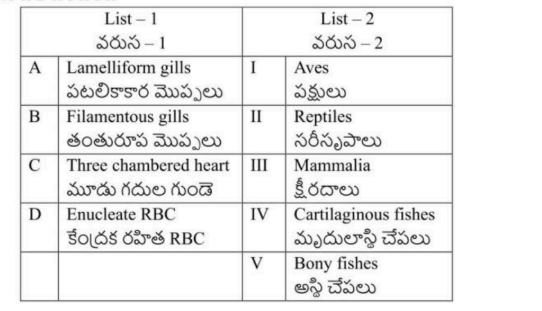
Match the following:
1
A - IV, B - V, C - II, D - III
2
A - III, B - II, C - V, D - IV
3
A - I, B - IV, C - V, D - II
4
A - IV, B - V, C - I, D - III
Official Solution
Correct Option:
(1)
Step 1: Match Each Item:
A. Lamelliform gills: Plate-like gills are characteristic of Elasmobranchs (**Cartilaginous fishes**). Hence, A matches with IV.
B. Filamentous gills: Pectinate or filamentous gills are characteristic of Teleosts (**Bony fishes**). Hence, B matches with V.
C. Three chambered heart: Found in Amphibians and most **Reptiles** (except Crocodiles). Hence, C matches with II.
D. Enucleate RBC: Red blood cells without a nucleus are a distinct feature of **Mammalia** (except camels/llamas which have enucleated but oval RBCs, usually stated as generic mammalian feature). Hence, D matches with III.
Step 2: Sequence:
A - IV, B - V, C - II, D - III. Step 3: Final Answer:
This corresponds to Option (A).
08
PYQ 2025
medium
zoologyID: ts-eamce
The reptile that is considered as living fossil is included in the order:
1
Chelonia
2
Crocodilia
3
Squamata
4
Rhynchocephalia
Official Solution
Correct Option:
(4)
Step 1: Identify the Living Fossil Reptile:
The reptile known as a "living fossil" is the **Tuatara** (\Sphenodon punctatus). It is the sole surviving member of an ancient order of reptiles that flourished 200 million years ago. Step 2: Identify the Order:
\Sphenodon belongs to the order **Rhynchocephalia**. Step 3: Other Options:
(A) Chelonia (Turtles/Tortoises).
(B) Crocodilia (Crocodiles).
(C) Squamata (Lizards and Snakes). Step 4: Final Answer:
Option (D) is correct.
09
PYQ 2025
medium
zoologyID: ts-eamce
In Pheretima, gizzard lies in this segment(s):
1
1 - 3
2
4
3
5 - 7
4
8
Official Solution
Correct Option:
(4)
Step 1: Recall Earthworm (\Pheretima posthuma) Digestive System:
The alimentary canal is a straight tube with the following segmentation:
Mouth: 1st segment.
Buccal Chamber: 1st - 3rd segments.
Pharynx: 4th segment.
Oesophagus: 5th - 7th segments.
Gizzard:8th segment (muscular organ for grinding soil).
Stomach: 9th - 14th segments.
Intestine: 15th segment to the last.
Step 2: Identify the Answer:
The gizzard is located in the 8th segment.
10
PYQ 2025
medium
zoologyID: ts-eamce
Consider the following statements:
Statement-I: Leucocytes are capable of reaching extra vascular areas by diapedesis.
Statement-II: Slight increase of WBC count is called leukemia.
The correct answer is
1
Both statements I and II are true
2
Both statements I and II are false
3
Statement I is true, but statement II is false
4
Statement I is false, but statement II is true
Official Solution
Correct Option:
(3)
Step 1: Analyze Statement I:
Diapedesis is the process by which White Blood Cells (Leucocytes) squeeze through the narrow spaces between the capillary endothelial cells to enter tissues (extra-vascular areas) to fight infection. This is a key property of WBCs. Status: True. Step 2: Analyze Statement II: Leukemia is a type of blood cancer characterized by an abnormal and uncontrolled (massive) increase in the number of immature WBCs.
A slight increase in WBC count (usually in response to infection) is called Leukocytosis, not leukemia. Status: False. Step 3: Final Answer:
Statement I is True, Statement II is False. Option (C).
11
PYQ 2025
medium
zoologyID: ts-eamce
Consider the following statements:
Assertion (A): Kidneys of vertebrates are called retroperitoneal organs.
Reason (R): They are lined by visceral peritoneum only on their ventral side.
The correct answer is
1
Both (A) and (R) are true, (R) is the correct explanation of (A)
2
Both (A) and (R) are true, (R) is not the correct explanation of (A)
3
(A) is true, but (R) is false
4
(A) is false, but (R) is true
Official Solution
Correct Option:
(1)
Step 1: Analyze Assertion (A):
The kidneys are positioned behind the peritoneum (the membrane lining the abdominal cavity). Organs located in this position are termed retroperitoneal ("retro" = behind). Thus, Assertion (A) is true. Step 2: Analyze Reason (R):
Because the kidneys lie against the posterior body wall, the peritoneum covers only their anterior (ventral) surface. They are not completely enclosed by the peritoneum. This specific anatomical arrangement—being covered only on the ventral side—is the \definition and reason for the term "retroperitoneal". Thus, Reason (R) is true and correctly explains why they are called retroperitoneal. Step 3: Final Answer:
Both statements are true, and R explains A.
12
PYQ 2025
medium
zoologyID: ts-eamce
Consider the following statements: Statement-I: In hyaline cartilage, perichondrium is present except in articular cartilages Statement-II: Matrix secreting cells in cartilage are chondrocytes
1
Both statements I and II are true
2
Both statements I and II are false
3
Statement I is true, but statement II is false
4
Statement I is false, but statement II is true
Official Solution
Correct Option:
(1)
Hyaline cartilage is covered by perichondrium except at articular surfaces. Chondrocytes are the cells that secrete the matrix. Hence, both statements are correct.
13
PYQ 2025
medium
zoologyID: ts-eamce
Tape worms belong to
1
Trematoda
2
Phasmidea
3
Cestoda
4
Turbellaria
Official Solution
Correct Option:
(3)
Concept: Tapeworms are members of the phylum Platyhelminthes (flatworms).
Explanation: Platyhelminthes are divided into three major classes: Cestoda (tapeworms, parasitic, segmented), Trematoda (flukes, parasitic, unsegmented), and Turbellaria (free-living flatworms).
14
PYQ 2025
medium
zoologyID: ts-eamce
Chordates share these features with echinoderms: I. Protostomeate condition II. Radial and indeterminate cleavages III. Schizocoelic coelom IV. Enterocoelic coelom V. Deuterostomeate condition
1
I, II, III
2
III, IV, V
3
I, III, IV
4
II, IV, V
Official Solution
Correct Option:
(4)
Chordates and echinoderms are deuterostomes (V). They exhibit radial and indeterminate cleavage (II) and have enterocoelic coelom formation (IV). Protostome characteristics (I, III) do not apply.
Cydippid is the larval form of ctenophores, small marine comb jellies. Sponges, cnidarians, and flatworms have different larval types.
17
PYQ 2025
medium
zoologyID: ts-eamce
Number of flagellae in {Trichomonas}
1
2
2
1
3
8
4
4
Official Solution
Correct Option:
(4)
Concept: {Trichomonas} species are flagellated protozoans.
Explanation: The organism, typically {Trichomonas vaginalis}, possesses four free anterior flagella and one recurrent flagellum that forms an undulating membrane. The number of free flagella is four.
18
PYQ 2025
medium
zoologyID: ts-eamce
Choose the flagellates having pantonematic flagellum: I. Euglena II. Polytoma III. Monas IV. Astasia V. Urceolus VI. Peranema
1
I, IV
2
III, VI
3
V, VI
4
II, III
Official Solution
Correct Option:
(2)
Pantonematic flagella are used for locomotion in certain flagellates. Monas (III) and Peranema (VI) have pantonematic flagella. Euglena, Astasia, Urceolus, Polytoma have other flagellar types.
19
PYQ 2025
medium
zoologyID: ts-eamce
Consider the following statements: Assertion (A): In cellular organization, the cells are arranged as loose cell aggregates and do not form tissues and are functionally isolated Reason (R): Absence of sensory cells and nerve cells
1
Both (A) and (R) are true, (R) is the correct explanation of (A)
2
Both (A) and (R) are true, (R) is not the correct explanation of (A)
3
(A) is true, but (R) is false
4
(A) is false, but (R) is true
Official Solution
Correct Option:
(1)
In sponges (Porifera), cells are loosely arranged as aggregates (cellular level of organization). There is no true tissue differentiation, and cells act independently but are functionally specialized. Sensory cells and nerve cells are absent; the cells coordinate via chemical signals. Hence, both A and R are true, and R explains A.
20
PYQ 2025
medium
zoologyID: ts-eamce
These animals are commonly called scavengers of the sea
1
Lampreys
2
Cartilagenous fishes
3
Hag fishes
4
Jelley fishes
Official Solution
Correct Option:
(3)
Concept: Scavengers are organisms that feed on dead and decaying matter.
Explanation: Hagfishes (Myxiniformes) are jawless, eel-like marine animals known for their scavenging lifestyle, often entering dead or dying fish to consume them from the inside out.
21
PYQ 2025
medium
zoologyID: ts-eamce
Consider the following statements Statement I: Bones are homeostatic reservoirs of calcium, magnesium and phosphorus Statement II: Bones are highly vascular. The correct answer is
1
Both statements I and II are true
2
Both statements I and II are false
3
statement I is true, but statement II is false
4
statement I is false, but statement II is true
Official Solution
Correct Option:
(1)
Concept: Bone tissue serves as both a structural support and a metabolic reservoir.
Explanation: Statement I is true as bone matrix stores of the body's calcium, along with significant amounts of magnesium and phosphorus, crucial for mineral homeostasis. Statement II is true because bones are highly vascular, with numerous blood vessels running through the central (Haversian) canals.
22
PYQ 2025
medium
zoologyID: ts-eamce
Consider the following statements.
Assertion (A): Bilaterally symmetrical animals are more efficient than other animals in seeking food, locating the mate, escape from enemies etc.
Reason (R): Cephalisation. The correct answer is
1
Both (A) and (R) are true, (R) is the correct explanation of (A)
2
Both (A) and (R) are true, (R) is not the correct explanation of (A)
3
(A) is true, but (R) is false
4
(A) is false, but (R) is true
Official Solution
Correct Option:
(1)
Concept: Bilateral symmetry and Cephalisation are linked evolutionary traits that provide advantages in motility and sensory perception.
Explanation: Bilateral symmetry allows for directional movement. This movement is maximized by Cephalisation, the concentration of nervous tissue and sense organs at the leading (anterior) end, which makes the animal more efficient at interacting with its environment.
23
PYQ 2025
medium
zoologyID: ts-eamce
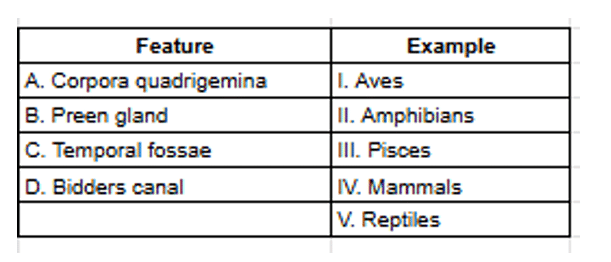
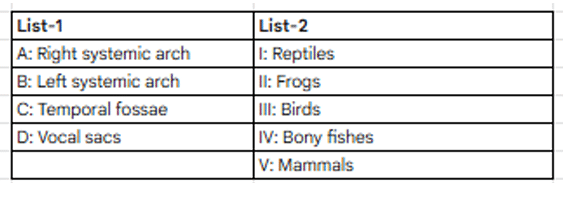
Match the following
1
A-III, B-IV, C-II, D-I
2
A-III, B-V, C-I, D-II
3
A-II, B-I, C-V, D-III
4
A-IV, B-III, C-II, D-I
Official Solution
Correct Option:
(2)
Concept: This matches anatomical features related to the circulatory and skeletal systems to major vertebrate groups.
Explanation: A. Birds (III) possess only the Right Systemic Arch. B. Mammals (V) possess only the Left Systemic Arch. C. Temporal fossae (openings in the skull) are characteristic of Reptiles (I, along with birds/dinosaurs). D. Vocal sacs are specialized pouches used by male Frogs (II) to amplify their calls.
About Animal Diversity - TS-EAMCET
Animal Diversity is a vital chapter for TS-EAMCET aspirants. Mastering the concepts covered in this chapter is essential for securing a top rank.
By rigorously practicing the previous year questions associated with this chapter, you can identify high-yield topics, understand the examiner's perspective, and boost your confidence during the actual exam.
Frequently Asked Questions
Why focus on Animal Diversity PYQs?
Analyzing PYQs for this specific chapter reveals the most frequently tested concepts and the typical complexity of questions, allowing you to tailor your study plan efficiently.
How to best use this analysis?
Review the topic breakdown to see which sub-topics within Animal Diversity carry the most weight. Then, tackle the questions iteratively to solidify your understanding.