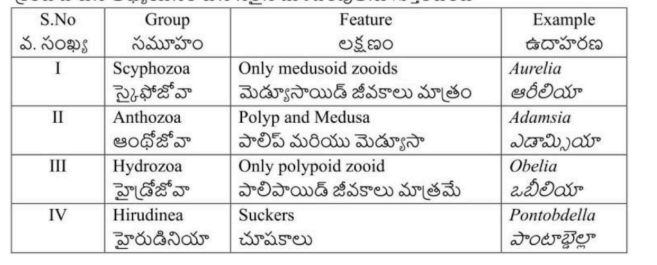
Study the following and pick up the correct combinations:
1
II, III
2
I, IV
3
I, II
4
III, IV
Official Solution
Correct Option:
(2)
Step 1: Evaluate Each Row:
I. Scyphozoa (Jellyfish): The medusa stage is dominant. The polyp stage is reduced or absent in the life cycle. \Aurelia is a classic example. The description "Only medusoid zooids" is acceptable in the context of general classification contrasts (vs Anthozoa). (Correct)
II. Anthozoa (Sea Anemones/Corals): They exist only in the Polyp form. They do not have a Medusa stage. \Adamsia is a Sea Anemone. The feature "Polyp and Medusa" is wrong. (Incorrect)
III. Hydrozoa: They typically exhibit alternation of generations (Metagenesis) with both Polyp and Medusa stages (e.g., \Obelia). Some are only polyps (\Hydra), but the example given is \Obelia, which has both. The feature "Only polypoid" is incorrect for the group/example pair. (Incorrect)
IV. Hirudinea (Leeches): These annelids have anterior and posterior suckers for attachment and locomotion. \Pontobdella is a marine leech. (Correct)
Step 2: Conclusion:
Combinations I and IV are correct.
02
PYQ 2025
medium
zoologyID: ts-eamce
Study the following and choose the incorrect combinations: I. Phylum: Porifera, Special cells: Lasso cells, Example: Spongilla II. Phylum: Cnidaria, Special cells: Stinging cells, Example: Hydra III. Phylum: Ctenophora, Special cells: Choanocytes, Example: Pleurobrachia IV. Phylum: Platyhelminthes, Special cells: Flame cells, Example: Fasciola
1
I, III
2
II, IV
3
I, IV
4
II, III
Official Solution
Correct Option:
(1)
- Lasso cells are characteristic of Cnidaria, not Porifera. - Ctenophora has colloblasts, not choanocytes (which belong to Porifera). Hence, I and III are incorrect combinations. II and IV are correct.
03
PYQ 2025
medium
zoologyID: ts-eamce
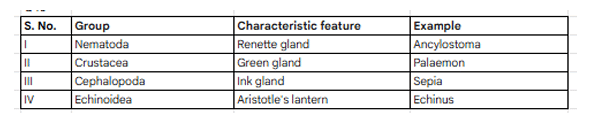
Study the following and choose the correct combinations:
1
I only
2
I and II only
3
I, II and III only
4
I, II, III and IV
Official Solution
Correct Option:
(4)
Concept: This requires matching phylum/class with a unique structural feature and a corresponding example.
Explanation: I. Nematoda ({Ancylostoma}) use renette glands for osmoregulation. II. Crustacea ({Palaemon}) use green glands (or antennal glands) for excretion. III. Cephalopoda ({Sepia}) use an ink gland for defense. IV. Echinoidea ({Echinus}) have the Aristotle's lantern, a complex chewing apparatus. All four combinations are correct.
About Biological Classification - TS-EAMCET
Biological Classification is a vital chapter for TS-EAMCET aspirants. Mastering the concepts covered in this chapter is essential for securing a top rank.
By rigorously practicing the previous year questions associated with this chapter, you can identify high-yield topics, understand the examiner's perspective, and boost your confidence during the actual exam.
Frequently Asked Questions
Why focus on Biological Classification PYQs?
Analyzing PYQs for this specific chapter reveals the most frequently tested concepts and the typical complexity of questions, allowing you to tailor your study plan efficiently.
How to best use this analysis?
Review the topic breakdown to see which sub-topics within Biological Classification carry the most weight. Then, tackle the questions iteratively to solidify your understanding.