In an experiment, Malpighian tubules of a cockroach are removed. Which substance might be absent in its fecal pellets?
1
Undigested matter
2
Urea
3
Uric acid
4
Undigested proteins
Official Solution
Correct Option:
(3)
Step 1: Understanding the Role of Malpighian Tubules
- Malpighian tubules in cockroaches function in excretion and produce uric acid as a nitrogenous waste. - Removing them prevents uric acid excretion, so it would be absent in feces. - Other substances like undigested matter and proteins remain unaffected.
02
PYQ 2024
medium
zoologyID: ts-eamce
Excretory organs in adult molluscs are:
1
Malpighian tubules
2
Green glands
3
Coxal glands
4
Pericardial glands
Official Solution
Correct Option:
(4)
Step 1: Understanding Molluscan Excretion
- Pericardial glands are the primary excretory organs in molluscs. - Other excretory organs like Malpighian tubules (in insects), Green glands (in crustaceans), and Coxal glands (in arachnids) are incorrect.
03
PYQ 2025
medium
zoologyID: ts-eamce
Selective reabsorption of components in glomerular filtrate is regulated in these parts of nephron
1
Proximal convoluted tubule and distal convoluted tubule
2
Loop of Henle and distal convoluted tubule
3
Distal convoluted tubule and collecting duct
4
Proximal convoluted tubule and Loop of Henle
Official Solution
Correct Option:
(3)
Step 1: Understanding Reabsorption Types:
Reabsorption in the nephron can be classified into two types:
Obligatory Reabsorption: Occurs in the Proximal Convoluted Tubule (PCT). It is constant and not hormonally regulated (e.g., bulk reabsorption of water and nutrients).
Facultative (Regulated) Reabsorption: Occurs in the Distal Convoluted Tubule (DCT) and Collecting Duct (CD). This reabsorption is regulated by hormones based on the body's needs.
Step 2: Hormonal Regulation:
Aldosterone: Acts on DCT and CD to increase reabsorption and water follows.
ADH (Vasopressin): Acts on DCT and CD to increase water reabsorption.
Step 3: Conclusion:
Since the question asks for \regulated reabsorption, the answer refers to the DCT and Collecting Duct.
04
PYQ 2025
medium
zoologyID: ts-eamce
Sensillae present on 1st, 2nd and 3rd tarsomeres of leg of cockroach are
1
Olfactory sensillae
2
Thermoreceptor sensillae
3
Gustatory sensillae
4
Chemoreceptor sensillae
Official Solution
Correct Option:
(2)
Step 1: Locate the Sensillae:
Cockroaches have various sensory receptors (sensillae) distributed over their body:
Legs (Tarsus): The tarsus is divided into 5 segments (tarsomeres). The soft pads (plantulae) on the underside of the first, second, and third tarsomeres contain specialized thermoreceptor sensillae, allowing the cockroach to detect surface temperature.
Step 2: Final Answer:
The correct option is Thermoreceptor sensillae.
05
PYQ 2025
medium
zoologyID: ts-eamce
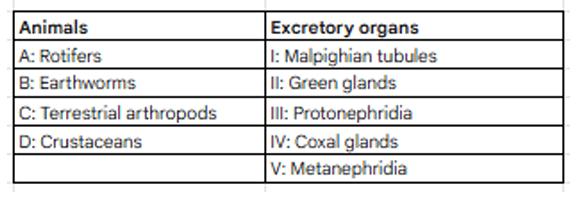
Match the following:
1
A III, B V, C I, D IV
2
A IV, B V, C II, D I
3
A II, B I, C V, D III
4
A III, B V, C I, D II
Official Solution
Correct Option:
(1)
• Rotifers Protonephridia (A III). • Earthworms Metanephridia (B V). • Terrestrial arthropods Malpighian tubules (C I). • Crustaceans Coxal glands (D IV). • Correct matching is A III, B V, C I, D IV}.
06
PYQ 2025
medium
zoologyID: ts-eamce
Appendages are absent in these segments of head of cockroach
1
1, 3
2
2, 4
3
3, 6
4
5, 6
Official Solution
Correct Option:
(1)
The first and third segments of the cockroach head (labrum and clypeus) do not bear appendages. Other head segments bear antennae, mandibles, and maxillae.
07
PYQ 2025
medium
zoologyID: ts-eamce
This part of ommatidium of cockroach is a refractive region
1
Crystalline cone
2
Vitrellar cells
3
Cornea
4
Retinulae
Official Solution
Correct Option:
(1)
Concept: The ommatidium is the single unit of an insect's compound eye, split into a light-focusing part and a light-sensing part.
Explanation: The dioptric (light-focusing/refractive) apparatus consists of the cornea (lens) and the **crystalline cone**. The retinulae cells contain the light-sensitive pigment.
08
PYQ 2025
medium
zoologyID: ts-eamce
Observe the list of animals given below: I. Tracheate arthropods II. Land snails III. Hydra IV. Earth worms V. Reptiles VI. Birds VII. Mammals VIII. Bony fishes IX. Amphibians Among the above, ureotelism is found in
1
I, VIII, IX
2
II, III, VI
3
V, VI, IX
4
VII, VIII, IX
Official Solution
Correct Option:
(3)
Ureotelic animals excrete urea. Reptiles, birds, and mammals primarily convert ammonia to urea (ureotelism). Other animals may be ammonotelic or uricotelic.
About Excretion - TS-EAMCET
Excretion is a vital chapter for TS-EAMCET aspirants. Mastering the concepts covered in this chapter is essential for securing a top rank.
By rigorously practicing the previous year questions associated with this chapter, you can identify high-yield topics, understand the examiner's perspective, and boost your confidence during the actual exam.
Frequently Asked Questions
Why focus on Excretion PYQs?
Analyzing PYQs for this specific chapter reveals the most frequently tested concepts and the typical complexity of questions, allowing you to tailor your study plan efficiently.
How to best use this analysis?
Review the topic breakdown to see which sub-topics within Excretion carry the most weight. Then, tackle the questions iteratively to solidify your understanding.