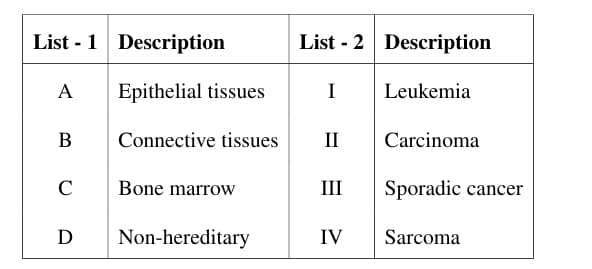
Step 1: Understanding the Relationship Between Tissues and Cancer Types
Different types of cancers originate from different tissues. Understanding this helps in matching them correctly. Step 2: Matching the Pairs
- Epithelial tissues are associated with Carcinoma (II), a cancer of epithelial cells.
- Connective tissues are associated with Sarcoma (IV), a cancer affecting bones, cartilage, and connective tissues.
- Bone marrow is linked to Leukemia (I), a blood cancer originating in bone marrow.
- Non-hereditary cancers refer to Sporadic cancer (III), which occurs due to environmental or lifestyle factors rather than genetic inheritance. Step 3: Conclusion
Thus, the correct matching is:
- A → II
- B → IV
- C → I
- D → III
02
PYQ 2025
medium
zoologyID: ts-eamce
Prolonged P-R interval indicates
1
Bradycardia
2
Tachycardia
3
Hypokalemia
4
Hypercalcemia
Official Solution
Correct Option:
(1)
Step 1: Understanding ECG Intervals:
The P-R interval represents the time taken for the electrical impulse to travel from the SA node through the atria, AV node, and His-Purkinje system to the ventricles. The normal duration is 0.12 to 0.20 seconds. Step 2: Analyzing "Prolonged" P-R Interval:
A P-R interval greater than 0.20 seconds indicates a delay in conduction, primarily at the AV node. This condition is called First-degree AV block.
This delay typically results in a slower heart rate or is associated with conditions causing a slow heart rate, known as Bradycardia. Step 3: Analyzing Other Options:
(B) Tachycardia: Fast heart rate (usually shortens intervals).
(C) Hypokalemia: Causes flattening of T waves and appearance of U waves.
(D) Hypercalcemia: Causes shortening of the QT interval. Step 4: Final Answer:
Prolonged P-R interval is most closely associated with Bradycardia (slowing of the heart) in the context of conduction blocks.
03
PYQ 2025
medium
zoologyID: ts-eamce
Tall T-wave in ECG indicates
1
Hyperkalemia
2
Hypokalemia
3
Myocardial infarction
4
Tachycardia
Official Solution
Correct Option:
(1)
• Tall, peaked T-waves on ECG are a classic sign of hyperkalemia (elevated serum potassium). • Hypokalemia produces flattened or inverted T-waves and U-waves. • Therefore the correct answer is (1) Hyperkalemia.
04
PYQ 2025
medium
zoologyID: ts-eamce
Wave pattern seen in EEG in people who are drowsy / sleepy with closed eyes is
1
Alpha waves
2
Beta waves
3
Delta waves
4
Theta waves
Official Solution
Correct Option:
(1)
Alpha waves (8–13 Hz) are recorded in relaxed, awake adults with eyes closed. Beta waves → alert thinking; Delta → deep sleep; Theta → drowsy/light sleep.
About Animal Tissues - TS-EAMCET
Animal Tissues is a vital chapter for TS-EAMCET aspirants. Mastering the concepts covered in this chapter is essential for securing a top rank.
By rigorously practicing the previous year questions associated with this chapter, you can identify high-yield topics, understand the examiner's perspective, and boost your confidence during the actual exam.
Frequently Asked Questions
Why focus on Animal Tissues PYQs?
Analyzing PYQs for this specific chapter reveals the most frequently tested concepts and the typical complexity of questions, allowing you to tailor your study plan efficiently.
How to best use this analysis?
Review the topic breakdown to see which sub-topics within Animal Tissues carry the most weight. Then, tackle the questions iteratively to solidify your understanding.