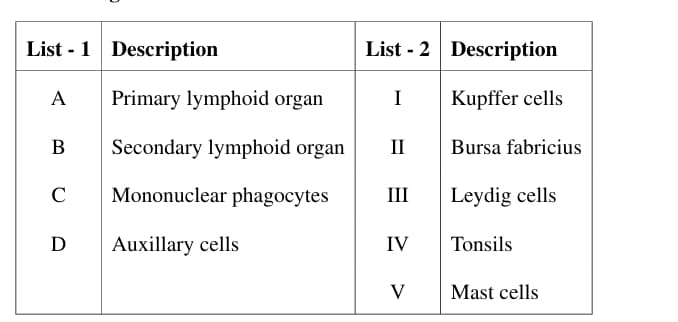
Each item in List-1 represents a specific type of biological structure, while List-2 provides corresponding components. Step 2: Matching the Terms Correctly
- Primary lymphoid organ refers to organs responsible for the production and maturation of immune cells. The Bursa of Fabricius (II) is a primary lymphoid organ in birds.
- Secondary lymphoid organ includes sites where immune responses occur. Tonsils (IV) are secondary lymphoid organs.
- Mononuclear phagocytes include cells that engulf pathogens. Kupffer cells (I) are liver macrophages and belong to this category.
- Auxiliary cells support immune responses, and Mast cells (V) play a role in allergic reactions.
Step 3: Conclusion
Thus, the correct matching is:
- A → II
- B → IV
- C → I
- D → V
02
PYQ 2025
medium
zoologyID: ts-eamce
The primary lymphoid organ is
1
Thymus gland
2
Tonsils
3
Peyer's patches
4
Spleen
Official Solution
Correct Option:
(1)
Step 1: Classification of Lymphoid Organs:
Lymphoid organs are classified into two types:
Primary Lymphoid Organs: Sites where immature lymphocytes differentiate and mature into antigen-sensitive lymphocytes. Examples: Bone Marrow and Thymus.
Secondary Lymphoid Organs: Sites where lymphocytes interact with antigens and proliferate. Examples: Spleen, Lymph nodes, Tonsils, Peyer's patches, MALT.
Step 2: Evaluate Options:
Among the given options, the Thymus gland is a primary lymphoid organ. The others are secondary.
03
PYQ 2025
medium
zoologyID: ts-eamce
In the connective tissue, monocytes become
1
Histiocytes
2
Kupfer cells
3
Microglia
4
Memory cells
Official Solution
Correct Option:
(1)
• Monocytes that migrate from blood into connective tissue differentiate into macrophage-type cells often referred to as histiocytes. • Kupffer cells (note spelling) are liver macrophages (specialised), microglia are CNS macrophages — both are tissue macrophages but derived from monocytes and specific to organs. • Memory cells are lymphocytes (not monocyte derivatives). • Hence the correct answer is (1) Histiocytes.
04
PYQ 2025
medium
zoologyID: ts-eamce
These cells are capable of producing antibodies
1
B-lymphocytes
2
T-lymphocytes
3
TH-cells
4
NK-cells
Official Solution
Correct Option:
(1)
B-lymphocytes (B-cells) differentiate into plasma cells which secrete antibodies (immunoglobulins) specific to antigens. T-lymphocytes provide cell-mediated immunity but do not produce antibodies. TH cells (helper T) stimulate B-cells. NK cells kill virus-infected or tumor cells.
About Immune System - TS-EAMCET
Immune System is a vital chapter for TS-EAMCET aspirants. Mastering the concepts covered in this chapter is essential for securing a top rank.
By rigorously practicing the previous year questions associated with this chapter, you can identify high-yield topics, understand the examiner's perspective, and boost your confidence during the actual exam.
Frequently Asked Questions
Why focus on Immune System PYQs?
Analyzing PYQs for this specific chapter reveals the most frequently tested concepts and the typical complexity of questions, allowing you to tailor your study plan efficiently.
How to best use this analysis?
Review the topic breakdown to see which sub-topics within Immune System carry the most weight. Then, tackle the questions iteratively to solidify your understanding.