Friction
15 previous year questions.
High-Yield Trend
Chapter Questions 15 MCQs
Two blocks are connected over a massless pulley as shown in figure. The mass of block A is 10 kg and the coefficient of kinetic friction is 0.2. Block A slides down the incline at constant speed. The mass of block B in kg is: 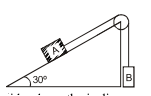
In the figure, two blocks are separated by a uniform strut attached to each block with frictionless pins. Block weighs 400 N, Block weighs 300 N, and the strut weighs 200 N. If under , determine the minimum coefficient of friction under to prevent motion. 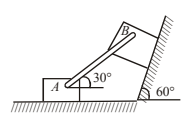
The masses of blocks and are and respectively. Between and there is a constant frictional force . Block can slide on a smooth horizontal surface. is set in motion with velocity while is at rest. What is the distance moved by relative to before they move with the same velocity? 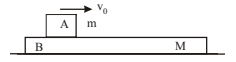
Block A of mass m and block B of mass 2m are placed on a fixed triangular wedge by means of a massless, inextensible string and a frictionless pulley as shown in the figure. The wedge is inclined at 45° to the horizontal on both sides. If the coefficient of friction between block A and the wedge is (2)/(3) and that between block B and the wedge is (1)/(3), and both blocks A and B are released from rest, the acceleration of A will be: 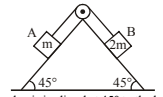
In the figure, two blocks are separated by a uniform strut attached to each block with frictionless pins. Block A weighs 400 N, block B weighs 300 N, and the strut AB weighs 200 N. If μ = 0.25 under block B, determine the minimum coefficient of friction under A to prevent motion. 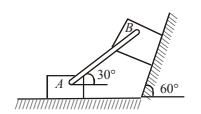
The masses of blocks A and B are m and M respectively. Between A and B, there is a constant frictional force F and B can slide on a smooth horizontal surface. A is set in motion with velocity v₀ while B is at rest. What is the distance moved by A relative to B before they move with the same velocity? 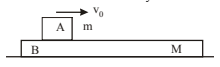
About Friction - BITSAT
Friction is a vital chapter for BITSAT aspirants. Mastering the concepts covered in this chapter is essential for securing a top rank.
By rigorously practicing the previous year questions associated with this chapter, you can identify high-yield topics, understand the examiner's perspective, and boost your confidence during the actual exam.
Frequently Asked Questions
Why focus on Friction PYQs?
Analyzing PYQs for this specific chapter reveals the most frequently tested concepts and the typical complexity of questions, allowing you to tailor your study plan efficiently.
How to best use this analysis?
Review the topic breakdown to see which sub-topics within Friction carry the most weight. Then, tackle the questions iteratively to solidify your understanding.