Waves And Oscillations
18 previous year questions.
High-Yield Trend
Chapter Questions 18 MCQs
A mass m is suspended from a spring of force constant k and another identical spring is fixed to the floor as shown. The time period of small oscillations is: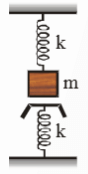
A load of mass falls from a height onto the scale pan hung from a spring of mass and force constant . If the spring constant is such that the scale pan is zero and the mass does not bounce relative to the pan, then the amplitude of vibration is: 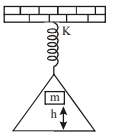
A 1kg mass is attached to a spring of force constant 600N m⁻1 and rests on a smooth horizontal surface with other end of the spring tied to a wall as shown in the figure. A second mass of 0.5kg slides along the surface with initial speed 3m s⁻1. If the masses make a perfectly inelastic collision, then find the amplitude and time period of oscillation of the combined mass. 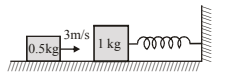
The following figure depicts a circular motion. The radius of the circle, the period of revolution, the initial position and the sense of revolution are indicated in the figure. The simple harmonic motion of the x-projection of the radius vector of the rotating particle P can be shown as 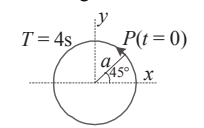
A load of mass m falls from a height h onto the scale pan hanging from a spring as shown in the figure. If the spring constant is k, mass of scale pan is zero, and the mass does not bounce relative to the pan, then the amplitude of vibration is 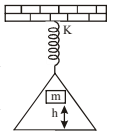
A 1kg mass is attached to a spring of force constant 600N/m and rests on a smooth horizontal surface with other end of the spring tied to a wall as shown in the figure. A second mass of 0.5kg slides on the surface and hits the first at 3m/s. If the masses make a perfectly inelastic collision, then find the amplitude of oscillation of the combined mass and time period of oscillation. 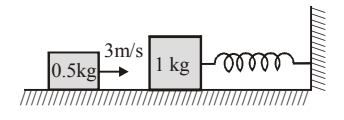
The following figure depicts a circular motion. The radius of the circle, the period of revolution, the initial position and the sense of revolution are indicated on the figure. The simple harmonic motion of the x-projection of the radius vector of the rotating particle P can be shown as: 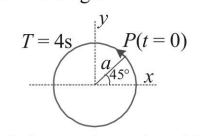
Five identical springs are used in the three configurations as shown in figure. The time periods of vertical oscillations in configurations (a), (b) and (c) are in the ratio. 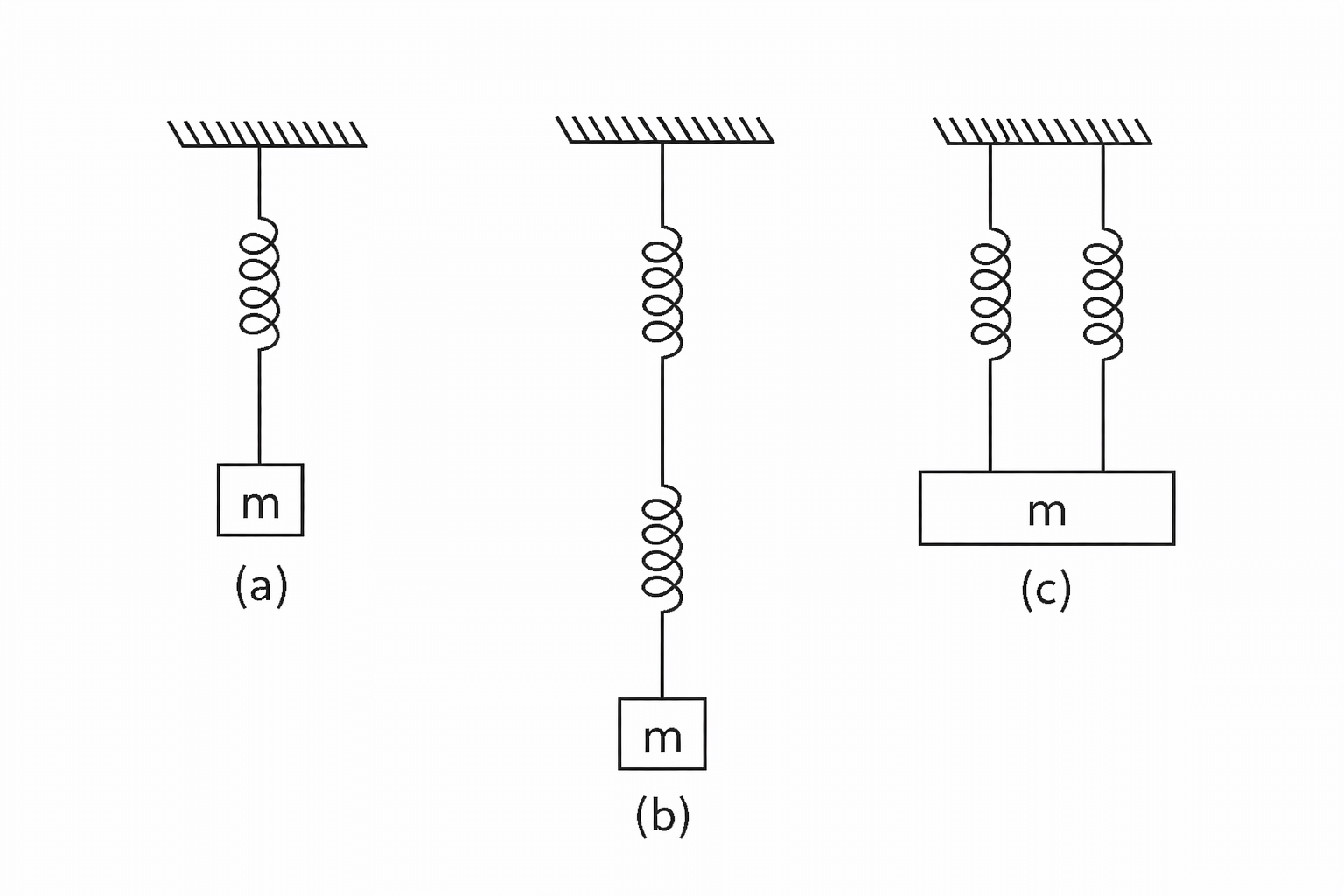
About Waves And Oscillations - BITSAT
Waves And Oscillations is a vital chapter for BITSAT aspirants. Mastering the concepts covered in this chapter is essential for securing a top rank.
By rigorously practicing the previous year questions associated with this chapter, you can identify high-yield topics, understand the examiner's perspective, and boost your confidence during the actual exam.
Frequently Asked Questions
Why focus on Waves And Oscillations PYQs?
Analyzing PYQs for this specific chapter reveals the most frequently tested concepts and the typical complexity of questions, allowing you to tailor your study plan efficiently.
How to best use this analysis?
Review the topic breakdown to see which sub-topics within Waves And Oscillations carry the most weight. Then, tackle the questions iteratively to solidify your understanding.