BITSAT SERIES
Physics

Kinematics

15 previous year questions.

Volume: 15 Ques
Yield: Medium

High-Yield Trend

1
2026
4
2025
1
2020
1
2019
1
2015
1
2013
1
2011
5
2009

Chapter Questions
15 MCQs

01
PYQ 2009
medium
physics ID: bitsat-2
When a mica sheet of thickness 7 microns and μ=1.6 is placed in the path of one of interfering beams in a biprism experiment then the central fringe gets at the position of seventh bright fringe. The wavelength of light used will be
1
4000 \AA
2
5000 \AA
3
6000 \AA
4
7000 \AA
02
PYQ 2009
medium
physics ID: bitsat-2
In Young's double slit experiment, if the slit widths are in the ratio 1:2, the ratio of the intensities at maxima will be
1
1 : 2
2
1 : 3
3
1 : 4
4
1 : 9
03
PYQ 2009
medium
physics ID: bitsat-2
In a photoelectric experiment, with light of wavelength λ, the fastest electron has speed v. If the exciting wavelength is changed to 3λ/4, the speed of the fastest emitted electron will become
1
√((3)/(4))v
2
√((4)/(3))v
3
less than √((4)/(3))v
4
greater than √((4)/(3))v
04
PYQ 2009
medium
physics ID: bitsat-2
Taking Rydberg’s constant RH=1.097×10⁷ m⁻¹, the first and second wavelength of Balmer series in hydrogen spectrum is
1
2000 \AA, 3000 \AA
2
1575 \AA, 2960 \AA
3
6529 \AA, 4280 \AA
4
6552 \AA, 4863 \AA
05
PYQ 2009
medium
physics ID: bitsat-2
An X-ray tube is operated at 15 kV. Calculate the upper limit of the speed of the electrons striking the target.
1
7.26×10⁷ m/s
2
7.62×10⁷ m/s
3
7.62×10⁹ m/s
4
7.26×10⁹ m/s
06
PYQ 2011
medium
physics ID: bitsat-2
A particle is moving in a straight line with initial velocity and uniform acceleration. If the sum of the distance travelled in tᵗᵉˣᵗᵗh and (t+1)ᵗᵉˣᵗᵗh seconds is 100 cm, then its velocity after t seconds, in cm/s, is:
1
80
2
50
3
20
4
30
07
PYQ 2013
medium
physics ID: bitsat-2
A man runs at a speed of 4 m/s to overtake a standing bus. When he is 6 m behind the door at , the bus moves forward and continuous with a constant acceleration of 1.2 m/s². The man reaches the door in time t. Then,
1

2

3

4

08
PYQ 2015
medium
physics ID: bitsat-2
A body is thrown vertically upwards from point , the top of a tower, and reaches the ground in time . If it is thrown vertically downwards from with the same speed, it reaches the ground in time . If it is allowed to fall freely from , the time it takes to reach the ground is given by:
1

2

3

4
09
PYQ 2019
medium
physics ID: bitsat-2
A body is thrown vertically upwards from A, the top of a tower, and reaches the ground in time t₁. If it is thrown vertically downwards from A with the same speed, it reaches the ground in time t₂. If it is allowed to fall freely from A, then the time taken to reach the ground is
1

2

3

4
t = √((t₁)/(t₂))
10
PYQ 2020
medium
physics ID: bitsat-2

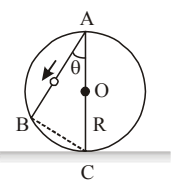
A frictionless wire AB is fixed on a sphere of radius R. A very small spherical ball rolls on this wire. The time taken by this ball to slip from A to B is: 
1

2

3

4
11
PYQ 2025
easy
physics ID: bitsat-2
A ball is thrown vertically upward with a speed of 49 m/s. How long will it take to return to the thrower’s hand?
1
5 s
2
7 s
3
10 s
4
14 s
12
PYQ 2025
easy
physics ID: bitsat-2
A car accelerates from rest to a speed of 20 m/s in 10 seconds. What is its acceleration?
1
2 m/s²
2
3 m/s²
3
4 m/s²
4
5 m/s²
13
PYQ 2025
easy
physics ID: bitsat-2
A particle starts from rest and accelerates uniformly at 4 m/s . What is the distance covered in the 5th second?
1
36 m
2
18 m
3
44 m
4
20 m
14
PYQ 2025
medium
physics ID: bitsat-2
A body starts from rest and moves with constant acceleration. If it covers a distance of in 4 seconds, then its acceleration is:
1

2

3

4

15
PYQ 2026
medium
physics ID: bitsat-2
An object of mass 5 kg is thrown vertically upwards from the ground. The air resistance produces a constant retarding force of 10 N throughout the motion. The ratio of time of ascent to the time of descent will be equal to: [Use ms ]
1
1 : 1
2

3

4
2 : 3

About Kinematics - BITSAT

Kinematics is a vital chapter for BITSAT aspirants. Mastering the concepts covered in this chapter is essential for securing a top rank.

By rigorously practicing the previous year questions associated with this chapter, you can identify high-yield topics, understand the examiner's perspective, and boost your confidence during the actual exam.

Frequently Asked Questions

Why focus on Kinematics PYQs?

Analyzing PYQs for this specific chapter reveals the most frequently tested concepts and the typical complexity of questions, allowing you to tailor your study plan efficiently.

How to best use this analysis?

Review the topic breakdown to see which sub-topics within Kinematics carry the most weight. Then, tackle the questions iteratively to solidify your understanding.