Meaning: Fiscal Deficit represents the total borrowing requirements of the government. It reflects the shortfall when the government’s total expenditure exceeds its total revenue (excluding borrowings). Formula: Fiscal deficit indicates the reliance of the government on borrowings to finance its expenditure.
02
PYQ 2026
easy
economicsID: cbse-cla
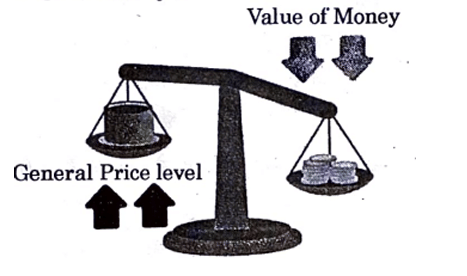
Refer the given image carefully:
Explain any two measures that can be taken by the Central Bank to control the indicated macroeconomic problem.
Official Solution
Correct Option:
(1)
Step 1: Identifying the macroeconomic problem.
The image depicts the relationship between the value of money and the general price level. It indicates a situation of "deficient demand," where the demand for goods and services in the economy is insufficient, leading to a decrease in the value of money and lower price levels. Step 2: Measures to control deficient demand.
Two main measures that the Central Bank can take to control deficient demand are: 1. Lowering the interest rates: The Central Bank can reduce the interest rates to make borrowing cheaper. Lower interest rates encourage consumers and businesses to take loans, which leads to an increase in spending and investment, thus stimulating demand in the economy. 2. Open Market Operations (OMOs): The Central Bank can buy government securities from the open market. This increases the money supply in the economy, as it injects money into the banking system. With more money in circulation, people have more money to spend, which increases demand and helps address deficient demand.
03
PYQ 2026
hard
economicsID: cbse-cla
Distinguish between `Involuntary Unemployment' and `Voluntary Unemployment'.
Official Solution
Correct Option:
(1)
Step 1: Understanding the Concept:
Unemployment is a condition where able-bodied persons who are willing to work at the existing wage rate are unable to find a job. However, not all non-working individuals are considered unemployed in economic terms.
Step 2: Detailed Explanation: Involuntary Unemployment:
A situation where able-bodied people who are willing to work at the prevailing wage rate cannot find employment. It arises due to lack of job opportunities in the economy. It is a genuine concern for policymakers and is counted in unemployment statistics. Voluntary Unemployment:
A situation where a person is technically able to work but chooses not to work at the existing wage rate, perhaps because they find the wage too low or are waiting for a better opportunity. They are not considered unemployed in the official count. Key Difference: Involuntary unemployment is caused by market failure; voluntary unemployment is a personal choice.
Step 3: Final Answer:
Involuntary unemployment is when willing workers cannot find jobs; Voluntary unemployment is when able workers choose not to work at the current wage.
04
PYQ 2026
medium
economicsID: cbse-cla
Read the following text carefully: The government has allocated ₹ 16.27 lakh crore for major sectors, ranging from defence to rural development to social welfare to commerce and so on. Government expenditure goes to paying states' share of taxes and duties. Around 19% is spent on interest payments and 16% on central sector schemes, with subsidies, pension and other payments contributing 19%. Government revenue is divided between borrowings and other liabilities, which account for massive 27% of the incoming cash. Income tax revenue of around 19%; Goods and Services Taxes (GST) and other taxes of around 18%; Corporation taxes account for around 17%. The next highest provision on this list is ₹ 2.66 lakh crore for rural development. This will include expenditure on rural infrastructure projects and increased outlay for the popular MGNREGA scheme. On the basis of given text and common understanding, answer the following questions:
[(i)] Identify the major sources of government revenue and state what percentage does each one of them contribute.
[(ii)] Discuss the need for allocating funds among different sectors of the economy.
Official Solution
Correct Option:
(1)
(i) Major Sources of Government Revenue
Step 1:Identify sources from the text
The major sources of government revenue mentioned are:
Borrowings and other liabilities → 27%
Income tax → 19%
GST and other taxes → 18%
Corporation tax → 17%
Step 2:Interpretation
Borrowings form the largest share of revenue
Tax revenues (income tax, GST, corporation tax) together form a significant portion
Conclusion (i):(ii) Need for Allocation of Funds Concept: Government Budget Allocation
The government allocates funds to ensure balanced economic and social development. Step 1:Economic development
Investment in infrastructure (roads, irrigation, rural projects)
Promotes production and growth
Step 2:Social welfare
Spending on health, education, pensions, subsidies
Improves standard of living
Step 3:Employment generation
Schemes like MGNREGA create job opportunities
Reduces poverty and unemployment
Step 4:Regional balance
Rural development reduces regional inequalities
Step 5:Fiscal responsibility
Allocation ensures proper utilization of limited resources
Helps in achieving economic stability
Conclusion (ii):
About Fiscal Deficit - CBSE-CLASS-XII
Fiscal Deficit is a vital chapter for CBSE-CLASS-XII aspirants. Mastering the concepts covered in this chapter is essential for securing a top rank.
By rigorously practicing the previous year questions associated with this chapter, you can identify high-yield topics, understand the examiner's perspective, and boost your confidence during the actual exam.
Frequently Asked Questions
Why focus on Fiscal Deficit PYQs?
Analyzing PYQs for this specific chapter reveals the most frequently tested concepts and the typical complexity of questions, allowing you to tailor your study plan efficiently.
How to best use this analysis?
Review the topic breakdown to see which sub-topics within Fiscal Deficit carry the most weight. Then, tackle the questions iteratively to solidify your understanding.