Read the following statements carefully: Statement 1: The price of a given currency in terms of another is known as bank rate. Statement 2: Demand curve for foreign exchange is a downward sloping curve.
1
Statement 1 is true and Statement 2 is false.
2
Statement 1 is false and Statement 2 is true.
3
Both Statements 1 and 2 are true.
4
Both Statements 1 and 2 are false.
Official Solution
Correct Option: (2)
\text{The price of a currency in terms of another is known as the exchange rate, not the bank rate. The demand curve for foreign exchange is downward sloping, indicating that as the price of foreign currency decreases, the quantity demanded increases.}
02
PYQ 2025
medium
economicsID: cbse-cla
Identify, which of the following is not a source of demand for foreign exchange.
1
Imports of goods and services
2
Gifts by Indians to their families living abroad
3
Indian tourists visiting foreign countries
4
Loans from Rest of the World
Official Solution
Correct Option: (4)
\text{Demand for foreign exchange arises from imports, gifts, and tourism. Loans from the rest of the world represent a source of supply for foreign exchange, not demand.}
03
PYQ 2026
medium
economicsID: cbse-cla
Read the following statements β Assertion and Reason (R). Choose the correct option from those given below:Assertion : Increase in exchange rate implies that the price of foreign currency in terms of domestic currency has increased. Reason (R): Balance of trade records the inflows and outflows of goods.
1
Both Assertion (A) and Reason (R) are true and Reason (R) is the correct explanation of Assertion (A).
2
Both Assertion (A) and Reason (R) are true, but Reason (R) is not the correct explanation of Assertion (A).
3
Assertion (A) is false, but Reason (R) is true.
4
Assertion (A) is false and Reason (R) is true.
Official Solution
Correct Option: (2)
Step 1:Analyze Assertion (A)
An increase in the exchange rate implies:
More units of domestic currency are required to purchase one unit of foreign currency.
This indicates a depreciation of domestic currency.
As a result, foreign currency becomes more expensive in terms of domestic currency.
Step 2:Analyze Reason (R)
Balance of Trade (BoT) refers to:
The difference between exports and imports of goods.
Exports represent inflow of goods (and foreign exchange earnings).
Imports represent outflow of goods (and foreign exchange payments).
Step 3:Relation between A and R
Although both statements are correct, the reason does not explain the assertion.
Exchange rate changes are determined by demand and supply of foreign exchange, not merely by the definition of balance of trade.
04
PYQ 2026
hard
economicsID: cbse-cla
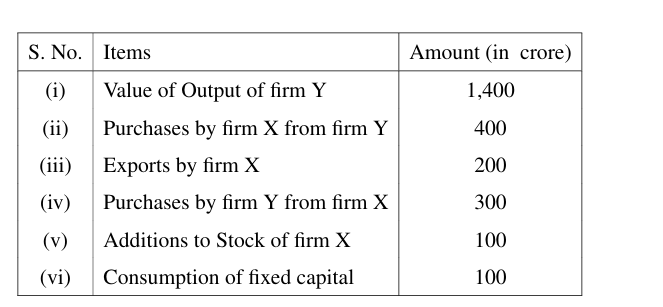
For a hypothetical economy, assuming there are only two firms (X and Y) with equal values of Gross Value Added (GVA). On the basis of the following data, estimate the values of Domestic Sales by firm X:
Official Solution
Correct Option: (1)
Step 1: Formula for Domestic Sales of Firm X.
The Domestic Sales of firm X can be calculated using the following formula: Step 2: Calculation of Value of Output of Firm X.
We know that the value of output of Firm X includes the value of its sales to other firms and households. To estimate it, we use the following: Substituting the values from the table: Step 3: Substitution in the Domestic Sales Formula.
Now, we can calculate the Domestic Sales of Firm X:
05
PYQ 2026
medium
economicsID: cbse-cla
``Unilateral Transfers'' are recorded in which account of BOP?
1
Capital Account
2
Current Account
3
Errors and Omissions
4
None of these
Official Solution
Correct Option: (2)
Step 1: Understanding the Concept:
The Balance of Payments (BOP) is a systematic record of all economic transactions between residents of a country and the rest of the world. It has two main accounts: Current Account and Capital Account.
Step 2: Detailed Explanation: Unilateral Transfers are one-sided transactions with no quid pro quo (no reciprocal transaction). Examples include: gifts, remittances sent by Indians working abroad, grants from foreign governments, and foreign aid.
These are recorded in the Current Account of the BOP under the sub-head ``Transfers''. The Current Account records trade in goods (Visible), trade in services (Invisible), and unilateral transfers.
Step 3: Final Answer:
``Unilateral Transfers'' are recorded in the Current Account of BOP.
06
PYQ 2026
medium
economicsID: cbse-cla
When the exchange rate of domestic currency rises in a managed floating system, it is called:
1
Devaluation
2
Depreciation
3
Appreciation
4
Revaluation
Official Solution
Correct Option: (3)
Step 1: Understanding the Concept:
Changes in the value of a currency are described by different terms depending on whether the exchange rate system is fixed or flexible.
Step 2: Detailed Explanation:
- Appreciation: Rise in the value of domestic currency under a flexible/floating exchange rate system (market-driven).
- Depreciation: Fall in the value of domestic currency under a flexible system.
- Revaluation: Rise in the value of domestic currency under a fixed exchange rate system (government/authority decision).
- Devaluation: Fall in the value of domestic currency under a fixed system.
In a managed floating system, the market primarily determines the rate, so a rise in the exchange rate of domestic currency is called Appreciation.
Step 3: Final Answer:
A rise in the exchange rate of domestic currency in a managed floating system is called Appreciation.
07
PYQ 2026
easy
economicsID: cbse-cla
Read the following statements carefully: Statement 1: Under the flexible exchange rate system, a deficit or surplus in the Balance of Payments is automatically corrected. Statement 2: Under the flexible exchange rate system, there is always a possibility of over/under valuation of currency. In the light of the above given statements, choose the correct option from the following:
1
Statement 1 is true and Statement 2 is false.
2
Statement 1 is false and Statement 2 is true.
3
Both Statements 1 and 2 are true.
4
Both Statements 1 and 2 are false.
Official Solution
Correct Option: (3)
Concept: Flexible Exchange Rate System
In a flexible (or floating) exchange rate system, the value of a country's currency is determined by the forces of demand and supply in the foreign exchange market. There is minimal or no direct intervention by the government or central bank. Step 1:Analyze Statement 1
A deficit in the Balance of Payments (BoP) implies that demand for foreign currency exceeds its supply.
As a result, the domestic currency depreciates in the foreign exchange market.
Depreciation makes exports cheaper and imports more expensive.
This leads to an increase in exports and a decrease in imports.
Hence, the BoP deficit tends to get corrected automatically over time.
Step 2:Analyze Statement 2
Under a flexible exchange rate system, exchange rates are determined by market forces.
Due to constant changes in demand and supply, exchange rates may fluctuate frequently.
Such fluctuations can sometimes result in overvaluation or undervaluation of the currency.
This introduces uncertainty and volatility in international trade and investments.
Step 3:Conclusion
08
PYQ 2026
medium
economicsID: cbse-cla
In a two sector economy, the flow of factor payments moves from ________ to _________.
1
firms, households
2
firms, government
3
banks, households
4
households, firms
Official Solution
Correct Option: (4)
Step 1: Understanding the flow of payments in a two-sector economy. In a two-sector economy, there are only two main economic agents: firms and households. The firms pay for the factors of production (like labor, capital, etc.) to the households, and in return, households provide these factors (labor, capital, etc.) to the firms. Step 2: Evaluation of the options.
(A) firms, households: Incorrect. While firms make factor payments, they are made to households, not from firms to households in the flow of factor payments.
(B) firms, government: Incorrect. In a two-sector economy, there is no government involved in the flow of factor payments.
(C) banks, households: Incorrect. The banks are not directly involved in the flow of factor payments between firms and households.
(D) households, firms: Correct. The flow of factor payments moves from households to firms in exchange for factors of production like labor and capital.
Step 3: Conclusion. In a two-sector economy, the factor payments flow from households to firms. Final Answer:} households, firms.
09
PYQ 2026
medium
economicsID: cbse-cla
Identify, which of the following is true at the Break Even level of Income.
1
Slope of Consumption Curve = Slope of Saving Curve
2
Average Propensity to Consume (APC) = Average Propensity to Save (APS)
3
Slope of Saving Curve = Unity (1)
4
Average Propensity to Consume (APC) = Unity (1)
Official Solution
Correct Option: (4)
Step 1: Understanding Break Even Level of Income. At the Break Even level of income, total consumption equals total income, and the savings are zero. At this point, the Average Propensity to Consume (APC) is equal to one. Step 2: Evaluation of the options.
(A) Slope of Consumption Curve = Slope of Saving Curve: Incorrect. The slope of the consumption curve and saving curve are not equal at the break-even point.
(B) APC = APS: Incorrect. At the break-even level, APC is equal to 1, while APS is 0, as there is no saving.
(C) Slope of Saving Curve = Unity (1): Incorrect. The slope of the saving curve is not necessarily equal to 1 at the break-even level.
(D) APC = Unity (1): Correct. At the break-even level of income, the average propensity to consume (APC) is equal to 1 because all income is being spent on consumption.
Step 3: Conclusion. At the Break Even level of income, the APC is unity, meaning that the entire income is consumed, and savings are zero. Final Answer:} APC = Unity (1).
10
PYQ 2026
medium
economicsID: cbse-cla
Explain the likely impact of implementation of βExports Promotion Schemeβ of Government of India on the Balance of Payment (BoP) of the country. (Keeping other factors constant) State the meaning of Trade Surplus.
Official Solution
Correct Option: (1)
(a) Impact of Export Promotion Scheme on BoP Concept: Balance of Payments (BoP)
BoP is a systematic record of all economic transactions between residents of a country and the rest of the world. It consists mainly of:
Current Account (exports and imports of goods and services)