βDomestic income is always less than national income.β Do you agree with the given statement? Support your answer with valid arguments.
Official Solution
Correct Option: (1)
Yes, the statement is generally correct. Domestic income (also called Domestic Product or NDP at Factor Cost) refers to the income generated by normal residents and non-residents (foreigners) within the domestic territory of a country. National income, on the other hand, includes income earned by residents both within and outside the country. Here's a detailed explanation: Domestic Income includes income earned within the geographical boundaries of the country by both residents and non-residents. National Income includes income earned by Indian residents both within India and from abroad, and excludes income earned by foreigners within India. Net Factor Income from Abroad (NFIA) is the key difference between national and domestic income. National Income = Domestic Income + NFIA. In general, NFIA is positive for India because Indian residents working abroad send remittances and profits back to India, which increases national income. Conclusion: Since NFIA is usually positive, national income is greater than domestic income.
02
PYQ 2025
medium
economicsID: cbse-cla
State and explain any two precautions that must be taken while estimating national income by income method.
Official Solution
Correct Option: (1)
While using the income method to estimate National Income, the following precautions must be taken:
Transfer Incomes Should Not Be Included: Transfer payments like old-age pensions, scholarships, and donations are not payments for any productive service and hence should not be included in national income. Including them would result in double counting.
Illegal Incomes Must Be Excluded: Illegal earnings such as black money from smuggling or gambling do not form part of legitimate economic activity and must be excluded from national income estimation. Only income generated from legal production activities should be counted.
03
PYQ 2025
medium
economicsID: cbse-cla
Aggregate expenditure in the economy during an accounting year is also known as ................
(Choose the correct option to fill in the blank)
1
Autonomous investment
2
Aggregate supply
3
Aggregate demand
4
Induced investment
Official Solution
Correct Option: (3)
Aggregate expenditure refers to the total amount of spending in the economy on goods and services during a particular accounting year. In macroeconomics, this total planned expenditure is also referred to as Aggregate Demand (AD). Where: = Private Final Consumption Expenditure
= Investment Expenditure (Autonomous + Induced)
= Government Final Consumption Expenditure
= Net Exports (Exports minus Imports)
Aggregate demand represents the total demand for goods and services at a given price level in an economy. It shows how much households, firms, government, and foreign buyers are willing to spend. Let's analyze the other options: Autonomous investment (A): Refers to investment that does not depend on income or output.
Aggregate supply (B): Refers to the total output produced in the economy, not total expenditure.
Induced investment (D): Is the investment that depends on income level, but it is only a part of aggregate demand.
Hence, aggregate expenditure is most accurately and completely captured by the concept of Aggregate Demand.
04
PYQ 2025
medium
economicsID: cbse-cla
Suppose, the consumption function is given as:
The value of Investment Multiplier (K) would be ................
(Choose the correct option to fill in the blank)
1
0.09
2
10.0
3
0.9
4
9.0
Official Solution
Correct Option: (2)
To calculate the Investment Multiplier (K), we use the formula based on the Marginal Propensity to Consume (MPC):
From the given consumption function:
Here, 205 is the autonomous consumption, and the coefficient of , i.e., , is the Marginal Propensity to Consume (MPC). So, we have:
Now, applying the value of MPC in the multiplier formula:
Thus, the correct value of the investment multiplier is 10. This means that for every unit increase in investment, the national income increases by 10 units.
05
PYQ 2025
medium
economicsID: cbse-cla
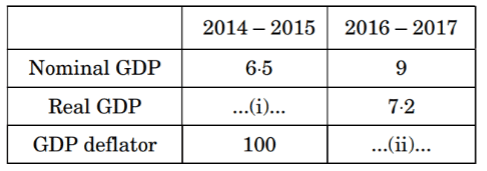
Using the given information, complete the following table: (Choose the correct option)
1
125, 100
2
125, 110
3
6.5, 125
4
100, 6.5
Official Solution
Correct Option: (3)
To solve the problem of completing the table with the correct values, we need to understand the context and options provided. Given the correct answer is 6.5, 125, it suggests two distinct values that need to be filled in the table. Let's examine each part:
First Value (6.5): This number likely represents a rate, percentage, or a coefficient that aligns with economic data outlined in the table.
Second Value (125): Typically a larger number like this could represent a quantity, total, or index related to economic metrics.
To determine why these values fit best:
The value 6.5 might correspond to a quantitative measure such as a percentage growth or an interest rate that reflects a minor increase, reasonable for economic behavior.
The value 125 could be an aggregate number like a GDP measure, sales figure, or an index level, offering substantial representation that aligns with economic expectations.
Comparing all given options, only 6.5, 125 adheres to typical economic table data values and relationships. Therefore, this is the logical completion for the table.
06
PYQ 2026
easy
economicsID: cbse-cla
In an economy, when __________ is insufficient to achieve the level of output corresponding to the full employment, the difference is termed a deflationary gap.
1
ex-ante Aggregate Demand
2
ex-post Aggregate Demand
3
ex-ante Aggregate Supply
4
ex-post Aggregate Supply
Official Solution
Correct Option: (1)
Step 1: Understanding the concept.
A deflationary gap arises when aggregate demand is insufficient to reach the level of output that corresponds to full employment. This gap represents the shortfall in demand relative to the full capacity of the economy. Step 2: Ex-ante vs. ex-post concepts.
- Ex-ante Aggregate Demand: This refers to the planned or intended level of aggregate demand in the economy before any real economic activities take place.
- Ex-post Aggregate Demand: This refers to the actual level of aggregate demand that occurs in the economy after the fact.
- Ex-ante Aggregate Supply: This is the planned supply of goods and services before actual economic activities.
- Ex-post Aggregate Supply: This is the actual supply of goods and services that results from economic activity.
Step 3: Conclusion.
The correct answer is (A) ex-ante Aggregate Demand, as a deflationary gap occurs when the planned demand falls short of the full employment output. Final Answer:} ex-ante Aggregate Demand.
07
PYQ 2026
medium
economicsID: cbse-cla
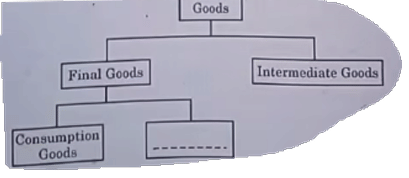
Read the following flow chart carefully and choose the correct option:
1
Transfer goods
2
Capital goods
3
Non-durable goods
4
Semi-durable goods
Official Solution
Correct Option: (2)
Concept: Classification of Goods
In economics, goods are broadly classified based on their use into:
Final Goods: Goods that are used for final consumption or investment.
Intermediate Goods: Goods that are used as inputs in the production of other goods.
Further, final goods can be subdivided into:
Consumption Goods: Goods used for satisfying human wants directly.
Capital Goods: Goods used for further production of goods and services.
Step 1:Analyze the flow chart
From the given flow chart:
Goods are first divided into Final Goods and Intermediate Goods.
Under Final Goods, one branch is labeled as Consumption Goods.
The other branch is left blank and needs to be identified.
Step 2:Identify missing category
Since final goods are of two types:
Consumption Goods
Capital Goods
the missing category must be:
Capital Goods
Step 3:Conclusion
08
PYQ 2026
medium
economicsID: cbse-cla
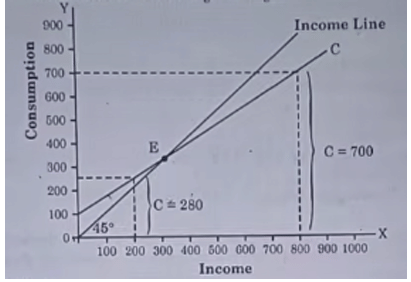
Choose the correct consumption function from the options given below with reference to the illustrated diagram.
1
2
3
4
Official Solution
Correct Option: (2)
Concept: Consumption Function
The consumption function shows the relationship between consumption expenditure and income. It is expressed as:
where:
= autonomous consumption (consumption when income is zero)
= marginal propensity to consume (MPC), i.e., the slope of the consumption curve
The intercept represents the minimum level of consumption, while the slope indicates how consumption changes with income. Step 1:Identify intercept
From the graph:
When income , consumption
Thus, autonomous consumption is:
Step 2:Find slope (MPC)
Using two points from the graph:
Initial point:
Final point:
Change in consumption:
Change in income:
Since the given options are approximate, we take:
Step 3:Form equation
Substituting the values of and into the consumption function:
Conclusion:
09
PYQ 2026
medium
economicsID: cbse-cla
Compare the development experiences of India and China on the basis of GDP growth and Sectoral contribution.
Official Solution
Correct Option: (1)
Step 1: Understanding the Concept:
India and China began their developmental journeys at roughly the same time (both post-1947/1949) but adopted very different strategies, leading to divergent outcomes in GDP growth and sectoral composition.
Step 2: Detailed Explanation: 1. GDP Growth Rate:
- China maintained exceptionally high double-digit GDP growth rates for nearly three decades after its 1978 reforms, peaking close to 10% annually, making it the world's second-largest economy.
- India has generally achieved a more moderate growth rate of 6--8% per annum, with acceleration post-1991 reforms, but has never matched China's industrial growth pace. 2. Industrial/Secondary Sector:
- China aggressively developed its manufacturing sector, becoming the ``World's Factory'' with massive output in electronics, textiles, and machinery.
- India has a relatively weaker manufacturing base, and its industrial sector did not dominate the growth story. 3. Service/Tertiary Sector:
- India uniquely leapfrogged a major industrial phase and shifted directly to a service-led growth model, particularly in IT, software, finance, and outsourcing (BPO), contributing over 50% to GDP.
- China's service sector is growing but remains secondary to industry. 4. Human Development:
- China generally ranks higher than India on the Human Development Index (HDI), with better literacy rates, life expectancy, and per capita income.
Step 3: Final Answer:
China leads India in GDP growth rate and industrial output, while India has built a stronger service sector. China has higher HDI but India has a more democratic and inclusive growth approach.
10
PYQ 2026
medium
economicsID: cbse-cla
Distinguish between `Revenue Receipts' and `Capital Receipts' in a Government Budget.
Official Solution
Correct Option: (1)
Step 1: Understanding the Concept:
Government receipts are the funds that flow into the government's treasury. They are broadly divided into Revenue Receipts and Capital Receipts based on their impact on assets and liabilities.
Step 2: Detailed Explanation: Revenue Receipts: These are receipts that neither create a liability for the government nor lead to any reduction in assets. They are recurring in nature.
Examples: Tax Revenue (Income Tax, GST), Non-Tax Revenue (Fines, Fees, Dividends from PSUs). Capital Receipts: These are receipts that either create a liability (e.g., Borrowings) or cause a reduction in assets of the government (e.g., Disinvestment -- sale of shares of PSUs).
Examples: Borrowings from RBI, market loans, recovery of loans given. Key Difference: Revenue Receipts do not alter the government's asset-liability position; Capital Receipts do.
Step 3: Final Answer:
Revenue Receipts do not create liability or reduce assets; Capital Receipts either create liability or reduce assets of the government.
11
PYQ 2026
medium
economicsID: cbse-cla
Assertion : can be greater than 1. Reason (R): At very low levels of income, consumption can exceed income.
1
Both A and R are true and R is the correct explanation.
2
Both A and R are true but R is not the explanation.
3
A is true, R is false.
4
A is false, R is true.
Official Solution
Correct Option: (1)
Step 1: Understanding the Concept:
APC (Average Propensity to Consume) is defined as the ratio of Total Consumption to Total Income: .
Step 2: Detailed Explanation:
When income is very low, people still need to spend on basic necessities (food, shelter). In such cases, consumption ( ) can exceed income ( ), making . This situation is called Dissaving, where past savings or borrowings are used to finance consumption. The Reason correctly and completely explains the Assertion.
Step 3: Final Answer:
Both A and R are true, and R is the correct explanation of A.
12
PYQ 2026
medium
economicsID: cbse-cla
If , what will be the value of the Investment Multiplier ( )?
1
1
2
2
3
4
4
5
Official Solution
Correct Option: (2)
Step 1: Understanding the Concept:
The Investment Multiplier ( ) shows by how many times the national income increases for every unit increase in investment. It is directly related to the MPC.
Step 2: Detailed Explanation:
The formula for the Investment Multiplier is:
Substituting the given value:
Step 3: Final Answer:
The value of the Investment Multiplier .
13
PYQ 2026
medium
economicsID: cbse-cla
Refer the given text carefully: According to the Economic Survey 2024-25, the government budgetβs projections for the fiscal year 2025-26 indicate that gross direct tax revenue will rise by 12.7%, while gross indirect tax collections are expected to grow by 8.3% relative to FY 2024-25. Direct taxes include income tax and corporate tax, reflecting earnings and profits of households and firms. It plays a key role in revenue growth of the government. Indirect taxes encompass Goods and Services Tax (GST), custom duties and other transaction-based levies. Higher growth rate projected for direct taxes suggests a push to enhance tax buoyancy through improved compliance and reforms. On the other hand, indirect taxes are expected to benefit from consumption trends and Goods and Services Tax (GST) administration improvements. The balance tax strategy aims to mobilize resources while supporting fiscal consolidation and sustainable economic growth. On the basis of the above passage and common understanding, answer the following questions: (i)Differentiate between the two types of taxes indicated in the above text, with suitable examples.(ii)Elaborate the likely consequences of the tax projections made by the government.
Official Solution
Correct Option: (1)
Step 1: Differentiating between direct and indirect taxes. - Direct Taxes: These are taxes levied directly on the income or wealth of individuals or businesses. Examples include Income Tax and Corporate Tax, where the tax liability is directly borne by the taxpayer. Direct taxes are typically progressive, meaning they increase with income or profit levels. - Indirect Taxes: These are taxes levied on goods and services, which are paid by the consumer but collected by an intermediary (like a business) from the consumer at the point of sale. Examples include Goods and Services Tax (GST) and custom duties. The burden of indirect taxes can be shifted to consumers, as businesses often pass on the tax costs in the form of higher prices. Step 2: Likely consequences of the tax projections. The government's projections of increasing direct and indirect taxes indicate a robust plan to boost revenue. The likely consequences could be: 1. Economic Growth: The increase in direct tax collections is expected to result from higher compliance and reforms, which could lead to a more equitable distribution of wealth and improved tax buoyancy. 2. Increased Consumption: The projected growth in indirect taxes, especially GST, could reflect an increase in consumption trends, providing more revenue to the government. 3. Fiscal Consolidation: The balance between direct and indirect tax collections aims to maintain fiscal discipline, support public finances, and help in sustainable economic growth. 4. Inflationary Pressure: A higher reliance on indirect taxes could lead to inflationary pressures, as businesses may pass on the higher tax burden to consumers.
14
PYQ 2026
medium
economicsID: cbse-cla
Michel, an entrepreneur of Country Zeta, borrowed \$5 million from an overseas bank to expand his textile business. During the same financial year, the Government of Country Zeta secured a loan of \$30 Billion from an International Financial Institution to manage the ongoing Balance of Payments. Samuel, an Economics student categorised both of these transactions as 'autonomous transactions' in the BoP account of the country. Do you agree with his classification? Justify your answer with valid reasons.
Official Solution
Correct Option: (1)
Step 1: Define Autonomous Transactions. Autonomous transactions in the Balance of Payments (BoP) refer to those transactions that are carried out for commercial, trade, or financial purposes, without being influenced by the balance of payments itself. These transactions involve a real exchange of goods, services, or capital, and are not the result of government policies or decisions. Step 2: Analyze the First Transaction. Michel's loan of 30 billion loan secured by the Government of Country Zeta from an international financial institution is a government borrowing to manage the country's Balance of Payments. This transaction is classified as a 'counter-cyclical' or 'official' transaction rather than an autonomous one, because it is driven by government policy aimed at managing the country's external balance, rather than for private trade or financial purposes. Step 4: Conclusion. I do not agree with Samuelβs classification. While Michelβs loan qualifies as an autonomous transaction, the governmentβs loan is more appropriately categorized as an official transaction, aimed at balancing the country's payments. Thus, only Michel's loan should be classified as autonomous.
15
PYQ 2026
medium
economicsID: cbse-cla
(I) Estimate the value of subsistence level of consumption expenditure from the following data, about an economy which is in equilibrium:
(II) βAn economy facing unplanned accumulation of inventories would try to increase its Aggregate Demand.β Defend or refute the given statement with valid arguments. (III) Identify the monetary measure being referred to each of the following and discuss whether the tool would be used during a situation of excess demand or deficient demand:
[(i)] Buying government securities (G-Sec) from public.
[(ii)] Encouraging commercial banks to park their surplus funds with the Reserve Bank of India (RBI).