Open market operations by the Reserve Bank of India (RBI) help in regulating money supply in the economy.Justify the given statement with valid arguments.
Official Solution
Correct Option: (1)
Open Market Operations (OMO) refer to the buying and selling of government securities (bonds, treasury bills, etc.) in the open market by the Reserve Bank of India (RBI) to regulate money supply and liquidity in the economy. How Open Market Operations Help Regulate Money Supply: 1. When RBI Buys Government Securities (Expansionary Policy): - RBI purchases securities from banks and the public. - This injects money into the banking system, increasing liquidity and encouraging lending and investment. - This is used to stimulate economic growth during a recession. 2. When RBI Sells Government Securities (Contractionary Policy): - RBI sells government securities to banks and the public. - This absorbs excess liquidity, reducing money supply and curbing inflationary pressures. - This is used to control inflation in an overheated economy. Conclusion: Open Market Operations (OMO) are an essential tool for controlling liquidity and stabilizing economic conditions in an economy.
02
PYQ 2024
medium
economicsID: cbse-cla
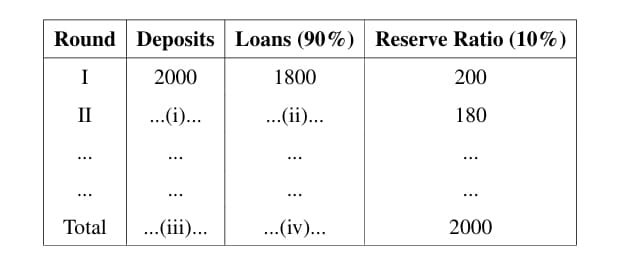
Choose the correct alternative to complete the given schedule:
1
2000, 1620, 20000, 18000
2
1800, 180, 2000, 18000
3
1620, 180, 2000, 18000
4
1800, 1620, 20000, 18000
Official Solution
Correct Option: (4)
This question relates to the credit creation process where: 1. Deposits in Round II = 1800 (from Loans of Round I)
2. Loans in Round II = 90% of Deposits in Round II = 1620 3. Total Deposits = Initial Deposit Γ Money Multiplier - Money Multiplier = - Total Deposits = - Total Loans = Total Deposits - Reserves = Conclusion: Thus, the correct values are (i) 1800, (ii) 1620, (iii) 20000, (iv) 18000, making option (D) correct.
03
PYQ 2024
medium
economicsID: cbse-cla
Read the following statements carefully:Statement 1: Reserve ratio and Credit creation process are inversely related.Statement 2: Central Bank of an economy performs the vital function of controlling the credit creation process.(Choose the correct alternative)
1
Statement 1 is true and Statement 2 is false.
2
Statement 1 is false and Statement 2 is true.
3
Both Statements 1 and 2 are true.
4
Both Statements 1 and 2 are false.
Official Solution
Correct Option: (3)
1. Reserve Ratio and Credit Creation: - A higher reserve ratio means banks have less money to lend, reducing credit creation. - A lower reserve ratio allows banks to lend more, increasing credit creation. - Thus, they are inversely related. 2. Central Bankβs Role in Credit Control: - The Central Bank (RBI) controls credit creation by adjusting monetary policy tools like CRR (Cash Reserve Ratio), SLR (Statutory Liquidity Ratio), and repo rate. Conclusion: Since both statements are true, option (C) is correct.
04
PYQ 2024
medium
economicsID: cbse-cla
Explain the "Bankerβs Bank and Advisor" function of the Central Bank of a nation.
Official Solution
Correct Option: (1)
The Central Bank, such as the Reserve Bank of India (RBI), plays a crucial role in managing the financial system and regulating monetary policies. Two of its key functions are: 1. Bankerβs Bank: - The Central Bank regulates and supervises commercial banks. - It provides liquidity support by acting as a lender of last resort. - It ensures banks maintain the required Cash Reserve Ratio (CRR) and Statutory Liquidity Ratio (SLR). 2. Advisor to the Government: - The Central Bank advises the government on monetary policies, economic growth strategies, and financial stability. - It helps in managing public debt, foreign exchange reserves, and fiscal policies. - It assists in formulating inflation control measures and interest rate policies. Conclusion: The Central Bank ensures financial stability, supports the banking system, and provides critical policy advice to the government.
05
PYQ 2024
medium
economicsID: cbse-cla
The Central Bank can reduce the Money Supply in the economy by ______ the _______. (Fill up the blanks with the correct alternative.)
1
increasing, bank rate
2
decreasing, cash reserve ratio
3
decreasing, bank rate
4
buying, government securities
Official Solution
Correct Option: (1)
The Central Bank reduces the money supply by increasing the bank rate. A higher bank rate makes borrowing more expensive for commercial banks, leading to reduced credit availability in the economy and contraction in the money supply.
06
PYQ 2025
easy
economicsID: cbse-cla
Suppose in an economy, primary deposits are βΉ 500, if the Reserve Ratio is 25\%. Estimate the total deposits created and the total lending by the banking system.
Official Solution
Correct Option: (1)
Formula:Total Deposits Created:Total Lending:Therefore, total deposits = βΉ 2,000 crore and total lending = βΉ 1,500 crore.
07
PYQ 2025
hard
economicsID: cbse-cla
As the Banker to the Bank, Reserve Bank of India performs all functions except ___.
1
Purchase and sale of securities on behalf of general public
2
Maintaining current account for Commercial Banks
3
Clearing and settlement of Interbank transactions
4
Facilitating governmental transactions
Official Solution
Correct Option: (1)
The Reserve Bank of India does not directly engage in the purchase and sale of securities on behalf of the general public. This function is typically carried out by commercial entities or the government. The RBI does, however, facilitate the sale and purchase of government securities to regulate money supply.
08
PYQ 2025
medium
economicsID: cbse-cla
Justify the following statements with valid arguments:
(i) Money supply in an economy is an example of a stock variable.
(ii) The Central Bank provides several Banking services to the government.
Official Solution
Correct Option: (1)
Money supply in an economy is an example of a stock variable: Money supply is considered a stock variable because it refers to the total amount of money available in the economy at a particular point in time. Unlike flow variables, which measure economic activity over a period of time (like income or expenditure), stock variables are measured at a specific moment and do not change with time unless there is an external influence, such as changes in the central bank's policy.
The Central Bank provides several Banking services to the government: The Central Bank acts as the banker to the government and provides essential banking services such as managing government accounts, issuing and managing government securities, handling public debt, and facilitating government payments and receipts. These services ensure the smooth functioning of government financial operations.
09
PYQ 2025
medium
economicsID: cbse-cla
Commercial banks are regarded as money creators because: (Choose the correct option)
1
they purchase securities from the Central Bank.
2
loans provided by them create deposits.
3
they act as a banker to the government.
4
they regulate the lending rate in the economy.
Official Solution
Correct Option: (2)
Commercial banks play a crucial role in the creation of money in the modern economy. This process is known as credit creation or money creation. When banks give loans to individuals or businesses, they do not disburse the amount in cash. Instead, they credit the loan amount to the borrower's deposit account. As a result, new deposits are created in the banking system without printing new currency. This process expands the total money supply in the economy and is thus referred to as money creation by commercial banks. The bank loans become new deposits, and those deposits can again be used to issue further loans (after keeping a portion as reserve), thereby multiplying the money supply through the money multiplier mechanism. Letβs understand this with an example:
Suppose a bank receives a deposit of βΉ 1,000 and keeps a reserve of 10%. It lends out βΉ 900. The borrower then spends this, and the money eventually gets redeposited in another bank, which again lends 90% of that. This process continues and leads to a much larger expansion of deposits (money) in the banking system. Other options like purchasing securities from the Central Bank or acting as a banker to the government do not directly contribute to money creation in the economy.
10
PYQ 2025
medium
economicsID: cbse-cla
Fill in the blank: ............... releases data of money supply in India. (Choose the correct option to fill in the blank)
1
Corporation Bank
2
Reserve Bank of India
3
Commercial Banks
4
State Bank of India
Official Solution
Correct Option: (2)
The Reserve Bank of India (RBI), established in 1935, is India's central bank and the key regulator of the monetary and financial system. One of its critical roles is to monitor and manage the countryβs money supply.
RBI regularly compiles and publishes data on the money supply in the economy through its official reports such as the Weekly Statistical Supplement (WSS), Annual Reports, and other bulletins. The concept of money supply refers to the total stock of money circulating in the economy at a particular time. This includes: Currency with the public
Demand deposits with the banks
Time deposits and other near-money assets
The RBI classifies money supply into different categories or aggregates: M1 (Narrow Money): Currency with the public + Demand deposits + Other deposits with RBI
M2, M3, M4: These include broader measures with increasing levels of liquidity
These aggregates help economists and policymakers to analyze liquidity, inflation, and formulate monetary policy decisions. No commercial or specific public sector banks like SBI or Corporation Bank have the authority to release official data on money supply β this role solely lies with the RBI.
11
PYQ 2025
medium
economicsID: cbse-cla
State the formula to compute Credit Multiplier.
Official Solution
Correct Option: (1)
The Credit Multiplier is the ratio of the total amount of credit created in the economy to the initial deposit. It is given by the formula: Where the Reserve Requirement Ratio (RRR) is the fraction of deposits that a commercial bank is required to hold as reserves (either in cash or as deposits with the central bank) and cannot lend out. The higher the reserve requirement ratio, the lower the credit multiplier, as banks can lend out less of their deposits.
12
PYQ 2025
medium
economicsID: cbse-cla
State the meaning and components of M1 measure of money supply.
Official Solution
Correct Option: (1)
The M1 measure of money supply refers to the narrow money supply. It includes the most liquid forms of money that are used for transactions. M1 includes: 1. Currency with the public: This includes coins and paper currency in circulation that are held by the public, excluding currency with banks. 2. Demand deposits with banks: These are deposits that can be withdrawn on demand by the account holder without any delay, including checking accounts. 3. Other deposits with the Reserve Bank of India (RBI): This includes the deposits held by the RBI that are available for immediate withdrawal. M1 is the most liquid measure of the money supply, as it includes only those forms of money that can be used for immediate consumption.
13
PYQ 2025
medium
economicsID: cbse-cla
"In a country, routine economic operations rely on a stable medium, to facilitate transactions for maintaining smooth economic activities." Discuss briefly the indicated function of money.
Official Solution
Correct Option: (1)
The indicated function of money in the statement is its role as a medium of exchange. In economic operations, money serves as a universally accepted intermediary in transactions. Instead of engaging in barter, where goods and services are exchanged directly, money allows for a more efficient transaction process. It facilitates buying and selling activities by providing a standard unit of value. A stable medium of exchange ensures that goods and services are traded at agreed-upon values, without the need for direct negotiation of barter terms. This stability promotes smooth economic activities and enhances market efficiency. Money also simplifies transactions, fosters specialization, encourages savings, and supports investment by maintaining stable value over time.
14
PYQ 2025
medium
economicsID: cbse-cla
βIrfaan (a student) borrows βΉ 80,000 to finance his college fee. He plans to begin repaying the loan six months after his graduation, making payments over a span of ten years.β Based on the above text, identify the indicated function of money. (Choose the correct option)
1
Medium of Exchange
2
Unit of Account
3
Standard of Deferred Payments
4
Store of Value
Official Solution
Correct Option: (3)
In this case, the function of money as a Standard of Deferred Payments is highlighted because Irfaan borrows money now and repays it in the future in monetary terms. This function facilitates loans, borrowings, and repayments over time.
15
PYQ 2025
medium
economicsID: cbse-cla
Read the following statements carefully :
Statement 1 : During deflationary gap, the Central Bank of a country may increase the repo rate.
Statement 2 : The government can reduce the deflationary gap by purchasing Government Securities (G-Sec) in the open market. In the light of the given statements, choose the correct option from the following :
1
Statement 1 is true and Statement 2 is false.
2
Statement 1 is false and Statement 2 is true.
3
Both Statements 1 and 2 are true.
4
Both Statements 1 and 2 are false.
Official Solution
Correct Option: (2)
Statement 1 is false because during a deflationary gap, the Central Bank typically lowers the repo rate to encourage borrowing and spending, rather than increasing it. Statement 2 is true because the government can reduce a deflationary gap by purchasing government securities in the open market, which injects liquidity into the economy and encourages spending.
16
PYQ 2025
medium
economicsID: cbse-cla
Assuming for a hypothetical economy, the Central Bank increases the Reserve Ratio from 20% to 25% and the total primary deposits stand at βΉ1,000. Explain the effect of rise in Reserve Ratio on credit creation by commercial banks.
Official Solution
Correct Option: (1)
The Reserve Ratio, also known as the Cash Reserve Ratio (CRR), is the fraction of the total deposits that commercial banks are required to keep as reserves with the central bank. When the central bank increases the Reserve Ratio from 20% to 25%, it reduces the amount of money available for banks to lend out. This limits the credit creation capacity of commercial banks. To explain this effect, let's calculate the credit multiplier and the potential credit creation: 1. Initial Reserve Ratio (20%): - Reserve Ratio = 20% - Total Primary Deposits = βΉ1,000 - Required Reserve = 20% of βΉ1,000 = βΉ200 - The rest, βΉ800, is available for lending. Using the credit multiplier formula: So, the total credit creation potential = βΉ800 5 = βΉ4,000. 2. New Reserve Ratio (25%): - Reserve Ratio = 25% - Total Primary Deposits = βΉ1,000 - Required Reserve = 25% of βΉ1,000 = βΉ250 - The rest, βΉ750, is available for lending. New Credit Multiplier = So, the total credit creation potential = βΉ750 4 = βΉ3,000. By increasing the Reserve Ratio, the central bank reduces the amount of money available for lending, thus decreasing the total credit creation in the economy. The total credit creation potential drops from βΉ4,000 to βΉ3,000.
17
PYQ 2025
medium
economicsID: cbse-cla
"Define 'Open Market Operations'."
Official Solution
Correct Option: (1)
Open Market Operations (OMO) refer to the buying and selling of government securities in the open market by a country's central bank, such as the Reserve Bank of India (RBI), to regulate the money supply and control interest rates in the economy. When the central bank buys government securities, it injects liquidity into the banking system, thus increasing the money supply. Conversely, when the central bank sells government securities, it absorbs liquidity from the banking system, reducing the money supply. OMOs are an important tool of monetary policy used to achieve objectives such as controlling inflation, stabilizing the currency, and maintaining overall economic stability.
18
PYQ 2025
medium
economicsID: cbse-cla
As the Banker to the Bank, Reserve Bank of India performs all functions except ........
1
Purchase and sale of securities on behalf of the general public
2
Maintaining current account for Commercial Banks
3
Clearing and settlement of Interbank transactions
4
Facilitating governmental transactions
Official Solution
Correct Option: (1)
The Reserve Bank of India (RBI) does not engage in the purchase and sale of securities on behalf of the general public. This is typically the responsibility of the government or commercial banks, while the RBI manages monetary policy, currency issuance, and the banking system.
19
PYQ 2025
easy
economicsID: cbse-cla
The monetary policy is formulated by the ____ in the Indian economy.
1
Central Government
2
State Governments
3
Reserve Bank of India
4
World Bank
Official Solution
Correct Option: (3)
The Reserve Bank of India (RBI) formulates the monetary policy in India. It controls the money supply and interest rates to regulate the economy.
20
PYQ 2025
medium
economicsID: cbse-cla
Read the following text carefully:
\textit{``This function of money provides different items to be evaluated against a common standard. It allows comparison of prices and keeping financial records.''} (i) On the basis of the given text, identify the indicated function of money. (ii) List any other two functions of money.
Official Solution
Correct Option: (1)
(i) Indicated Function:Unit of Account (or Measure of Value) β This function of money allows various goods and services to be measured and compared against a common standard, facilitating financial record-keeping. (ii) Any other two functions of money: Medium of Exchange: Money facilitates buying and selling of goods and services. Store of Value: Money acts as a medium to store wealth and purchasing power for future use.
21
PYQ 2025
medium
economicsID: cbse-cla
Elaborate the process of Credit Creation using a suitable numerical example.
Official Solution
Correct Option: (1)
Credit creation refers to the process by which commercial banks are able to expand the money supply in an economy on the basis of primary deposits. It is possible due to the fractional reserve system, where banks keep a part of deposits as reserves and lend out the remaining. Numerical Example: Assume the initial deposit in a bank is βΉ 1,000 and the Legal Reserve Ratio (LRR) is 20\%. Bank keeps βΉ 200 (20\% of βΉ 1,000) as cash reserve. Lends βΉ 800 to borrowers. This βΉ 800 is spent and comes back to the banking system as a deposit. Now, 20\% of βΉ 800 i.e., βΉ 160 is kept as reserve and βΉ 640 is lent out. This process continues. Total Credit Creation: Using the formula:
So, a primary deposit of βΉ 1,000 leads to total deposits of βΉ 5,000 in the banking system.
22
PYQ 2025
medium
economicsID: cbse-cla
In the context of the Commercial Banks, which of the following statements are correct? (Choose the correct option)
(I) Deposits received are liabilities for Commercial Banks.
(II) They are creator of credit in the economy.
(III) They accept deposits from general public.
(IV) They accept deposits on behalf of Reserve Bank of India.
1
(I), (II) and (III)
2
(II) and (III)
3
(I) and (II)
4
(I) and (IV)
Official Solution
Correct Option: (1)
Commercial Banksβ deposits are liabilities, they create credit by lending, and they accept deposits from the public. They do not accept deposits on behalf of the Reserve Bank of India; RBI deals with the government and other banks.
23
PYQ 2026
hard
economicsID: cbse-cla
In an economy, the currency held by the public, Net Demand Deposits with Commercial Banks and Net Time Deposits with Commercial Banks stand at βΉ 1,42,000 crore, βΉ 22,000 crore and βΉ 86,000 crore respectively. The value of Money Supply (M1) would be βΉ _______ crore.
1
2,50,000
2
86,000
3
1,64,000
4
1,42,000
Official Solution
Correct Option: (3)
Step 1: Understanding Money Supply (M1).
Money Supply (M1) is the sum of currency held by the public, demand deposits with commercial banks, and other liquid assets in the economy. Step 2: Calculation of Money Supply (M1).
M1 = Currency held by the public + Net Demand Deposits + Net Time Deposits
M1 = βΉ 1,42,000 crore + βΉ 22,000 crore + βΉ 86,000 crore = βΉ 1,64,000 crore. Step 3: Conclusion.
Therefore, the value of Money Supply (M1) is βΉ 1,64,000 crore. Final Answer:} βΉ 1,64,000 crore.
24
PYQ 2026
medium
economicsID: cbse-cla
Identify, which one of the following is not a function of Reserve Bank of India as a bank, agent and advisor to the government.
1
Carries out banking business of the government
2
Manages national debt
3
Advises on financial matters
4
Conducts periodic inspections
Official Solution
Correct Option: (4)
Concept: Functions of RBI
The Reserve Bank of India (RBI) performs multiple roles in the economy. One of its important roles is acting as:
Banker to the government
Agent of the government
Advisor to the government
These roles help in managing the financial operations and policy framework of the government. Step 1:Functions under this role
Under its role as banker, agent, and advisor to the government, RBI performs the following functions:
Maintains and operates government accounts
Receives and makes payments on behalf of the government
Manages public debt by issuing government bonds and treasury bills
Acts as an agent in handling financial transactions of the government
Provides economic and financial advice to the government on policy matters
Is related to RBI's role as a controller and supervisor of commercial banks
Ensures proper functioning and regulation of the banking system
Does not fall under its role as banker, agent, or advisor to the government
Conclusion:
25
PYQ 2026
medium
economicsID: cbse-cla
Sumit deposited βΉ 10 lakh in his savings account. The deposits made by him is a part of ____________ in the measure of money supply.
1
Currency held by public
2
Interbank deposits
3
Demand deposits with commercial banks
4
Term deposits with Reserve Bank of India (RBI)
Official Solution
Correct Option: (3)
Concept: Measures of Money Supply
Money supply refers to the total stock of money available in an economy at a given point of time. One of the important measures is , also known as narrow money:
This measure includes the most liquid forms of money that can be readily used for transactions. Step 1:Identify type of deposit
Savings account deposits have the following characteristics:
They can be withdrawn on demand using cheques, ATMs, or online transfers.
Although some restrictions may exist (like limited withdrawals), they are still largely accessible.
Hence, savings deposits are treated as:
Demand deposits
Step 2:Classify under
Demand deposits form a key component of :
Savings account deposits are included under:
Therefore, they are a part of the narrow money supply.
Step 3:Conclusion
26
PYQ 2026
medium
economicsID: cbse-cla
Identify that function of money which has effectively solved the problem of βdouble coincidence of wantsβ in transactions.
1
Standard of deferred payment
2
Store of value
3
Measure of value
4
Medium of exchange
Official Solution
Correct Option: (4)
Concept: Functions of Money
Money performs several important functions in an economy, which help in facilitating smooth economic transactions and overcoming the limitations of the barter system:
Medium of exchange: Money is widely accepted as a means for buying and selling goods and services.
Measure of value: It provides a common unit in which the value of goods and services can be expressed.
Store of value: Money allows individuals to store purchasing power for future use.
Standard of deferred payment: It is used for future payments such as loans and credit transactions.
Step 1:Understand the problem
Double coincidence of wants is a major limitation of the barter system. It occurs when:
Two individuals must simultaneously have a need for each other's goods or services.
For example, if a person with wheat wants cloth, they must find someone who has cloth and also wants wheat.
This condition is difficult to satisfy in a large and complex economy, making barter inefficient.
Step 2:Role of money
Money removes the problem of double coincidence of wants through its function as a medium of exchange:
A person can sell their goods or services in exchange for money instead of directly trading for another good.
The money received can then be used to purchase any other goods or services as per their needs.
This separates the act of selling from buying, making transactions more flexible and efficient.
As money is generally accepted, it eliminates the need to find someone with matching wants.
Conclusion:
27
PYQ 2026
medium
economicsID: cbse-cla
Explain the `Banker to the Government' function of the Central Bank.
Official Solution
Correct Option: (1)
Step 1: Understanding the Concept:
As the apex institution of the monetary system, the Central Bank (RBI in India) performs a vital role in supporting the functioning of the government, just like a commercial bank manages the financial needs of its clients.
Step 2: Detailed Explanation:
As a Banker to the Government, the Central Bank performs three key roles: 1. Banking Function: The Central Bank maintains accounts of both the Central and State Governments. It accepts deposits, makes payments, and carries out the remittance of funds on behalf of the government. 2. Agent Function: It manages the Public Debt of the Government. It is responsible for issuing new loans (Treasury Bills, Government Securities), managing existing ones, and organizing their repayment. 3. Advisor Function: It acts as a financial advisor to the government on critical economic matters such as controlling inflation, formulating exchange rate policy, managing fiscal deficits, and deficit financing.
Step 3: Final Answer:
The Central Bank acts as banker, agent, and financial advisor to the government, managing its accounts, public debt, and providing monetary policy counsel.
28
PYQ 2026
medium
economicsID: cbse-cla
Explain the concept of `Deflationary Gap' with the help of a diagram.
Official Solution
Correct Option: (1)
Step 1: Understanding the Concept:
In Keynesian economics, full employment is not automatically guaranteed. When Aggregate Demand is insufficient to generate full employment output, an output gap arises.
Step 2: Detailed Explanation:
A Deflationary Gap (also called a Recessionary Gap) refers to the shortfall in Aggregate Demand (AD) relative to the level of Aggregate Demand required to maintain full employment equilibrium.
In the diagram below, the line represents the full employment level. is the required AD for full employment, and is the actual (lower) AD. The vertical distance between and at the full employment level of income is the Deflationary Gap. This results in less output, income, and employment than the potential, causing deflation and recession.
Step 3: Final Answer:
Deflationary Gap = Shortfall in Aggregate Demand at the full employment level, leading to a fall in output, income, and employment.
29
PYQ 2026
medium
economicsID: cbse-cla
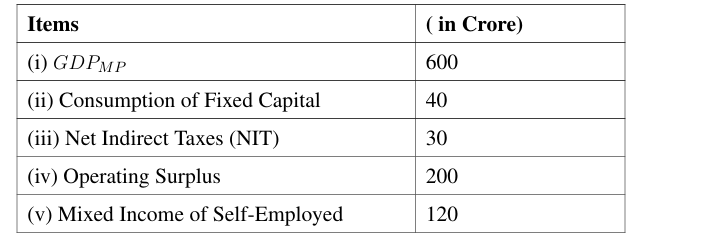
Calculate `Compensation of Employees' (COE) from the following data :
Official Solution
Correct Option: (1)
Step 1: Understanding the Concept:
Under the Income Method of calculating National Income, is the sum of all factor incomes: Compensation of Employees, Operating Surplus, and Mixed Income of Self-Employed.
Step 2: Key Formula or Approach:
Step 2: Detailed Explanation: Step 1 -- Find :}
Step 2 -- Apply Income Method Formula:
Step 3: Final Answer: Compensation of Employees (COE) = βΉ 210 Crore.
30
PYQ 2026
medium
economicsID: cbse-cla
If the Legal Reserve Ratio ( ) is 20%, the Money Multiplier will be:
1
2
2
5
3
10
4
20
Official Solution
Correct Option: (2)
Step 1: Understanding the Concept:
The Money Multiplier shows how much the money supply increases for every unit of primary deposit in the banking system. It is inversely related to the Legal Reserve Ratio (LRR).
Step 2: Detailed Explanation:
The formula for the Money Multiplier is:
Given:
This means for every βΉ 1 of initial deposit, the banking system can create βΉ 5 of total money supply.
Step 3: Final Answer:
The Money Multiplier = .
31
PYQ 2026
medium
economicsID: cbse-cla
Which of the following is NOT a function of the Central Bank?
1
Issue of currency
2
Banker to the Government
3
Accepting deposits from the general public
4
Custodian of foreign exchange
Official Solution
Correct Option: (3)
Step 1: Understanding the Concept:
The Central Bank (RBI in India) is the apex monetary institution and its functions are distinct from those of Commercial Banks.
Step 2: Detailed Explanation:
The Central Bank's functions include: Issue of currency notes, acting as a Banker to the Government, acting as a Banker's Bank, acting as a Custodian of foreign exchange reserves, and controlling credit in the economy. Accepting deposits from the general public is a function of Commercial Banks, not the Central Bank. The Central Bank only accepts deposits from commercial banks and the government.
Step 3: Final Answer: Accepting deposits from the general public is NOT a function of the Central Bank.
32
PYQ 2026
medium
economicsID: cbse-cla
Supply of money refers to:
1
Stock of money with the government.
2
Stock of money with the banking system.
3
Stock of money with the public at a point in time.
4
Total gold reserves in the country.
Official Solution
Correct Option: (3)
Step 1: Understanding the Concept:
Money Supply is a macroeconomic variable that refers to the total amount of monetary assets available in an economy at a specific time.
Step 2: Detailed Explanation:
The supply of money (also called Money Stock) is defined as the total stock of money held by the public (households and firms) at a given point in time. It includes currency (notes and coins) in circulation and demand deposits with commercial banks. Money held by the government or central bank itself is not included.
Step 3: Final Answer:
Supply of money refers to the Stock of money with the public at a point in time.
33
PYQ 2026
medium
economicsID: cbse-cla
Ms. Reeta DβCosta, retired from the post of Income Tax Commissioner in the year 2023. Apart from her pension, she also receives the following from various sources: - Rental income from a flat she owns. - Interest income from her fixed deposits. - Money sent by her children settled abroad. Identify and classify her monthly incomes into 'factor income' and 'transfer income', with valid reasons.
Official Solution
Correct Option: (1)
Step 1: Definition of Factor Income.
Factor income refers to the income earned by providing productive services or factors of production, such as land, labor, capital, and entrepreneurship. It includes wages, rent, interest, and profit that arise from production activities. Step 2: Definition of Transfer Income.
Transfer income refers to income received without providing any productive services in return. It includes gifts, pensions, and remittances, as they are transfers of income from one individual to another without any productive activity involved. Step 3: Classifying the Income Sources.
- Rental income from a flat she owns: This is factor income, as it is earned from the use of her property (land) and involves the productive use of her asset.
- Interest income from her fixed deposits: This is factor income, as it is earned from the capital she has invested in the form of fixed deposits.
- Money sent by her children settled abroad: This is transfer income, as it is a remittance from her children without any exchange of goods or services.
34
PYQ 2026
medium
economicsID: cbse-cla
Read the following statements: Assertion and Reason (R). Choose the correct option from those given below: % Assertion Assertion : Money is of perishable nature and is generally accepted by all at any point of time. % Reason (R) Reason (R): Money serves as a store of value, facilitating individuals to transfer purchasing power from the present to the future.
1
Both Assertion (A) and Reason (R) are true, and Reason (R) is the correct explanation of Assertion (A).
2
Both Assertion (A) and Reason (R) are true, but Reason (R) is not the correct explanation of Assertion (A).
3
Assertion (A) is true, but Reason (R) is false.
4
Assertion (A) is false, but Reason (R) is true.
Official Solution
Correct Option: (4)
Step 1: Understanding Assertion (A). Money is not perishable in nature. While it can lose value over time due to inflation, it does not perish like physical goods. The assertion that money is perishable is incorrect. Step 2: Understanding Reason (R). Money does indeed serve as a store of value. This is one of the key functions of money, as it allows individuals to transfer purchasing power from the present to the future by saving money. Step 3: Evaluation of the options.
(A) Both Assertion (A) and Reason (R) are true, and Reason (R) is the correct explanation of Assertion (A): Incorrect. While Reason (R) is true, Assertion (A) is false.
(B) Both Assertion (A) and Reason (R) are true, but Reason (R) is not the correct explanation of Assertion (A): Incorrect. Reason (R) is true, but it does not explain why Assertion (A) is false.
(C) Assertion (A) is true, but Reason (R) is false: Incorrect. Assertion (A) is false, while Reason (R) is true.
(D) Assertion (A) is false, but Reason (R) is true: Correct. Assertion (A) is false, but Reason (R) is true and correctly describes one of the functions of money.
Step 4: Conclusion. Assertion (A) is false, but Reason (R) is true, as money serves as a store of value. Final Answer:} Assertion (A) is false, but Reason (R) is true.
35
PYQ 2026
medium
economicsID: cbse-cla
Read the following statements: Assertion and Reason (R). Choose the correct option from those given below: Assertion : Unilateral Transfers are recorded in the Current Account of the Balance of Payments (BoP) of a nation.
Reason (R): Capital account records transactions which cause a change in the assets or liabilities of the country.
1
Both Assertion (A) and Reason (R) are true, and Reason (R) is the correct explanation of Assertion (A).
2
Both Assertion (A) and Reason (R) are true, but Reason (R) is not the correct explanation of Assertion (A).
3
Assertion (A) is true, but Reason (R) is false.
4
Assertion (A) is false, but Reason (R) is true.
Official Solution
Correct Option: (2)
Step 1: Understanding Assertion (A).
Unilateral transfers refer to one-way transfers of money or goods, such as remittances or foreign aid, which are recorded in the Current Account of the Balance of Payments. Step 2: Understanding Reason (R).
The capital account records transactions that involve changes in the country's assets or liabilities, such as foreign investments or loans, which is unrelated to unilateral transfers. Step 3: Conclusion.
Both Assertion (A) and Reason (R) are true, but Reason (R) is not the correct explanation for Assertion (A) because unilateral transfers do not relate to the capital account. Final Answer:} Both Assertion (A) and Reason (R) are true, but Reason (R) is not the correct explanation of Assertion (A).
36
PYQ 2026
medium
economicsID: cbse-cla
Read the following statements carefully:
Statement 1: Final goods are those goods which normally lose their identity in the production process.
Statement 2: Final goods may get transformed during the consumption process by a consumer.
1
Statement 1 is true and statement 2 is false.
2
Statement 1 is false and statement 2 is true.
3
Both statements 1 and 2 are true.
4
Both statements 1 and 2 are false.
Official Solution
Correct Option: (2)
Step 1: Understanding final goods.
Final goods are goods that retain their identity and are ready for final consumption or investment. They do not lose their identity during production. Step 2: Transformation of final goods.
Final goods, during consumption, can be transformed (e.g., food being eaten, or a car being driven), which means they may undergo changes during the consumption process. Therefore, Statement 2 is true. Step 3: Conclusion.
Thus, Statement 1 is false, while Statement 2 is true. Final Answer:} Statement 1 is false and statement 2 is true.
37
PYQ 2026
medium
economicsID: cbse-cla
Read the following text carefully: βThe Reserve Bank of India (RBI) announced a 50 basis point Repo Rate cut to 5.50% from 6%.β In the light of the given text and common understanding, answer the following questions:
[(i)] Identify the economic issue indicated in the above text.
[(ii)] Explain the likely causes and consequences of this step of RBI on the economy.
Official Solution
Correct Option: (1)
(i) Economic Issue Concept: Monetary Policy Adjustment
A reduction in repo rate is generally undertaken to:
Stimulate economic growth
Increase liquidity in the economy
Answer:(ii) Causes and Consequences A. Likely Causes
Step 1:Low economic growth
Reduced investment and production
Decline in industrial output
Step 2:Low demand in economy
Consumers spending less
Businesses facing low sales
Step 3:Low inflation
Inflation under control gives RBI space to reduce rates
B. Consequences of Repo Rate Cut
Step 1:Cheaper loans
Banks borrow from RBI at lower rate
Interest rates on loans decrease
Step 2:Increase in investment
Businesses take more loans
Expansion of production activities
Step 3:Increase in consumption
Consumers borrow more (home loans, car loans)
Demand for goods and services rises
Step 4:Rise in income and employment
Increased production leads to job creation
Income levels improve
Step 5:Overall economic impact
Economic growth is stimulated
Aggregate demand increases
Conclusion:
38
PYQ 2026
medium
economicsID: cbse-cla
βWhen initial deposits in the credit creation process remains same, the total amount of credit created rises as the value of money multiplier increases.β Defend or refute the above statement with the help of hypothetical numerical example.OR βCentral Bank maintains reserves of all commercial banks and use to settle interbank claims.β Do you agree with the given statement? Give valid explanation in support of your answer.
Official Solution
Correct Option: (1)
(A) Credit Creation and Money Multiplier Concept:
The total credit created by banks depends on the money multiplier:
and
Step 1:Understanding the relationship
Initial deposit remains constant
If CRR (Cash Reserve Ratio) decreases β money multiplier increases
Higher multiplier β more credit creation
Step 2:Numerical Example Case 1: CRR = 20%
Initial deposit = βΉ1000 Case 2: CRR = 10%
Step 3:Comparison
Initial deposit same (βΉ1000)
Credit increased from βΉ5000 to βΉ10000
Conclusion:(B) Role of Central Bank Concept: Bankerβs Bank
Central bank acts as:
Banker to commercial banks
Custodian of their reserves
Step 1:Maintaining reserves
Commercial banks keep a part of their reserves with the central bank
These reserves ensure liquidity and stability
Step 2:Settlement of interbank claims
Banks make payments to each other (e.g., cheque clearing)
These transactions are settled through accounts maintained with the central bank
Step 3:Example
Bank A owes βΉ10 lakh to Bank B
Central bank transfers funds from Bank Aβs account to Bank Bβs account