Income And Employment
45 previous year questions.
High-Yield Trend
Chapter Questions 45 MCQs
Statement 1: As per National Sample Survey Organisation (NSSO), unemployment is a situation in which all those who, owing to lack of work, are not working, but seeking work from prospective employers, expressed their willingness to work under the prevailing condition of work and remuneration.
Statement 2: Disguised unemployment is generally a massive problem in a highly populated country like India.
In the light of the given statements, choose the correct alternative from the following:
- Change in income ( )
- Change in consumption ( )
In the light of the above context, identify the value of investment multiplier (K). (Choose the correct option)
Statement 2: Regular salaried employment is a major source of employment in rural areas in India.
In the light of the given statements, choose the correct option from the following:
Explain the likely impact of the given situation on output, employment and income.
\bigskip
The Labour Force Participation Rate (LFPR) measures the percentage of the population either employed or actively seeking employment in a nation. In India, the labour force grew by 99·2 million persons between 2000 – 2019. The labour force grew from 396·3 million to 495·5 million.
During 2012 – 2019, the labour force grew without a matching increase in employment, leading to higher unemployment.
The gender disparity in India’s labour market is notable with women’s LFPR at 32·8\% in 2022, significantly lower than men’s LFPR at 77·2\%. This is a major reason for India’s overall low LFPR, which is lower than the global average of 47·3\%.
During 2000 – 2019, rural LFPR declined by 14·1\%, compared to a 3·5\% decline in urban areas. This trend reversed between 2019 – 2022, with rural LFPR increasing by 6\% (especially among rural women) and urban LFPR by 2·1\%. These shifts suggest that fluctuations occur in women’s labour market participation, particularly in rural areas.
This significantly affected the overall LFPR. Women join the workforce during economic hardships and move out when conditions improve.
On the basis of the given text and common understanding, answer the following questions:
(a) Define unemployment.
(b) Write the meaning of Labour Force Participation Rate (LFPR).
(c) Comment upon the gender disparities in rural and urban Labour Force Participation Rate (LFPR) during 2000 – 2019.
(b) In the Indian rural landscape, agricultural diversification has emerged as a reasonable alternative to fill up the gaps in income.
(Choose the correct option to fill in the blank)
Read the following text carefully :
In an economy, a significant reduction in Aggregate demand raised concerns about future growth prospects of the country. This economic downturn underscores the urgent need for strategic measures to boost confidence of households and stimulate economic activities. Based on the above text and common understanding, explain the measures which the government may take to stabilise the indicated situation.
Suppose for two imaginary economies A and B, the value of Marginal Propensity to Consume (MPC) stands at 0.8 and 0.6 respectively. For both the economies, Autonomous Consumption (Ĉ) = ₹ 400 crore and Investment Expenditure (I) = ₹ 2,000 crore.
Calculate the following :
(a) Break-even level of income for Economy A.
(b) Equilibrium level of income for Economy B.
Statement 1 : Marginal Propensity to Consume (MPC) exhibits the consumption per unit of income.
Statement 2 : As the national income of a country rises, the proportionate increase in the consumption is always more than the increase in the income.
In the light of the given statements, choose the correct option from the following :
The Labour Force Participation Rate (LFPR) measures the percentage of the population either employed or actively seeking employment in a nation. In India, the labour force grew by 99·2 million persons between 2000 – 2019. The labour force grew from 396·3 million to 495·5 million.
During 2012 – 2019, the labour force grew without a matching increase in employment, leading to higher unemployment.
The gender disparity in India’s labour market is notable with women’s LFPR at 32·8% in 2022, significantly lower than men’s LFPR at 77·2%. This is a major reason for India’s overall low LFPR, which is lower than the global average of 47·3%.
During 2000 – 2019, rural LFPR declined by 14·1%, compared to a 3·5% decline in urban areas. This trend reversed between 2019 – 2022, with rural LFPR increasing by 6% (especially among rural women) and urban LFPR by 2·1%. These shifts suggest that fluctuations occur in women’s labour market participation, particularly in rural areas.
This significantly affected the overall LFPR. Women join the workforce during economic hardships and move out when conditions improve.
On the basis of the given text and common understanding, answer the following questions:
(a) Define unemployment.
(b) Write the meaning of Labour Force Participation Rate (LFPR).
(c) Comment upon the gender disparities in rural and urban Labour Force Participation Rate (LFPR) during 2000 – 2019.
In an economy, a significant reduction in Aggregate demand raised concerns about future growth prospects of the country. This economic downturn underscores the urgent need for strategic measures to boost confidence of households and stimulate economic activities.
Based on the above text and common understanding, explain the measures which the government may take to stabilise the indicated situation.
Assertion (A): If the value of Marginal Propensity to Save is 0.5, Marginal Propensity to Consume will be equal to Marginal Propensity to Save.
Reason (R): Sum of Marginal Propensity to Consume and Marginal Propensity to Save always equals to unity.
On the basis of the given data, compare and analyse the distribution of workforce and its contribution to Gross Value added in India and China. 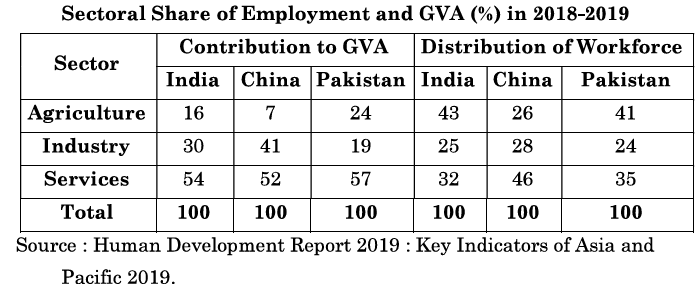
The given chart indicates the problem of ____ in the Indian Economy, post 1990-92. (Choose the correct option to fill up the blank)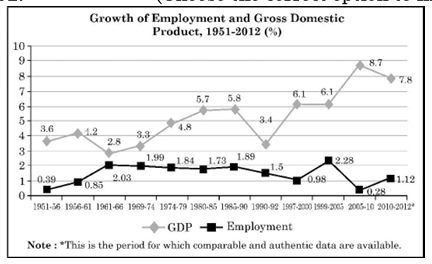
(i) Equilibrium level of income.
(ii) Total consumption expenditure at equilibrium income level.
About Income And Employment - CBSE-CLASS-XII
Income And Employment is a vital chapter for CBSE-CLASS-XII aspirants. Mastering the concepts covered in this chapter is essential for securing a top rank.
By rigorously practicing the previous year questions associated with this chapter, you can identify high-yield topics, understand the examiner's perspective, and boost your confidence during the actual exam.
Frequently Asked Questions
Why focus on Income And Employment PYQs?
Analyzing PYQs for this specific chapter reveals the most frequently tested concepts and the typical complexity of questions, allowing you to tailor your study plan efficiently.
How to best use this analysis?
Review the topic breakdown to see which sub-topics within Income And Employment carry the most weight. Then, tackle the questions iteratively to solidify your understanding.