Local names like Panna, Para, Palli, Nagla, Dhani etc. are examples of which of the following types of rural settlements in India ?
1
Clustered settlement
2
Semi-clustered settlement
3
Hamleted settlement
4
Dispersed settlement
Official Solution
Correct Option: (3)
Hamleted settlements are characterized by small, scattered communities that are often referred to by names such as Panna, Para, Palli, Nagla, and Dhani. These settlements typically consist of small clusters of houses in a rural area, with a focus on agriculture and related activities.
- Clustered settlement (A): This refers to closely packed houses or buildings in a concentrated area, which is not the case for the settlement types mentioned.
- Semi-clustered settlement (B): These settlements involve a combination of scattered houses and a group of buildings close together, but this does not fit the example provided.
- Hamleted settlement (C): This is the correct term. It refers to small rural settlements that are usually scattered across the landscape, often referred to by different local names.
- Dispersed settlement (D): These settlements are characterized by widely scattered dwellings, but "hamleted settlements" are more localized. Thus, the correct answer is option (C) Hamleted settlement.
03
PYQ 2025
medium
geographyID: cbse-cla
Read the following statements related to the objectives of smart city mission carefully and choose the correct option :
(i) To promote the city with clean and sustainable environment.
(ii) To provide decent quality of life to its citizens.
(iii) To provide employment to the job seekers.
(iv) To make the city less vulnerable to disasters.
1
Only (ii), (iii) and (iv) are correct.
2
Only (i), (iii) and (iv) are correct.
3
Only (i), (ii) and (iii) are correct.
4
Only (i), (ii) and (iv) are correct.
Official Solution
Correct Option: (4)
The objectives of the Smart City Mission primarily focus on improving the quality of life, sustainability, and disaster resilience in urban areas.
- (i) To promote the city with clean and sustainable environment: This is a key objective of the Smart City Mission. It focuses on making cities more sustainable, with clean energy initiatives and better waste management.
- (ii) To provide decent quality of life to its citizens: This is a core objective as the mission aims to improve living conditions by enhancing basic infrastructure, healthcare, education, and public services.
- (iii) To provide employment to the job seekers: Although this is important for urban development, it is not a direct objective of the Smart City Mission. The mission focuses more on infrastructure and services rather than direct employment creation.
- (iv) To make the city less vulnerable to disasters: This is a critical goal of the Smart City Mission, which includes initiatives to improve disaster management and urban resilience. Thus, the correct answer is option (D), as statements (i), (ii), and (iv) are directly aligned with the goals of the Smart City Mission.
04
PYQ 2025
medium
geographyID: cbse-cla
Arrange the following towns of India from the oldest to the newest order based on their historical evolution and choose the correct option :
(i) Jaipur
(ii) Chandigarh
(iii) Madurai
(iv) Jamshedpur
1
(iii), (i), (ii), (iv)
2
(iii), (i), (iv), (ii)
3
(i), (iii), (ii), (iv)
4
(i), (iii), (ii), (iv)
Official Solution
Correct Option: (2)
- Madurai (iii): One of the oldest cities in India, it has a rich history dating back to more than 2,500 years. It was the capital of the Pandya kings and has ancient temples.
- Jaipur (i): Jaipur was founded in 1727 by Maharaja Jai Singh II, making it one of the oldest planned cities in India, although it is newer than Madurai.
- Jamshedpur (iv): Established in the early 20th century, it is a relatively new city, founded in 1907 by the industrialist J. N. Tata.
- Chandigarh (ii): It is the youngest of these cities, as it was designed by Pierre Jeanneret and Le Corbusier, and became the capital of Punjab and Haryana in 1966. Thus, the correct order of cities based on their historical evolution is: Madurai (iii), Jaipur (i), Jamshedpur (iv), and Chandigarh (ii).
05
PYQ 2025
easy
geographyID: cbse-cla
Why is it that slums are the areas of residence with least choice ? Choose the correct options :
(i) They have dilapidated houses with poor ventilation.
(ii) The basic facilities like lights and toilets are difficult to get.
(iii) Hygienic conditions and drinking water are improper.
(iv) Better drainage facilities are available.
1
Only (i), (ii) and (iii) are correct.
2
Only (ii), (iii) and (iv) are correct.
3
Only (i), (iii) and (iv) are correct.
4
Only (i), (ii) and (iv) are correct.
Official Solution
Correct Option: (1)
Statement (i): Slums are typically characterized by dilapidated houses, which are often overcrowded with poor ventilation, inadequate space, and substandard construction. This statement is correct. Statement (ii): Basic facilities like electricity, water, and proper sanitation are indeed scarce in slums, making life difficult for their residents. The lack of toilets and clean drinking water is a major issue in these areas. This statement is correct. Statement (iii): Hygienic conditions in slums are generally poor due to overcrowding, lack of sanitation facilities, and improper waste disposal. Drinking water often remains contaminated. This statement is correct. Statement (iv): Slums generally suffer from poor drainage facilities, which contribute to flooding and health risks. Hence, this statement is incorrect. Thus, the correct statements are (i), (ii), and (iii), making option (A) the right choice.
06
PYQ 2025
medium
geographyID: cbse-cla
"Urban centres in India are more differentiated in terms of the socio-economic, politico-cultural and other indicators of development." Evaluate the statement with examples.
Official Solution
Correct Option: (1)
Urban centres in India show wide variation in development due to differences in history, economy, population, culture, and governance. Socio-economic Differences: Cities like Mumbai and Bengaluru are highly developed economically, while others like Patna and Gaya lag behind in infrastructure and employment opportunities. Cultural Variation: Urban centres such as Varanasi focus on religion and tradition, while cities like Pune emphasize education and innovation. Political Importance: Cities like New Delhi hold national political significance, whereas others have only local administrative roles. Access to Services: Metro cities offer better healthcare, education, and transport than smaller towns. Thus, urban centres are highly differentiated due to uneven development and regional disparities.
07
PYQ 2025
medium
geographyID: cbse-cla
Suggest the measures to solve the problems of slums in India.
Official Solution
Correct Option: (1)
Slums in India are often characterized by overcrowded living conditions, inadequate sanitation, and poor infrastructure. To solve the problems of slums, the following measures can be implemented:
1. Improved Housing: Government initiatives like the Pradhan Mantri Awas Yojana (PMAY) should be expanded to provide affordable housing for the poor. Building more affordable and durable homes will help in reducing slum populations.
2. Better Infrastructure: The government should focus on improving the infrastructure in slums, including providing better roads, sewage systems, clean water, electricity, and healthcare facilities.
3. Community Involvement: Encouraging the active participation of local communities in improving their living conditions can help in ensuring the long-term sustainability of efforts. Community-driven solutions can be effective in tackling local issues.
4. Slum Rehabilitation Projects: In areas where slums cannot be removed, slum rehabilitation projects should be developed. These projects should include proper sanitation, water, and waste management systems.
5. Economic Empowerment Programs: Providing education, skill training, and employment opportunities for the residents of slums will help break the cycle of poverty. It will enable them to support themselves and improve their living standards.
08
PYQ 2025
medium
geographyID: cbse-cla
Read the following statements regarding medieval towns in India carefully and choose the correct option: (i) About 100 of the existing towns have their roots in the medieval period. (ii) Varanasi, Madurai, and Prayag are some of its examples. (iii) Most of the towns were developed as headquarters of the kingdoms. (iv) These are mostly fort towns built on ruins of ancient towns.
1
Only (i), (ii), and (iii) are correct.
2
Only (i), (ii), and (iv) are correct.
3
Only (i), (ii), and (iii) are correct.
4
Only (ii), (iii), and (iv) are correct.
Official Solution
Correct Option: (1)
Many existing towns have their roots in the medieval period, especially cities like Varanasi, Madurai, and Prayag. These towns were often built as headquarters of the kingdoms and were mostly fort towns constructed on ruins of ancient settlements.
09
PYQ 2025
medium
geographyID: cbse-cla
Choose the correct option to fill the blank: ______were originally developed for refuelling, watering, and collecting food items.
1
Entreports
2
Ports of Call
3
Packet Stations
4
Comprehensive Ports
Official Solution
Correct Option: (2)
Ports of call were established primarily to provide facilities for ships to stop and refuel, resupply, and allow passengers to disembark. These ports serve as temporary halts during longer voyages.
10
PYQ 2025
medium
geographyID: cbse-cla
Suggest the measures to solve the problems of urban waste disposal in India.
Official Solution
Correct Option: (1)
The problems of urban waste disposal in India can be addressed through the following measures: - Improved Waste Segregation: Citizens should be educated about the importance of segregating waste into biodegradable and non-biodegradable categories at the source itself. This will facilitate recycling and reduce the burden on landfills. - Proper Waste Collection and Transportation: Municipal authorities should ensure that there are adequate waste collection points and that waste is collected regularly to prevent pile-up in residential areas. The use of covered bins and proper transportation systems should be prioritized. - Promoting Recycling and Composting: Encouraging the recycling of waste materials such as plastic, paper, and glass can help reduce waste volume. Similarly, composting of organic waste can be promoted to generate useful fertilizers. - Setting up Waste-to-Energy Plants: Establishing waste-to-energy plants can help convert waste into energy, which can be used to power cities or industries. This approach addresses both the waste disposal and energy needs. - Awareness Campaigns: Public awareness campaigns about the harmful effects of improper waste disposal, along with educating people on the benefits of proper waste management, can go a long way in changing public behavior and encouraging participation in waste management programs. By implementing these measures, urban waste disposal problems can be significantly mitigated in India, contributing to cleaner and healthier cities.
11
PYQ 2025
medium
geographyID: cbse-cla
Read the following statements regarding urban settlements of India carefully and choose the correct options:
1
All urban settlements are manufacturing centres.
(ii) Urban settlements are generally compact and larger in size.
(iii) They are engaged in a variety of non-agricultural activities.
(iv) The urban settlements have direct relation with rural settlements.
2
Only (i), (ii), and (iv) are correct.
3
Only (i), (iii), and (iv) are correct.
4
Only (ii), (iii), and (iv) are correct.
Official Solution
Correct Option: (1)
Urban settlements in India are generally compact, larger in size, and are engaged in non-agricultural activities. They also have direct relations with rural settlements. However, not all urban settlements are manufacturing centres.
12
PYQ 2025
medium
geographyID: cbse-cla
Arrange the following towns of India as per their historical evolution from the oldest to the newest order and choose the correct option: % Towns
(i) Chennai \quad (ii) Gandhinagar \quad (iii) Patna \quad (iv) Lucknow
1
(iii), (iv), (ii), (i)
2
(iii), (iv), (i), (ii)
3
(iv), (iii), (ii), (i)
4
(iv), (ii), (iii), (i)
Official Solution
Correct Option: (2)
The historical evolution of the towns in India from oldest to newest is: Patna (iii), Lucknow (iv), Chennai (i), and Gandhinagar (ii).
13
PYQ 2025
medium
geographyID: cbse-cla
Which one of the following is an industrial town in India?
1
Salem
2
Chandigarh
3
Nainital
4
Shillong
Official Solution
Correct Option: (2)
The given statement highlights how the deterioration of agricultural land is contributing to increased pressure on agricultural productivity. Let's analyze the reasons provided: - Soil erosion and waterlogging: These are major contributors to the deterioration of agricultural land quality. Soil erosion removes the topsoil which is essential for plant growth, while waterlogging leads to reduced oxygen in the soil, affecting crop yields. Both contribute to the pressure on agricultural land.
- Salinisation and alkalinisation of soil: These processes involve the accumulation of salts or alkalis in the soil, which severely affects soil fertility and reduces its productivity. This is a major cause of soil degradation and increasing pressure on agricultural land.
- Rich land fertility and multiple cropping: Rich land fertility and multiple cropping are generally considered positive factors that support agricultural productivity, not factors leading to land deterioration. Therefore, this statement does not contribute to the given context.
- Decline in land productivity: This is the direct result of soil degradation caused by factors like erosion, waterlogging, salinisation, and poor farming practices. As the quality of land declines, so does its productivity. Thus, the correct option is (B) because statements I, II, and IV are valid reasons contributing to the pressure on agricultural land, whereas statement III is not.
14
PYQ 2025
medium
geographyID: cbse-cla
Arrange the following towns of India from the oldest to the newest on the basis of their evolution and choose the correct option. I. Lucknow
II. Varanasi
III. Bhilai
IV. Jamshedpur
1
I, IV, III, II
2
I, IV, II, III
3
II, I, IV, III
4
II, I, III, IV
Official Solution
Correct Option: (4)
The factors influencing migration are broadly categorized into push and pull factors. In this case, we are asked to identify the push factors, which are the conditions that drive people to leave their rural areas for urban centers. - Unemployment: The lack of job opportunities in rural areas often pushes people to migrate to urban centers where jobs are more accessible. This is a clear push factor.
- Job opportunities: Job opportunities are considered a pull factor, not a push factor. Urban areas typically offer more jobs, which attracts people to migrate, rather than driving them away.
- Economic backwardness: Rural areas with poor economic conditions often push people to migrate to urban areas where better economic opportunities exist.
- Lack of medical facilities: Insufficient medical care in rural areas forces people to move to urban areas for better healthcare options. This is another push factor. Thus, the correct option is (D), where I, III, and IV are correct push factors, while II (Job opportunities) is a pull factor.
15
PYQ 2025
medium
geographyID: cbse-cla
Two statements are given below. They are Assertion (A) and Reason (R). Read both the statements carefully and choose the correct option. Assertion (A): Lack of basic necessities such as housing, health and drinking water, etc. are found in slum settlements. Reason (R): The government of India launched 'The Swachh Bharat Mission' to improve the quality of life in urban slums.
1
Both (A) and (R) are true and (R) is the correct explanation of (A).
2
Both (A) and (R) are true, but (R) is not the correct explanation of (A).
3
(A) is correct, but (R) is incorrect.
4
(A) is incorrect, but (R) is correct.
Official Solution
Correct Option: (2)
The primary source of pollution in the Yamuna River in Delhi is the dumping of domestic waste. Due to rapid urbanization, untreated sewage, household waste, and industrial effluents are directly released into the river. This has led to severe water pollution, with high levels of toxins and waste in the water. While the use of pesticides and fertilizers does contribute to pollution in agricultural areas, the dumping of domestic waste is the most significant factor in polluting the Yamuna in Delhi. Thus, the correct option is (B) Dumping of domestic waste.
16
PYQ 2025
medium
geographyID: cbse-cla
Analyse the main features of the composition of working population in India.
Official Solution
Correct Option: (1)
The composition of the working population in India is diverse, with various sectors contributing to employment. The key features of India's working population are as follows: Sectoral Distribution of Employment: \begin{itemize} A significant proportion of the working population is still employed in the agricultural sector, especially in rural areas. This contributes to a large informal workforce. The industrial and manufacturing sectors employ a smaller but growing percentage of the working population, particularly in urban and semi-urban areas. The service sector has seen tremendous growth in recent years, particularly in IT, banking, healthcare, and education, contributing significantly to employment. \end{itemize} Gender Disparity: The Indian workforce shows a significant gender gap, with fewer women employed compared to men. The participation of women in the workforce has increased over the years, but it is still lower than the global average. Youth Employment: The youth population in India represents a large portion of the working force. However, youth unemployment is a growing issue, with many young people struggling to find suitable employment opportunities due to a mismatch between skills and market demand. Unorganised Sector: A significant portion of India's workforce is employed in the unorganised sector, which lacks job security, regular wages, and benefits like healthcare or pensions. This includes small businesses, agriculture, and casual labor. Increasing Urban Employment: As urbanization grows, more people are finding jobs in cities. These include both skilled and unskilled labor, with significant growth in the informal and gig economy. In conclusion, India’s working population is primarily engaged in agriculture, with growing shifts toward industry and services. However, challenges such as gender disparity, youth unemployment, and informal labor persist, and require targeted policies for improving the employment situation.
17
PYQ 2025
medium
geographyID: cbse-cla
"The distribution of rural population is not uniform throughout the country." Evaluate the statement with suitable examples.
Official Solution
Correct Option: (1)
Uneven Distribution of Rural Population:
The distribution of rural population in India is not uniform due to differences in physical, climatic, and socio-economic factors. For example: The Indo-Gangetic plains and coastal regions have high rural population densities because of fertile soil and favorable climate. Desert areas like Rajasthan and mountainous regions such as the Himalayas have sparse rural populations due to harsh environmental conditions. States like Uttar Pradesh and Bihar have large rural populations, whereas northeastern states have comparatively fewer rural inhabitants. This variation arises from differences in resource availability, land fertility, water supply, and livelihood opportunities.
18
PYQ 2025
medium
geographyID: cbse-cla
"The distribution of urban population has a wide variation throughout India." Evaluate the statement with suitable examples.
Official Solution
Correct Option: (1)
The distribution of urban population in India is highly uneven and shows significant regional variation due to geographical, historical, economic, and infrastructural factors. High Urbanisation in Western and Southern States: Maharashtra, Tamil Nadu, Gujarat, and Karnataka have higher urban populations due to early industrialisation, trade centres, and IT hubs. Cities like Mumbai, Chennai, and Bengaluru are examples. Low Urbanisation in Northern and Eastern States: States like Bihar, Odisha, and Uttar Pradesh have lower urbanisation levels due to agrarian economies, poor infrastructure, and low industrial development. Union Territories with High Urban Share: Some UTs like Delhi (urban population over 97%) and Chandigarh are highly urbanised due to being administrative and service hubs. Disparity within States: Even within a state, urban population is concentrated in specific cities while the rest of the region remains rural. Hence, urban population distribution in India is not uniform and varies significantly across regions.
19
PYQ 2025
medium
geographyID: cbse-cla
Read the following statements regarding urban settlements of India carefully and choose the correct options: (i) All urban settlements are manufacturing centres. (ii) Urban settlements are generally compact and larger in size. (iii) They are engaged in a variety of non-agricultural activities. (iv) The urban settlements have direct relation with rural settlements.
1
Only (i), (ii), and (iv) are correct.
2
Only (i), (iii), and (iv) are correct.
3
Only (ii), (iii), and (iv) are correct.
4
Only (i), (ii), and (iii) are correct.
Official Solution
Correct Option: (1)
Urban settlements in India are generally compact, larger in size, and are engaged in non-agricultural activities. They also have direct relations with rural settlements. However, not all urban settlements are manufacturing centres.
20
PYQ 2025
medium
geographyID: cbse-cla
Arrange the following towns of India as per their historical evolution from the oldest to the newest order and choose the correct option: (i) Chennai (ii) Gandhinagar (iii) Patna (iv) Lucknow
1
(iii), (iv), (ii), (i)
2
(iii), (iv), (i), (ii)
3
(iv), (iii), (ii), (i)
4
(iv), (ii), (iii), (i)
Official Solution
Correct Option: (2)
The historical evolution of the towns in India from oldest to newest is: Patna (iii), Lucknow (iv), Chennai (i), and Gandhinagar (ii).
21
PYQ 2025
medium
geographyID: cbse-cla
Suggest the measures to solve the problems of slums in India.
Official Solution
Correct Option: (1)
Slums in India are often characterized by overcrowded living conditions, inadequate sanitation, and poor infrastructure. To solve the problems of slums, the following measures can be implemented:
1. Improved Housing: Government initiatives like the Pradhan Mantri Awas Yojana (PMAY) should be expanded to provide affordable housing for the poor. Building more affordable and durable homes will help in reducing slum populations.
2. Better Infrastructure: The government should focus on improving the infrastructure in slums, including providing better roads, sewage systems, clean water, electricity, and healthcare facilities.
3. Community Involvement: Encouraging the active participation of local communities in improving their living conditions can help in ensuring the long-term sustainability of efforts. Community-driven solutions can be effective in tackling local issues.
4. Slum Rehabilitation Projects: In areas where slums cannot be removed, slum rehabilitation projects should be developed. These projects should include proper sanitation, water, and waste management systems.
5. Economic Empowerment Programs: Providing education, skill training, and employment opportunities for the residents of slums will help break the cycle of poverty. It will enable them to support themselves and improve their living standards.
22
PYQ 2025
medium
geographyID: cbse-cla
Why is it that slums are the areas of residence with the least choice? Choose the correct options: (i) They have dilapidated houses with poor ventilation. (ii) The basic facilities like lights and toilets are difficult to get. (iii) Hygienic conditions and drinking water are improper. (iv) Better drainage facilities are available.
1
Only (i), (ii) and (iii) are correct.
2
Only (ii), (iii) and (iv) are correct.
3
Only (i), (iii) and (iv) are correct.
4
Only (i), (ii) and (iv) are correct.
Official Solution
Correct Option: (1)
Slums typically face multiple challenges, including poor housing conditions with inadequate ventilation, lack of basic amenities like electricity and sanitation, and inadequate access to clean drinking water. These conditions contribute to the low quality of life in slums.
23
PYQ 2025
medium
geographyID: cbse-cla
Local names like Panna, Para, Palli, Nagla, Dhani etc. are examples of which of the following types of rural settlements in India?
1
Clustered settlement
2
Semi-clustered settlement
3
Hamleted settlement
4
Dispersed settlement
Official Solution
Correct Option: (3)
Local names like Panna, Para, Palli, Nagla, and Dhani are examples of hamleted settlements. These are small rural settlements that consist of a number of dispersed houses grouped together but still retain a level of individual separation.
24
PYQ 2025
medium
geographyID: cbse-cla
Arrange the following towns of India as per their location from north to south direction and choose the correct option: (i) Nagpur (ii) Hyderabad (iii) Madurai (iv) Lucknow
1
(i), (ii), (iii), (iv)
2
(ii), (iv), (i), (iii)
3
(iv), (iii), (ii), (i)
4
(i), (iv), (iii), (ii)
Official Solution
Correct Option: (4)
The towns arranged from north to south are: Nagpur (i), Lucknow (iv), Madurai (iii), and Hyderabad (ii). This order reflects their geographical positions based on latitude and longitude.
25
PYQ 2025
medium
geographyID: cbse-cla
Read the following statements regarding medieval towns in India carefully and choose the correct option: (i) About 100 of the existing towns have their roots in the medieval period. (ii) Varanasi, Madurai, and Prayag are some of its examples. (iii) Most of the towns were developed as headquarters of the kingdoms. (iv) These are mostly fort towns built on ruins of ancient towns.
1
Only (i), (ii), and (iii) are correct.
2
Only (i), (ii), and (iv) are correct.
3
Only (i), (ii), and (iii) are correct.
4
Only (ii), (iii), and (iv) are correct.
Official Solution
Correct Option: (1)
Many existing towns have their roots in the medieval period, especially cities like Varanasi, Madurai, and Prayag. These towns were often built as headquarters of the kingdoms and were mostly fort towns constructed on ruins of ancient settlements.
26
PYQ 2025
medium
geographyID: cbse-cla
Read the following statements regarding urban settlements of India carefully and choose the correct options: (i) All urban settlements are manufacturing centres. (ii) Urban settlements are generally compact and larger in size. (iii) They are engaged in a variety of non-agricultural activities. (iv) The urban settlements have direct relation with rural settlements.
1
Only (i), (ii), and (iv) are correct.
2
Only (i), (iii), and (iv) are correct.
3
Only (ii), (iii), and (iv) are correct.
4
Only (i), (ii), and (iii) are correct.
Official Solution
Correct Option: (1)
Urban settlements in India are generally compact, larger in size, and are engaged in non-agricultural activities. They also have direct relations with rural settlements. However, not all urban settlements are manufacturing centres.
27
PYQ 2025
medium
geographyID: cbse-cla
Arrange the following towns of India as per their historical evolution from the oldest to the newest order and choose the correct option: (i) Chennai (ii) Gandhinagar (iii) Patna (iv) Lucknow
1
(iii), (iv), (ii), (i)
2
(iii), (iv), (i), (ii)
3
(iv), (iii), (ii), (i)
4
(iv), (ii), (iii), (i)
Official Solution
Correct Option: (2)
The historical evolution of the towns in India from oldest to newest is: Patna (iii), Lucknow (iv), Chennai (i), and Gandhinagar (ii).
28
PYQ 2025
medium
geographyID: cbse-cla
Suggest the measures to solve the problems of slums in India.
Official Solution
Correct Option: (1)
Slums in India are often characterized by overcrowded living conditions, inadequate sanitation, and poor infrastructure. To solve the problems of slums, the following measures can be implemented:
1. Improved Housing: Government initiatives like the Pradhan Mantri Awas Yojana (PMAY) should be expanded to provide affordable housing for the poor. Building more affordable and durable homes will help in reducing slum populations.
2. Better Infrastructure: The government should focus on improving the infrastructure in slums, including providing better roads, sewage systems, clean water, electricity, and healthcare facilities.
3. Community Involvement: Encouraging the active participation of local communities in improving their living conditions can help in ensuring the long-term sustainability of efforts. Community-driven solutions can be effective in tackling local issues.
4. Slum Rehabilitation Projects: In areas where slums cannot be removed, slum rehabilitation projects should be developed. These projects should include proper sanitation, water, and waste management systems.
5. Economic Empowerment Programs: Providing education, skill training, and employment opportunities for the residents of slums will help break the cycle of poverty. It will enable them to support themselves and improve their living standards.
29
PYQ 2025
medium
geographyID: cbse-cla
Why is it that slums are the areas of residence with the least choice? Choose the correct options: (i) They have dilapidated houses with poor ventilation. (ii) The basic facilities like lights and toilets are difficult to get. (iii) Hygienic conditions and drinking water are improper. (iv) Better drainage facilities are available.
1
Only (i), (ii) and (iii) are correct.
2
Only (ii), (iii) and (iv) are correct.
3
Only (i), (iii) and (iv) are correct.
4
Only (i), (ii) and (iv) are correct.
Official Solution
Correct Option: (1)
Slums typically face multiple challenges, including poor housing conditions with inadequate ventilation, lack of basic amenities like electricity and sanitation, and inadequate access to clean drinking water. These conditions contribute to the low quality of life in slums.
30
PYQ 2025
medium
geographyID: cbse-cla
Local names like Panna, Para, Palli, Nagla, Dhani etc. are examples of which of the following types of rural settlements in India?
1
Clustered settlement
2
Semi-clustered settlement
3
Hamleted settlement
4
Dispersed settlement
Official Solution
Correct Option: (3)
Local names like Panna, Para, Palli, Nagla, and Dhani are examples of hamleted settlements. These are small rural settlements that consist of a number of dispersed houses grouped together but still retain a level of individual separation.
31
PYQ 2025
medium
geographyID: cbse-cla
Read the following statements regarding medieval towns in India carefully and choose the correct option: (i) About 100 of the existing towns have their roots in the medieval period. (ii) Varanasi, Madurai, and Prayag are some of its examples. (iii) Most of the towns were developed as headquarters of the kingdoms. (iv) These are mostly fort towns built on ruins of ancient towns.
1
Only (i), (ii), and (iii) are correct.
2
Only (i), (ii), and (iv) are correct.
3
Only (i), (ii), and (iii) are correct.
4
Only (ii), (iii), and (iv) are correct.
Official Solution
Correct Option: (1)
Many existing towns have their roots in the medieval period, especially cities like Varanasi, Madurai, and Prayag. These towns were often built as headquarters of the kingdoms and were mostly fort towns constructed on ruins of ancient settlements.
32
PYQ 2025
medium
geographyID: cbse-cla
Arrange the following towns of India as per their location from north to south direction and choose the correct option: (i) Nagpur (ii) Hyderabad (iii) Madurai (iv) Lucknow
1
(i), (ii), (iii), (iv)
2
(ii), (iv), (i), (iii)
3
(iv), (iii), (ii), (i)
4
(i), (iv), (iii), (ii)
Official Solution
Correct Option: (4)
The towns arranged from north to south are: Nagpur (i), Lucknow (iv), Madurai (iii), and Hyderabad (ii). This order reflects their geographical positions based on latitude and longitude.
33
PYQ 2026
easy
geographyID: cbse-cla
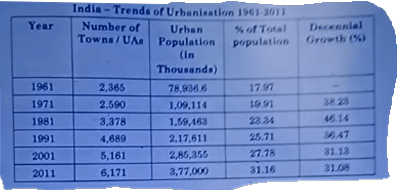
Study the given table carefully and answer the questions that follow.
Official Solution
Correct Option: (1)
34
PYQ 2026
medium
geographyID: cbse-cla
Mention the number of towns/UAs during 1981-91.
Official Solution
Correct Option: (1)
Step 1: Read the table for 1981 and 1991.
From the table:
Number of towns/UAs in 1981 = 3,382
Number of towns/UAs in 1991 = 4,652
Step 2: Interpret the question.
The question asks for "the number of towns/UAs during 1981-91". This could mean:
The number at the beginning of the decade (1981): 3,382
The number at the end of the decade (1991): 4,652
The range or the increase during the decade
Based on standard interpretation in such questions, it typically asks for the number at the end of the period or the number during that census year. Answer: During 1981-91, the number of towns/urban agglomerations increased from 3,382 in 1981 to 4,652 in 1991.
35
PYQ 2026
medium
geographyID: cbse-cla
Explain the decennial growth rate of urban population.
Official Solution
Correct Option: (1)
Step 1: Definition of decennial growth rate.
Decennial growth rate refers to the percentage increase in urban population over a ten-year period (from one census to the next). It is calculated using the formula: Step 2: Analysis of decennial growth rates from the table.
1961-1971: 38.23%
Moderate growth rate
Urban population increased from 78.94 million to 109.11 million
Post-independence urbanization phase with industrial development
1971-1981: 46.14%
Highest decennial growth rate in the table
Rapid urbanization during this period
Due to industrial expansion, Green Revolution benefits, and migration to cities
Urban population increased to 159.46 million
1981-1991: 36.47%
Decline from the previous decade's peak
Urban population reached 217.61 million
Growth rate still substantial but showing signs of stabilization
Economic factors: Industrialization, employment opportunities in cities
Social factors: Better education, healthcare, and amenities in urban areas
Migration: Rural-to-urban migration for better livelihood
Natural increase: Higher birth rates in urban areas during earlier decades
Reclassification: Villages reclassified as towns when they meet urban criteria
Government policies: Industrial policies, urban development programs
Step 4: Trend analysis.
The decennial growth rate of urban population shows:
An increasing trend from 1961 to 1981 (peaking at 46.14%)
A declining trend from 1981 onwards (36.47% in 1991, 31.13% in 2001)
Despite declining growth rates, absolute numbers continue to increase significantly
Reflects the maturation of urbanization process and possible saturation in some metropolitan areas
Answer: The decennial growth rate of urban population represents the percentage increase in urban population over a ten-year period. From the table, it increased from 38.23% (1961-71) to a peak of 46.14% (1971-81), then declined to 36.47% (1981-91) and further to 31.13% (1991-2001). This indicates rapid urbanization in the 1970s followed by a gradual slowdown in growth rate, though absolute urban population continues to rise substantially.
36
PYQ 2026
medium
geographyID: cbse-cla
During which decade the increase in number of towns/UAs is the lowest?
Official Solution
Correct Option: (1)
Step 1: Calculate the increase in number of towns/UAs for each decade.
1961-1971: 2,590 - 2,365 = 225 towns
1971-1981: 3,382 - 2,590 = 792 towns
1981-1991: 4,652 - 3,382 = 1,270 towns
1991-2001: 5,161 - 4,652 = 509 towns
Step 2: Identify the lowest increase.
Comparing the increases:
1961-71: 225 towns
1971-81: 792 towns
1981-91: 1,270 towns
1991-2001: 509 towns
The lowest increase is 225 towns during the decade 1961-1971. Answer: The decade 1961-1971 recorded the lowest increase in the number of towns/urban agglomerations with an addition of only 225 towns.