International Trade
37 previous year questions.
High-Yield Trend
Chapter Questions 37 MCQs
The act of opening up economies for trading is known as _______.
Commercial Port - Dover
I. Honolulu
II. London
III. San Francisco
IV. Colon
III, I, IV, II
Read the given passage carefully and answer the questions that follow :
In agriculturally important countries, agro products are exchanged for manufactured goods, whereas industrialised nations export machinery and finished products and import food grains and other raw materials. Foreign investment can boost trade in developing countries which lack in capital required for the development of mining, oil drilling, heavy engineering, lumbering and plantation agriculture. By developing such capital intensive industries in developing countries, the industrial nations ensure import of food stuffs, minerals and create markets for their finished products. This entire cycle steps up the volume of trade between nations.
Assertion (A): International trade is mutually beneficial to nations.
Reason (R): It helps in getting the needed items from other countries.
Case for Free Trade
The act of opening up economies for trading is known as free trade or trade liberalization. This is done by bringing down trade barriers like tariffs. Trade liberalization allows goods and services from everywhere to compete with domestic products and services.
Globalisation along with free trade can adversely affect the economies of developing countries by not giving equal playing field by imposing conditions which are unfavorable. With the development of transport and communication systems goods and services can travel faster and farther than ever before. But free trade should not only let rich countries enter the markets, but allow the developed countries to keep their own markets protected from foreign products.
Countries also need to be cautious about dumped goods; as along with free trade dumped goods of cheaper prices can harm the domestic producers.
What should be done by the developing countries to protect from negative impact of ‘free trade’? Mention any two steps.
Case for Free Trade
The act of opening up economies for trading is known as free trade or trade liberalization. This is done by bringing down trade barriers like tariffs. Trade liberalization allows goods and services from everywhere to compete with domestic products and services.
Globalisation along with free trade can adversely affect the economies of developing countries by not giving equal playing field by imposing conditions which are unfavorable. With the development of transport and communication systems goods and services can travel faster and farther than ever before. But free trade should not only let rich countries enter the markets, but allow the developed countries to keep their own markets protected from foreign products.
Countries also need to be cautious about dumped goods; as along with free trade dumped goods of cheaper prices can harm the domestic producers.
How have ‘globalisation’ and ‘free trade’ affected the economies of developing countries?
Case for Free Trade
The act of opening up economies for trading is known as free trade or trade liberalization. This is done by bringing down trade barriers like tariffs. Trade liberalization allows goods and services from everywhere to compete with domestic products and services.
Globalisation along with free trade can adversely affect the economies of developing countries by not giving equal playing field by imposing conditions which are unfavorable. With the development of transport and communication systems goods and services can travel faster and farther than ever before. But free trade should not only let rich countries enter the markets, but allow the developed countries to keep their own markets protected from foreign products.
Countries also need to be cautious about dumped goods; as along with free trade dumped goods of cheaper prices can harm the domestic producers.
Explain the meaning of ‘trade liberalisation’.
| Column-I (Basis of International Trade) | Column-II (Feature) |
|---|---|
| a. Geological structure | ii. It determines the mineral resource base. |
| b. Mineral resources | iii. It provides the base for industrial development. |
| c. Climate | i. It determines the biotic life. |
| d. Cultural factors | iv. The development of crafts and skills is determined by it. |
Case for Free Trade
The act of opening up economies for trading is known as free trade or trade liberalisation. This is done by bringing down trade barriers like tariffs. Trade liberalisation allows goods and services from everywhere to compete with domestic products and services.
Globalisation along with free trade can adversely affect the economies of developing countries by not giving equal playing field by imposing conditions which are unfavourable. With the development of transport and communication systems, goods and services can travel faster and farther than ever before. But free trade should not only let rich countries enter the markets, but allow the developed countries to keep their own markets protected from foreign products.
Countries also need to be cautious about dumped goods; as along with free trade dumped goods of cheaper prices can harm the domestic producers.
\textit{“In modern times, trade is the basis of the world’s economic organisation and is related to the ___\ of nations.”}
% Assertion and Reason Assertion : \textit{‘International trade may prove to be detrimental to nations.’}
Reason (R): \textit{‘It may lead to dependence on other nations causing exploitation.’}
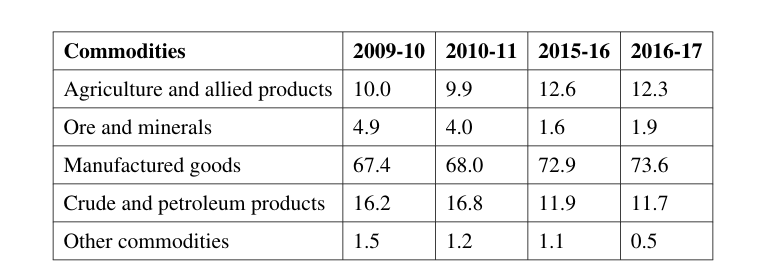
| Commodities | 2009-10 | 2010-11 | 2015-16 | 2016-17 |
|---|---|---|---|---|
| Agriculture and allied products | 10.0 | 9.9 | 12.6 | 12.3 |
| Ore and minerals | 4.9 | 4.0 | 1.6 | 1.9 |
| Manufactured goods | 67.4 | 68.0 | 72.9 | 73.6 |
| Crude and petroleum products | 16.2 | 16.8 | 11.9 | 11.7 |
| Other commodities | 1.5 | 1.2 | 1.1 | 0.5 |
\bigskip
Composition of India’s Export: 2009-2017
“In modern times, trade is the basis of the world’s economic organisation and is related to the_____ of nations.”
Assertion (A): ‘International trade may prove to be detrimental to nations.’
Reason (R): ‘It may lead to dependence on other nations causing exploitation.’
(i) India has a long coastline surrounded by the ocean from three sides.
(ii) Indian coasts have a large number of well-developed sea ports.
(iii) Kandla port exports a huge amount of iron-ore.
(iv) The transportation cost by water is very cheap for voluminous items.
Assertion (A): ‘International trade may prove to be detrimental to nations.’
Reason (R): ‘It may lead to dependence on other nations causing exploitation.’
“In modern times, trade is the basis of the world’s economic organisation and is related to the_____ of nations.”
(i) India has a long coastline surrounded by the ocean from three sides.
(ii) Indian coasts have a large number of well-developed sea ports.
(iii) Kandla port exports a huge amount of iron-ore.
(iv) The transportation cost by water is very cheap for voluminous items.
About International Trade - CBSE-CLASS-XII
International Trade is a vital chapter for CBSE-CLASS-XII aspirants. Mastering the concepts covered in this chapter is essential for securing a top rank.
By rigorously practicing the previous year questions associated with this chapter, you can identify high-yield topics, understand the examiner's perspective, and boost your confidence during the actual exam.
Frequently Asked Questions
Why focus on International Trade PYQs?
Analyzing PYQs for this specific chapter reveals the most frequently tested concepts and the typical complexity of questions, allowing you to tailor your study plan efficiently.
How to best use this analysis?
Review the topic breakdown to see which sub-topics within International Trade carry the most weight. Then, tackle the questions iteratively to solidify your understanding.