CUET-PG SERIES
Food-science-and-technology

Food Science

13 previous year questions.

Volume: 13 Ques
Yield: Medium

High-Yield Trend

13
2025

Chapter Questions
13 MCQs

01
PYQ 2025
medium
food-science-and-technology ID: cuet-pg-
The major microorganism that the food handler's may harbour as part of the body's flora is:
1
Staphylococcus aureus
2
Bacillus thermophilus
3
Clostridium botulinum
4
Bacillus cereus
02
PYQ 2025
medium
food-science-and-technology ID: cuet-pg-
Identify the correct sequence of product/by-product formation during cocoa and chocolate processing/manufacturing:
(A). Cocoa powder
(B). Chocolate liquor
(C). Cocoa butter
(D). Nibs
Choose the most appropriate answer from the options given below:
1
(A), (B), (C), (D)
2
(A), (B), (D), (C)
3
(D), (B), (C), (A)
4
(C), (B), (D), (A)
03
PYQ 2025
medium
food-science-and-technology ID: cuet-pg-
Which of the following criteria that are used for screening of the New Food Product ideas?
(A). Marketability
(B). Technical feasibility
(C). Manufacturing capability
(D). Financial capability
Choose the most appropriate answer from the options given below:
1
(A), (B) and (D) only.
2
(A), (B) and (C) only.
3
(A), (B), (C) and (D).
4
(B), (C) and (D) only.
04
PYQ 2025
medium
food-science-and-technology ID: cuet-pg-
The instrument used to measure the salt percentage of pickles is__________
1
Polarimeter
2
Brinograph
3
Saltmeter
4
Ionograph
05
PYQ 2025
medium
food-science-and-technology ID: cuet-pg-

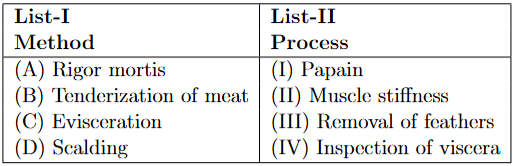
Match List-I with List-II 

Choose the most appropriate answer from the options given below: 
 

1
(A) - (I), (B) - (II), (C) - (III), (D) - (IV)
2
(A) - (I), (B) - (III), (C) - (II), (D) - (IV)
3
(A) - (II), (B) - (I), (C) - (IV), (D) - (III)
4
(A) - (III), (B) - (IV), (C) - (I), (D) - (II)
06
PYQ 2025
medium
food-science-and-technology ID: cuet-pg-

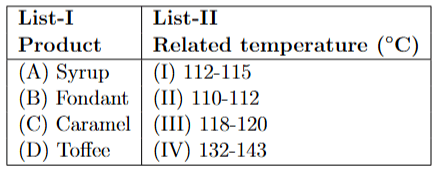
Match List-I with List-II 

Choose the most appropriate answer from the options given below: 
 

1
(A) - (II), (B) - (I), (C) - (III), (D) - (IV)
2
(A) - (I), (B) - (III), (C) - (II), (D) - (IV)
3
(A) - (I), (B) - (II), (C) - (IV), (D) - (III)
4
(A) - (III), (B) - (IV), (C) - (I), (D) - (II)
07
PYQ 2025
medium
food-science-and-technology ID: cuet-pg-
The major microorganism responsible for food infection transmitted through eggs is __________
1
E. coli
2
Salmonella
3
Pseudomonas
4
Clostridium botulinum
08
PYQ 2025
medium
food-science-and-technology ID: cuet-pg-
The penetration of fat within the muscle fibre when an animal is well fed, is called as __________
1
stabilization
2
marbling
3
ageing
4
rigor mortis
09
PYQ 2025
medium
food-science-and-technology ID: cuet-pg-
NOEL stands for
1
Non-Observable Effluent Limit
2
No Observable Effluent Limit
3
Non-Observable Effect Level
4
No Observable Effect Level
10
PYQ 2025
medium
food-science-and-technology ID: cuet-pg-
The process for the development of cocoa mass follows a sequence of
(A). Milling
(B). Cleaning and roasting
(C). Breaking and winnowing
(D). Fermentation of dried beans
Choose the most appropriate answer from the options given below:
1
(A), (B), (C), (D).
2
(D), (B), (C), (A).
3
(B), (A), (D), (C).
4
(C), (B), (D), (A).
11
PYQ 2025
medium
food-science-and-technology ID: cuet-pg-
QRAC stands for:
1
Qualitative Risk Analyzing Committee
2
Qualitative Risk Assessment Committee
3
Quantitative Risk Assessment Committee
4
Quantitative Risk Analysing Committee
12
PYQ 2025
medium
food-science-and-technology ID: cuet-pg-

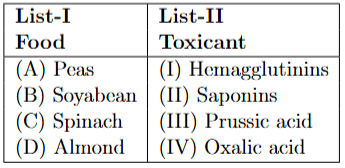
Match List-I with List-II 

Choose the most appropriate answer from the options given below: 
 

1
(A) - (II), (B) - (I), (C) - (IV), (D) - (III)
2
(A) - (I), (B) - (III), (C) - (II), (D) - (IV)
3
(A) - (I), (B) - (II), (C) - (IV), (D) - (III)
4
(A) - (III), (B) - (IV), (C) - (I), (D) - (II)
13
PYQ 2025
medium
food-science-and-technology ID: cuet-pg-
Which of the following is used as an antioxidant in fats and oils?
1
BHA
2
BHF
3
HBT
4
HBA

About Food Science - CUET-PG

Food Science is a vital chapter for CUET-PG aspirants. Mastering the concepts covered in this chapter is essential for securing a top rank.

By rigorously practicing the previous year questions associated with this chapter, you can identify high-yield topics, understand the examiner's perspective, and boost your confidence during the actual exam.

Frequently Asked Questions

Why focus on Food Science PYQs?

Analyzing PYQs for this specific chapter reveals the most frequently tested concepts and the typical complexity of questions, allowing you to tailor your study plan efficiently.

How to best use this analysis?

Review the topic breakdown to see which sub-topics within Food Science carry the most weight. Then, tackle the questions iteratively to solidify your understanding.