Coordination Chemistry
10 previous year questions.
High-Yield Trend
Chapter Questions 10 MCQs
Answer the question on the basis of the passage given below:
Transition metals form a large number of complexes or coordination compounds in which the metal atoms are bound to a number of anions or neutral molecules. The valence bond theory explains the formation, magnetic behaviour, and geometrical shapes, while the crystal field theory explains the effect of different crystal fields on the degeneracy of -orbitals energies of the central metal atom/ion. This provides for the quantitative estimation of orbital separation energies, magnetic moments, and spectral and stability parameters.
Match List - I (Species/ions) with List - II (Colours):
List - I List - II 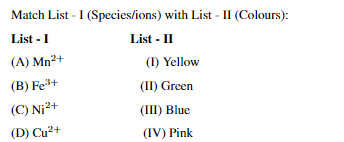
Choose the correct answer from the options given below:
Transition metals form a large number of complexes or coordination compounds in which the metal atoms are bound to a number of anions or neutral molecules. The valence bond theory explains the formation, magnetic behaviour, and geometrical shapes, while the crystal field theory explains the effect of different crystal fields on the degeneracy of -orbitals energies of the central metal atom/ion. This provides for the quantitative estimation of orbital separation energies, magnetic moments, and spectral and stability parameters.
Amongst the following ions, which should have the highest magnetic moment value?
Transition metals form a large number of complexes or coordination compounds in which the metal atoms are bound to a number of anions or neutral molecules. The valence bond theory explains the formation, magnetic behavior, and geometrical shapes, while the crystal field theory explains the effect of different crystal fields on the degeneracy of -orbitals energies of the central metal atom/ion. This provides for the quantitative estimation of orbital separation energies, magnetic moments, and spectral and stability parameters.
Which of the following complexes are not correctly matched with the hybridisation of their central metal ion?
-
Transition metals form a large number of complexes or coordination compounds in which the metal atoms are bound to a number of anions or neutral molecules. The valence bond theory explains the formation, magnetic behaviour, and geometrical shapes, while the crystal field theory explains the effect of different crystal fields on the degeneracy of -orbitals and the energies of the central metal atom/ion. This provides for the quantitative estimation of orbital separation energies, magnetic moments, and spectral and stability parameters.
Two complexes of nickel have the same geometry but different magnetic behaviour are:
(A)
(B)
(C)
(D)
Choose the correct answer from the options given below:
Transition metals form a large number of complexes or coordination compounds in which the metal atoms are bound to a number of anions or neutral molecules. The valence bond theory explains the formation, magnetic behaviour, and geometrical shapes, while the crystal field theory explains the effect of different crystal fields on the degeneracy of -orbitals energies of the central metal atom/ion. This provides for the quantitative estimation of orbital separation energies, magnetic moments, and spectral and stability parameters.
The compound exhibits:
Coordination isomerism
(A) Paramagnetic
(B) sp d hybridization
(C) Magnetic moment = 5.92 BM
(D) d sp hybridization
About Coordination Chemistry - CUET-UG
Coordination Chemistry is a vital chapter for CUET-UG aspirants. Mastering the concepts covered in this chapter is essential for securing a top rank.
By rigorously practicing the previous year questions associated with this chapter, you can identify high-yield topics, understand the examiner's perspective, and boost your confidence during the actual exam.
Frequently Asked Questions
Why focus on Coordination Chemistry PYQs?
Analyzing PYQs for this specific chapter reveals the most frequently tested concepts and the typical complexity of questions, allowing you to tailor your study plan efficiently.
How to best use this analysis?
Review the topic breakdown to see which sub-topics within Coordination Chemistry carry the most weight. Then, tackle the questions iteratively to solidify your understanding.