Haloalkanes And Haloarenes
5 previous year questions.
High-Yield Trend
Chapter Questions 5 MCQs
A. reaction proceeds with stereo chemical inversion.
B. The process of conversion of Racemic mixture into enantiomer is known as Racemization
C. A mixture containing 2 enantiomers in equal proportions is brown as Racemic mixture.
D. The stereoisomers related to each other as superimposable mirror image are called enantiomers.
E. The objects which are non-superimposable on their mirror image are said to be chiral and this property is known as chirality.
Choose the correct answer from the options given below:
(B) Chlorine destabilizes the intermediate carbocation formed during electrophilic sub-stitution.
(C) Chlorine accepts electrons through resonance
(D) Chlorine releases electrons through resonance.
Choose the correct answer from the options given below:
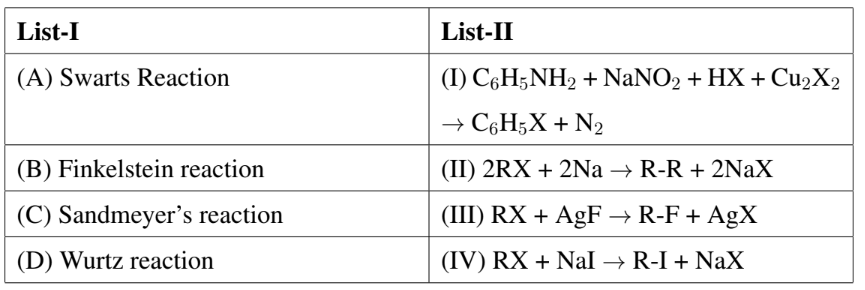
A-I, B-II, C-III, D-IV
A-I, B-III, C-II, D-IV
A-III, B-IV, C-I, D-II
A-I, B-II, C-IV, D-III
(A) CH3CH2CH2CH2Br (B) CH3CH2CH(Br)CH3 (C) (CH3)3CBr (D) (CH3)2CHCH2Br
About Haloalkanes And Haloarenes - CUET-UG
Haloalkanes And Haloarenes is a vital chapter for CUET-UG aspirants. Mastering the concepts covered in this chapter is essential for securing a top rank.
By rigorously practicing the previous year questions associated with this chapter, you can identify high-yield topics, understand the examiner's perspective, and boost your confidence during the actual exam.
Frequently Asked Questions
Why focus on Haloalkanes And Haloarenes PYQs?
Analyzing PYQs for this specific chapter reveals the most frequently tested concepts and the typical complexity of questions, allowing you to tailor your study plan efficiently.
How to best use this analysis?
Review the topic breakdown to see which sub-topics within Haloalkanes And Haloarenes carry the most weight. Then, tackle the questions iteratively to solidify your understanding.