In which year was the concept of First Past the Post (FPTP) in a form of electoral system adopted in the Indian sub-continent?
1
1919
2
1835
3
1947
4
1951
Official Solution
Correct Option: (3)
The First Past the Post (FPTP) electoral system was adopted in India after independence in 1947, following the British model. It was used in the first general elections held in 195(1) Under this system, the candidate with the most votes in a constituency wins the election, even if they do not have an absolute majority. The system was chosen for its simplicity and ease of implementation across a vast and diverse country like India. Significance of FPTP: This system is effective in large democratic systems as it tends to produce stable governments by ensuring that the winning party has a clear majority. However, it can lead to disproportionate representation, where a party may win a majority of seats without receiving a majority of votes.
02
PYQ 2023
medium
political-scienceID: cuet-ug-
Who is the founder of the Bahujan Samaj Party?
1
Mulayam Singh Yadav
2
Kanshi Ram
3
Mamata Banerjee
4
Lalu Yadav
Official Solution
Correct Option: (2)
Kanshi Ram founded the Bahujan Samaj Party (BSP), a political party in India representing the interests of Dalits, Adivasis, and other marginalized communities.
03
PYQ 2023
medium
political-scienceID: cuet-ug-
Why did Lal Bahadur Shastri resign from the position of Railway Minister?
1
Accepting moral responsibilities for railway accident
2
He was forced to resign
3
His party lost election
4
He was not healthy
Official Solution
Correct Option: (1)
Lal Bahadur Shastri resigned as Railway Minister in 1956, taking moral responsibility for a major railway accident. This was a significant act of accountability and demonstrated his commitment to ethics in public office. His decision to resign set a benchmark in Indian politics for taking moral responsibility for administrative failures.
04
PYQ 2023
medium
political-scienceID: cuet-ug-
Who coined the famous slogan Jai Jawan Jai Kisan?
1
Lal Bahadur Shastri
2
Khan Abdul Ghaffar Khan
3
Jawahar Lal Nehru
4
Mahatma Gandhi
Official Solution
Correct Option: (1)
Lal Bahadur Shastri coined the famous slogan "Jai Jawan Jai Kisan" (Hail the Soldier, Hail the Farmer) in 1965, during the India-Pakistan war. The slogan highlighted the importance of both the soldier defending the country and the farmer ensuring food security for the nation. Significance of the Slogan: The slogan symbolized Shastriβs recognition of the twin pillars on which India's development and security rested. It continues to resonate as a tribute to both the agricultural and defense sectors.
05
PYQ 2023
medium
political-scienceID: cuet-ug-
What was the tenure of Shastriji as a Prime Minister of India
1
1964-1967
2
1964-1966
3
1963-1967
4
1965-1967
Official Solution
Correct Option: (2)
Lal Bahadur Shastri served as the Prime Minister of India from June 1964 to January 1966. His leadership during a critical period in Indiaβs history, including the 1965 India-Pakistan war and the signing of the Tashkent Agreement, left a significant impact. Legacy of His Tenure: Though his tenure was brief, Shastri's role in enhancing India's defense capabilities and promoting agricultural reforms continues to be remembered.
06
PYQ 2023
medium
political-scienceID: cuet-ug-
Lal Bahadur Shastri was a minister in Union Cabinet from:
1
1952-1956
2
1954-1956
3
1953-1956
4
1951-1956
Official Solution
Correct Option: (2)
Lal Bahadur Shastri served in the Union Cabinet as a minister from 1954 to 1956. He held various key positions, including Minister of Transport and Communications, and later as the Home Minister. Key Contributions: During his tenure in the Cabinet, Shastri contributed significantly to the countryβs infrastructure development and helped shape domestic policies that later played a vital role in his tenure as Prime Minister.
07
PYQ 2023
medium
political-scienceID: cuet-ug-
The Syndicate refers to:
1
An elected representation of the party
2
A group of powerful and influential leaders within the Congress
3
Parties with different ideologies
4
Chief ministers of various states
Official Solution
Correct Option: (2)
The "Syndicate" refers to a group of influential leaders within the Indian National Congress who dominated the party's decision-making processes during the 1960s. They played a significant role in shaping the party's policies and leadership. Political Influence: The Congress Syndicate wielded considerable power within the party, especially during the leadership of Indira Gandhi, leading to a series of political struggles and eventual changes in party leadership.
08
PYQ 2023
medium
political-scienceID: cuet-ug-
Match List I with List II: Match the leaders with their states
LIST I
LIST II
A. N. Sanjeeva Reddy
III. Andhra Pradesh
B. K. Kamraj
II. Mysore (now Karnataka)
C. S.K. Patil
I. Bombay (now Mumbai)
D. S. Nijalingappa
IV. West Bengal
1
A-II, B-I, C-IV, D-III
2
A-III, B-IV, C-II, D-I
3
A-IV, B-II, C-I, D-III
4
A-I, B-II, C-III, D-IV
Official Solution
Correct Option: (2)
The correct matching of leaders and their associated states is as follows:
\begin{itemize} \item A. N. Sanjeeva Reddy: Andhra Pradesh \item B. K. Kamaraj: Tamil Nadu \item C. S.K. Patil: Maharashtra \item D. S. Nijalingappa: Karnataka
\end{itemize} Geopolitical Context: Understanding the political landscape and key figures of specific Indian states is crucial for understanding their contributions to national politics.
09
PYQ 2023
medium
political-scienceID: cuet-ug-
The Congress Syndicate was led by:
1
A, B and C
2
B
3
E and D
4
D
Official Solution
Correct Option: (4)
K. Kamaraj is widely considered the key figure and leader of the Congress Syndicate, a group of powerful leaders within the Indian National Congress during the 1960s. The Syndicate controlled much of the party's decision-making and played a significant role in Indian politics during that time. Context: The Congress Syndicate was instrumental in shaping the direction of the party, especially in the internal conflicts following Jawaharlal Nehru's death. The faction's influence significantly affected the leadership of the Congress party.
10
PYQ 2023
medium
political-scienceID: cuet-ug-
Who was the leader of Congress (R)?
1
Morarji Desai
2
Lal Bahadur Shastri
3
Indira Gandhi
4
S.K. Patil
Official Solution
Correct Option: (3)
After the split in the Indian National Congress in 1969, Indira Gandhi led the faction known as Congress (R) (Congress - Requisitionists). This faction eventually became the dominant faction of the party, with Indira Gandhi emerging as the undisputed leader. Context of the Split: The split occurred over differences regarding the leadership and ideology of the Congress party, with Indira Gandhi's faction ultimately prevailing.
11
PYQ 2023
medium
political-scienceID: cuet-ug-
All the popular and powerful leaders of Indian politics lost their prestige after the split in Congress after:
1
1969
2
1971
3
1972
4
1970
Official Solution
Correct Option: (1)
The split in the Indian National Congress in 1969 significantly impacted the standing of many prominent political leaders within the party. The factionalism that followed weakened their influence, particularly the Congress Syndicate leaders, who had once been the party's powerbrokers. Aftermath of the Split: The Congress split resulted in the formation of two factions: Congress (O) and Congress (R), with Indira Gandhiβs leadership becoming dominant. The split reshaped the political dynamics of the Congress party.
12
PYQ 2023
medium
political-scienceID: cuet-ug-
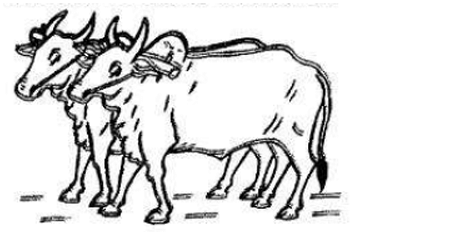
This logo belongs to which party?
1
Indian National Congress
2
Bharatiya Kisan Party
3
Socialist Party
4
Bharatiya Jana Sangh
Official Solution
Correct Option: (2)
The logo of the Bharatiya Kisan Party features bullocks and a plough, which symbolize the party's agrarian roots and focus on the welfare of farmers. This party was formed to represent the interests of the rural population, particularly farmers, and to address issues related to agricultural policies. Its logo reflects its commitment to promoting rural and agrarian development. Context of Party Symbols: Party logos are often designed to visually communicate the party's core values and priorities. In this case, the plough and bullocks are symbolic of the partyβs agrarian focus, signaling its advocacy for farmers' rights and issues related to agriculture and rural development.
13
PYQ 2023
medium
political-scienceID: cuet-ug-
Name the Indian President who proclaimed emergency in 1975.
1
Dr. Rajendra Prasad
2
Lal Bahadur Shastri
3
Fakhruddin Ali Ahmed
4
V.V. Giri
Official Solution
Correct Option: (3)
Fakhruddin Ali Ahmed, the then President of India, declared a state of emergency on 25 June 1975, under the provisions of Article 352 of the Indian Constitution. This followed a period of political instability.
14
PYQ 2023
medium
political-scienceID: cuet-ug-
E.V. Ramasami Naicker, also popularly known as Periyar is primarily known for his ideas on:
1
Anti-casteism and recovery of The Dravidian identity
2
Women and suffrage
3
Support for ancient Indian language like Sanskrit
4
Support for religious minority groups in India
Official Solution
Correct Option: (1)
E.V. Ramasami Naicker, known as Periyar, was a prominent social reformer and leader of the Dravidian movement in South India. His major contributions were in fighting against the caste system and promoting the Dravidian identity and culture.
15
PYQ 2025
hard
political-scienceID: cuet-ug-
The first general elections was held in India between:
1
1951-1952
2
1952-1953
3
1953-1954
4
1954-1955
Official Solution
Correct Option: (2)
Step 1: Understanding the context India held its first general elections in 1952, shortly after gaining independence in 1947. The elections were a significant event in India's history as it marked the establishment of the democratic process at a national level. Step 2: Election timeline The elections were conducted between October 1951 and February 1952, which led to the formation of India's first government. Step 3: Exact date range Thus, the first general elections in India were held between 1952-1953, with voting taking place in phases from October 1951 to February 1952. Step 4: Final Answer Therefore, the correct answer is 1952-1953.
16
PYQ 2025
hard
political-scienceID: cuet-ug-
Which of the following statements are correct about elections in India?
1
The Congress Party won more seats in the Lok Sabha in 1989 elections than in 1984 elections.
2
The 1991 Lok Sabha elections marked the end of the 'Congress system'.
3
The Lok Sabha elections in 1989 led to the defeat of the Congress party but did not result in a majority for any other party.
4
In 1989 the National Front formed a coalition government at the centre.
Official Solution
Correct Option: (4)
Step 1: Analysis of Statement (A) Statement (A) is incorrect. In the 1989 Lok Sabha elections, the Congress party won fewer seats compared to the 1984 elections. In 1984, Congress had a landslide victory, securing a record number of seats. Step 2: Analysis of Statement (B) Statement (B) is incorrect. The 1991 elections did not mark the end of the 'Congress system'. While the Congress party lost some support, it continued to play a significant role in Indian politics until the 1990s. The end of the 'Congress system' is often attributed to the 1996 elections. Step 3: Analysis of Statement (C) Statement (C) is correct. In the 1989 elections, the Congress party suffered a major defeat, but no other party secured an absolute majority. This led to a period of coalition governments in India. Step 4: Analysis of Statement (D) Statement (D) is also correct. The National Front, a coalition of several parties including the Janata Dal, formed a government in 1989, with V.P. Singh as the Prime Minister. Step 5: Final Answer Therefore, the correct answer is (D) (C) and (D) only.
17
PYQ 2025
hard
political-scienceID: cuet-ug-
Arrange the following events in chronological order:
1
DMK was formed
2
Indira Gandhi got the Congress Working Committee adopt a Ten Point Programme.
3
K. Kamraj proposed that all Congressmen should resign from office.
4
The fifth general election to Lok Sabha were held.
Official Solution
Correct Option: (4)
Step 1: The Formation of DMK The Dravida Munnetra Kazhagam (DMK) was formed in 1949, making it the earliest event in this list. Step 2: Kamraj Plan (K. Kamraj's Resignation Proposal) In 1963, K. Kamraj, the then Congress President, proposed that all Congressmen should resign from office to make way for new leadership. This plan was an important political move within the Congress party. Step 3: Indira Gandhiβs Ten Point Programme In 1969, Indira Gandhi, the then Prime Minister, got the Congress Working Committee to adopt the Ten Point Programme, which aimed at progressive economic and social reforms. Step 4: Fifth General Election to Lok Sabha The fifth general election to the Lok Sabha was held in 1971, where Indira Gandhi led the Congress to victory. Step 5: Final Answer Thus, the correct chronological order of the events is: (A) DMK was formed β (C) K. Kamraj proposed that all Congressmen should resign from office β (B) Indira Gandhi got the Congress Working Committee adopt a Ten Point Programme β (D) The fifth general election to Lok Sabha were held.
18
PYQ 2025
medium
political-scienceID: cuet-ug-
Match List-I with List-II
List-I
List-II
(A) Gujarat Movement
(I) May 1974
(B) Bihar Movement
(II) 1979
(C) Assam Movement
(III) March 1974
(D) Railway Strike
(IV) January 1974
1
(A) - (IV), (B) - (III), (C) - (II), (D) - (I)
2
(A) - (IV), (B) - (II), (C) - (III), (D) - (I)
3
(A) - (I), (B) - (III), (C) - (II), (D) - (IV)
4
(A) - (IV), (B) - (I), (C) - (II), (D) - (III)
Official Solution
Correct Option: (1)
Step 1: Understanding the events in the movements - Gujarat Movement β It occurred in January 1974 as a student-led protest against the rising prices and the lack of basic necessities in Gujarat. - Bihar Movement β This movement occurred in March 1974, led by Jayaprakash Narayan against the ruling government. - Assam Movement β It took place in 1979, primarily aimed at protesting the influx of illegal migrants from Bangladesh. - Railway Strike β This event happened in May 1974 and was a strike by railway workers demanding better wages and working conditions. Step 2: Analyzing the options - (A) Gujarat Movement matches with (IV) January 1974. - (B) Bihar Movement matches with (III) March 1974. - (C) Assam Movement matches with (II) 1979. - (D) Railway Strike matches with (I) May 1974. Step 3: Conclusion Thus, the correct matching is (A) - (IV), (B) - (III), (C) - (II), (D) - (I). Hence, option 1 is correct.
19
PYQ 2025
easy
political-scienceID: cuet-ug-
The fall of the Berlin Wall symbolises which of the following events in International Politics?
1
Disintegration of Germany
2
Unification of Germany
3
Beginning of Cold War
4
Collapse of the Second World
Official Solution
Correct Option: (2)
Step 1: Background of the Berlin Wall The Berlin Wall, erected in 1961 during the Cold War, symbolized the physical and ideological division between East and West Germany. It was a symbol of the broader Cold War conflict between the Soviet Union and the Western Bloc, led by the United States. Step 2: Fall of the Berlin Wall The fall of the Berlin Wall on 9th November 1989 marked a pivotal moment in history. It symbolized the end of the Cold War era, the collapse of Soviet influence in Eastern Europe, and the beginning of German reunification. Step 3: Event Symbolism - The fall of the Berlin Wall symbolizes the Unification of Germany, as it opened the way for the reunification of East and West Germany in 1990. - It also symbolizes the Collapse of the Second World, referring to the collapse of the Communist Bloc led by the Soviet Union. Step 4: Final Answer Therefore, the correct answer is (B) Unification of Germany and (D) Collapse of the Second World.
20
PYQ 2025
medium
political-scienceID: cuet-ug-
How many women were not recorded in the first draft of the electoral rolls?
1
10 lakh
2
20 lakh
3
30 lakh
4
40 lakh
Official Solution
Correct Option: (4)
Step 1: Background information The electoral rolls in India were prepared in order to include all eligible voters, and a large section of women were initially missed in the first draft. The government took steps to correct this. Step 2: Data correction process The final numbers showed that 40 lakh women were not recorded in the first draft, highlighting the discrepancies that needed to be addressed for complete voter inclusion. Step 3: Final Answer Therefore, the correct answer is that 40 lakh women were not recorded in the first draft of the electoral rolls.
21
PYQ 2025
medium
political-scienceID: cuet-ug-
Who became the Prime Minister of India after the 1977 Lok Sabha elections?
1
Jagjivan Ram
2
Morarji Desai
3
Indira Gandhi
4
Atal Bihari Vajpayee
Official Solution
Correct Option: (2)
After the 1977 Lok Sabha elections, Morarji Desai became the Prime Minister of India. The 1977 elections were held after the Emergency period, which had been imposed by Prime Minister Indira Gandhi from 1975 to 1977. The Emergency led to widespread criticism of the Congress party, and in the subsequent elections, the Janata Party, a coalition of opposition parties, emerged victorious. Morarji Desai, the leader of the Janata Party, was sworn in as the first non-Congress Prime Minister of India. His government focused on restoring democratic rights and dismantling many of the policies introduced during the Emergency. Despite facing internal challenges, Desai's tenure marked the end of Congress's dominance in Indian politics for a time.
22
PYQ 2025
medium
political-scienceID: cuet-ug-
The Mandal Commission was appointed by which government at the Centre?
1
Indian National Congress Party
2
Bharatiya Janata Party
3
Janata Party
4
Samajwadi Party
Official Solution
Correct Option: (3)
The Mandal Commission was appointed by the Janata Party government in 1979 under the leadership of Prime Minister Morarji Desai. Its objective was to identify socially and educationally backward classes in India and recommend steps for their advancement, particularly in the areas of employment and education. The commission's recommendations, including reservations for Other Backward Classes (OBCs) in government jobs and educational institutions, were initially met with resistance but were later implemented in the 1990s. The Mandal Commission became a landmark in India's affirmative action policies. The report's recommendations significantly altered India's social fabric by challenging the existing reservation system and promoting social justice for the underprivileged communities.
23
PYQ 2025
medium
political-scienceID: cuet-ug-
How many Lok Sabha seats did the Bharatiya Jana Sangh secure in the 1952 elections?
1
10
2
7
3
4
4
3
Official Solution
Correct Option: (3)
In the 1952 General Elections, the Bharatiya Jana Sangh (BJS), the predecessor of the Bharatiya Janata Party (BJP), secured 4 seats in the Lok Sabha. This was a modest beginning for the party, which was founded by Syama Prasad Mukherjee in 1951 with the aim of providing an alternative to the Congress party's dominance. The BJS had a limited presence in the early years, but over time, it grew to become one of the major political parties in India, eventually leading to the formation of the BJP. The 1952 election marked the first general election in India after independence, and while the BJS's performance was modest, it was the beginning of the party's journey in Indian politics.
24
PYQ 2025
medium
political-scienceID: cuet-ug-
The era of One-Party Dominance of the Congress Party was broken in which year?
1
1951
2
1957
3
1962
4
1967
Official Solution
Correct Option: (4)
The era of One-Party Dominance of the Congress Party was effectively broken in 1967. This was the year when Congress began losing its absolute dominance in many state elections and faced increasing competition from regional parties. The 1967 elections saw Congress's reduced majority and the rise of opposition parties in several states, signaling the beginning of a multi-party political system in India. This shift was a significant turning point in Indian politics, where regional parties began to challenge the Congress party's hold on power.
25
PYQ 2025
medium
political-scienceID: cuet-ug-
In India, the fourth General Elections to the Lok Sabha were held in:
1
December, 1966
2
February, 1967
3
November, 1967
4
February, 1968
Official Solution
Correct Option: (2)
The fourth General Elections to the Lok Sabha in India were held in February 1967. This election was significant as it marked a shift in the political landscape, with the Congress party's dominance starting to face challenges. While the Congress party won a majority, the 1967 elections were the beginning of a more competitive political environment in India. The election took place following the political turbulence in the country and was part of the continued process of democratic consolidation post-independence.
26
PYQ 2025
medium
political-scienceID: cuet-ug-
Which General Lok Sabha elections has been described as a βPolitical Earthquakeβ by many political observers?
1
1951
2
1957
3
1961
4
1967
Official Solution
Correct Option: (3)
The 1961 General Lok Sabha elections have been described as a "Political Earthquake" due to the dramatic shifts in India's political landscape. The elections were significant because they saw the rise of new political forces and a shift in the dynamics of Indian politics, marking a substantial change in voter behavior and political party dominance. While the Congress party maintained power, the elections were a turning point in terms of emerging political trends and regional influences. The term "Political Earthquake" refers to the large-scale political changes that were observed during this time, which reshaped India's political environment.