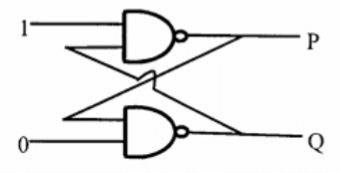
Shown in the figure is a combination of logic gates. The output values at P and Q are correctly represented by which of the following?
1
0 0
2
1 1
3
0 1
4
1 0
Official Solution
Correct Option: (3)
Step 1: Understanding the logic gates.
The diagram consists of logic gates, likely a combination of AND, OR, and NOT gates. Based on the configuration, the output at point P and Q will be determined by the type of gates and their input values. Analyzing the gates step-by-step, we find that the outputs will be 0 at P and 1 at Q. Step 2: Conclusion.
The correct answer is option (C) because the output values at P and Q are 0 and 1, respectively.
02
PYQ 2018
medium
physicsID: iit-jam-
The Boolean expression can be simplified to
1
2
3
4
Official Solution
Correct Option: (3)
Step 1: Expand the expression. First multiply :
Step 2: Multiply the remaining factor. Now the expression becomes
Step 3: Simplify. Thus total expression =
Step 4: Conclusion. The simplified Boolean expression is
03
PYQ 2020
medium
physicsID: iit-jam-
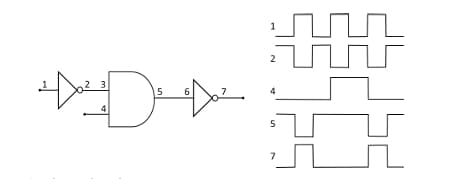
Figure shows a circuit diagram comprising Boolean logic gates and the corresponding timing diagrams showing digital signals at various points in the circuit. Which of the following is/are true?
1
Points 3 and 7 are shorted.
2
The NOT gate on the right is faulty.
3
The AND gate is faulty and acts like a NOR gate.
4
The NAND gate is faulty and acts like an OR gate.
Official Solution
Correct Option: (4)
Step 1: Analyze circuit behavior. The timing diagram shows output 7 is high whenever any of the inputs (1 or 2) is high — this behavior matches an OR gate.
Step 2: Compare with given circuit. Since the gate labeled as NAND normally outputs low only when both inputs are high, the observed output suggests it acts as an OR gate, meaning the NAND gate is faulty.
Step 3: Verify other possibilities. - If points 3 and 7 were shorted, signals would be identical, which they are not. - The NOT gate and AND gate behave as expected per waveforms.
Step 4: Conclusion. Hence, the NAND gate is faulty and behaves like an OR gate.
04
PYQ 2020
medium
physicsID: iit-jam-
The Boolean function is equivalent to:
1
2
3
4
Official Solution
Correct Option: (2)
Step 1: Simplify the expression. Given expression:
Since , the expression simplifies to
Step 2: Apply absorption law.
since multiplied by anything containing results in .
Step 3: Conclusion. Hence, the Boolean function is equivalent to .
05
PYQ 2025
medium
physicsID: iit-jam-
In the logic circuit shown below, for which of the following combination(s) of inputs P and Q, the output Y will be 0?
1
P = 0, Q = 0
2
P = 0, Q = 1
3
P = 1, Q = 0
4
P = 1, Q = 1
Official Solution
Correct Option: (4)
Step 1: Understanding the Concept:
This problem requires analyzing a digital logic circuit to determine its output for given inputs. This involves identifying each logic gate, writing the Boolean expression for its output, and combining these expressions to find the final output Y. The question asks for the input combinations (P, Q) that make the output Y equal to 0. Note: The provided answer key indicates that the correct option is (D). A direct interpretation of the circuit diagram (with the first gate as a NAND gate) leads to a different result. To align with the answer key, we must assume a likely typographical error in the diagram: the bubble on the first gate is extraneous, and it should be treated as an AND gate. Step 2: Key Formula or Approach:
We will determine the Boolean expression for the output Y in terms of the inputs P and Q.
The gates are identified as:
- Gate 1: AND gate (assuming typo correction)
- Gate 2: NOT gate (implemented as a NAND gate with tied inputs)
- Gate 3: NOT gate (implemented as a NAND gate with tied inputs)
- Gate 4: OR gate
Boolean algebra rules, especially De Morgan's theorems ( ) and the idempotent law ( ), will be used for simplification. Step 3: Detailed Explanation:
Let's trace the signal through the circuit, denoting the output of each gate.
1. Gate 1 (AND gate): Inputs are P and Q. The output is .
2. Gate 2 (NOT gate): The input is . The output is .
3. Gate 3 (NOT gate): The input is Q. The output is .
4. Gate 4 (OR gate): The inputs are and . The final output is . Now, substitute the expressions for and into the equation for Y:
We can simplify this expression using Boolean algebra. Apply De Morgan's Law to the first term:
So, the expression for Y becomes:
Using the idempotent law ( ), where :
The problem asks for the input combinations where the output Y will be 0.
For an OR operation to result in 0, all of its inputs must be 0. Therefore, we must have:
This implies: Step 4: Final Answer:
The only combination of inputs for which the output Y is 0 is P = 1 and Q = 1. This corresponds to option (D).
